China’s trade surplus narrowed to $105.3 billion in October even as the country’s January-to-October surplus hit $1.04 trillion, putting Beijing on track to surpass last year’s record $1.2 trillion, according to customs data released Tuesday. The shift reflects a deeper restructuring of commodity flows as state-backed buyers reroute energy, metals and agricultural purchases away from traditional Western suppliers.
Middle East Disruption Drives Crude Rerouting
Crude oil imports surged to 41.94 million metric tons in October, the highest monthly level since March, rising 9.4% from September despite a 13.3% year-on-year decline in total volumes, according to the General Administration of Customs. The increase comes as the U.S.-Israeli war on Iran disrupts Middle East supplies, forcing Chinese buyers to alter purchasing patterns across the region, Reuters reported.
Oil product imports climbed to 3.15 million tons from 1.85 million tons in September, while exports fell sharply to 5.18 million tons from 7.16 million tons, signaling weaker domestic demand and reduced refining capacity utilization. For the first ten months of the year, refined oil product exports totaled 46.59 million tons, down 2% year-on-year, while oil product imports fell to 27.15 million tons from 34.19 million tons, pointing to softer cumulative inbound volumes.
State-Led Buying Reshapes Metals and Agriculture
State-owned enterprises are increasingly leading commodity purchases, bypassing traditional Western suppliers, according to customs data and market analysts. Copper imports fell 2.2% month-on-month in October, while iron ore dropped 3.8%, reflecting shifting state-led purchasing strategies rather than price signals alone.

Soybean imports dropped 22.5% to 7.35 million tons in October, the lowest since 2023, as U.S. supplies stalled and domestic inventories swelled. “In October, South American old-crop supplies were running out while bulk shipments of new-crop US soybeans had yet to begin,” said Liu Jinlu, an agriculture researcher at Guoyan Futures. High crusher inventories, negative crushing margins and low pork prices further suppressed demand. From January to October, soybean arrivals totaled 93.48 million tons, down 2.3% year-on-year.
Yuan Strength and AI Demand Alter Trade Calculus
The yuan hit a four-year high in October, weighing on export values and pressuring Beijing to diversify supply chains, according to the People’s Bank of China midpoint fixings. Semiconductors and data center components drove import growth, while AI hardware exports remained the top driver of China’s $412.33 billion October trade. Semiconductor exports soared 137.1% year-on-year in value terms, and auto exports rose 37.6%.
Imports grew 41.6% year-on-year in October, outpacing export growth of 35.2%, narrowing the monthly surplus from $133.5 billion in September. The stronger import bill reflects both higher commodity prices and firmer domestic demand for materials tied to the artificial intelligence buildout.
Analysts Flag Sustainability Risks
Overcapacity in many industries, excess domestic savings and weakened domestic demand are still leading China to ship goods abroad, said Alicia García-Herrero, chief economist for Asia Pacific at Natixis. “The situation is not sustainable,” she said. Businesses are feeling pressure from ferocious competition as the economy slows, with manufacturers competing on price amid significant product homogenization.
China’s exports to the U.S. grew 32.9% year-on-year in October, building on a low base after trade was hit last year by elevated tariffs. For the first ten months, the trade surplus with the U.S. was around $266.5 billion, while the surplus with the EU exceeded $310 billion. Trade is likely to be among top issues at planned meetings between President Donald Trump and Xi Jinping next week on the sidelines of the APEC leaders summit in Shenzhen.
What Comes Next
A recovery in soybean imports in November and December will depend on China-U.S. trade relations and an improvement in crushing margins, Liu said. Key risks include U.S. weather disruptions, slower export shipments and uncertain South American planting weather. China’s pig herd is expected to contract in the fourth quarter of 2026 or the first quarter of 2027 as Beijing steps up efforts to stabilize the oversupplied market, clouding the outlook for future feed demand. Breeding sow inventory stood at 36.02 million at the end of September, down 10.7% from three months earlier.
AI-driven demand for semiconductors and metals could lock in new trade corridors, analysts note. “If the AI boom slows or turns into a correction, lower chip and electronics prices and smaller shipping volumes would hit China’s exports hard,” said Dave Chia, an economist at Moody’s Analytics. A two-month extension of a trade truce until January has provided some relief to exporters, though it remains unclear how long that may last.
Sources
- China’s imports outpace exports in October as trade surplus passes US$1 trillion
- China October exports beat forecasts, imports surge 41.6% as trade surplus narrows
- China trade balance shrinks more than expected in Oct; imports surge
- China crude imports reach seven-month high as Middle East disruption reshapes flows
- China's trade surplus surpasses $1 trillion for a 2nd straight year, as exports surge 35%
- China October soybean imports fall on high inventories, weak crush margins
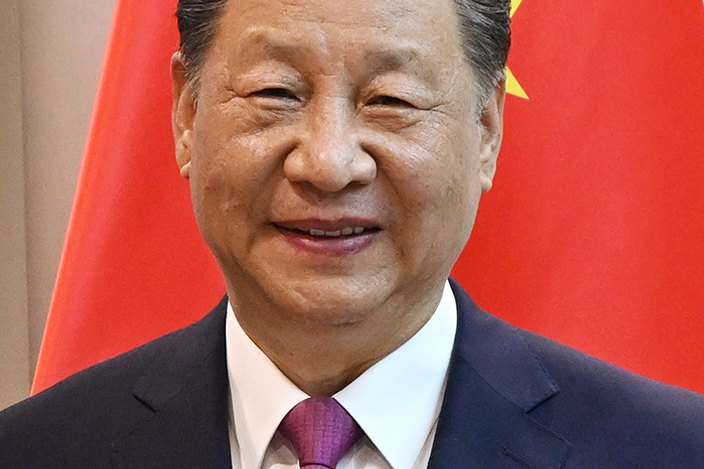
Photo:
Press Service of the President of the Republic of Azerbaijan
(CC BY 4.0)