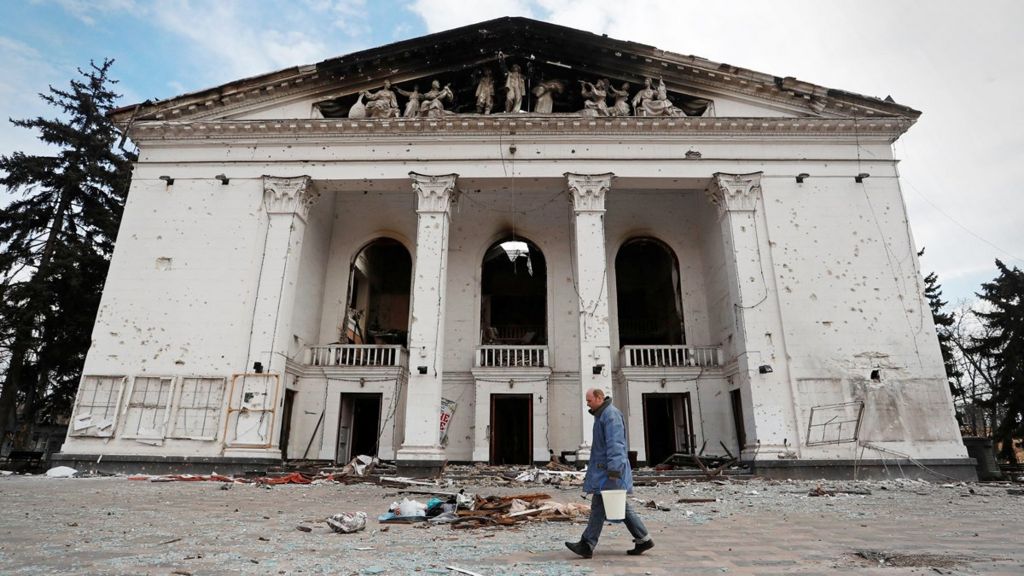
On March 20, 2022, survivors of the Russian siege of Mariupol arrived by train in Lviv, Ukraine, after enduring weeks of relentless bombardment, starvation, and freezing conditions. Nearly 10% of the city’s pre-war population of 430,000 have fled over the past week, according to Mariupol authorities, with many risking their lives in convoys to reach safety. The evacuees described a city reduced to rubble, where bodies line the streets and residents drink melted snow for water.
The escape from a shattered city
Marina Galla wept in the doorway of a crowded train compartment as it pulled into Lviv. She and her 13-year-old son had spent three weeks hiding in the basement of Mariupol’s Palace of Culture, moving underground after the horizon turned black with smoke.
“There is no city anymore,” Galla said. “We had no water, no light, no gas, absolutely no communications.” They cooked meals outside with wood in the yard, even while under fire.
Galla’s family does not know she has escaped. “I don’t know anything about them,” she said. “My mother, grandmother, grandfather and father. They don’t even know that we have left.” Her son kissed her repeatedly, trying to comfort her as she cried.
Russian checkpoints and forced relocation
Even as they finally fled Mariupol, aiming to reach trains heading west, Russian soldiers at checkpoints made a chilling suggestion. It would be better to go to the Russian-occupied city of Melitopol or the Russian-annexed Crimean Peninsula instead.
Residents found the suggestion ludicrous after Russian forces bombed a Mariupol theater where children and others were sheltering. Authorities said an art school holding hundreds of people had also been bombed.
The Mariupol City Council has asserted that several thousand residents were taken into Russia against their will. Russia-backed separatists in eastern Ukraine said 2,973 people had been “evacuated” from Mariupol since March 5, including 541 over the last 24 hours.
Shared trauma on the train
For hours on the train journey, survivors shared their experiences with fellow passengers. Even residents of other Ukrainian cities that have been battered or occupied by the Russians see Mariupol as a horror apart.
Yelena Sovchyuk, a resident of Melitopol, shared a train compartment with a Mariupol family. She bought them food. They had nothing, only a small bag.
“Everyone from there is in deep shock,” Sovchyuk said. She recalled seeing convoys from the besieged city on the road. “There’s a way to tell a Mariupol car. They have no glass in their windows.”
With deep disdain, Sovchyuk said Russian soldiers amid such devastation were still encouraging Ukrainians to come to Russia, claiming it would be for their safety.
Arrival in Lviv
The train approached the central station of Lviv on Sunday afternoon. The city near Poland has absorbed an estimated 200,000 people fleeing other areas of Ukraine. As they climbed off one by one into the arms of family and friends after weeks of fearing for their lives, some Mariupol survivors wept.
A mother embraced a red-faced, teary teenage boy at the foot of the steps. An elderly woman in a kerchief helped off the train, walked away in silence. Another stood motionless among her bags, blinking behind thick glasses. Her neighbor, who fled with her, described cars in their convoy coming under fire.
Olga Nikitina cried on the platform, her hair askew, clutched by family. “They began to destroy our city, completely, house after house,” the young woman said. “Battles took place over every street. Every house became a target.”
Gunshots blew out the windows. When the temperatures in her apartment dropped below freezing, Nikitina moved in with her godmother, who has cancer, and takes care of her elderly father. Ukrainian soldiers later came and warned them that their house would come under fire. “Either hide or move out,” the soldiers said.
Nikitina left. The others were too fragile to flee. Now, like so many Mariupol survivors who escaped, she doesn’t know the fate of those left behind.
The survivors carry the weight of a city that no longer exists, a place of rubble and silence where families are torn apart and the living cannot be sure the dead will ever be found.