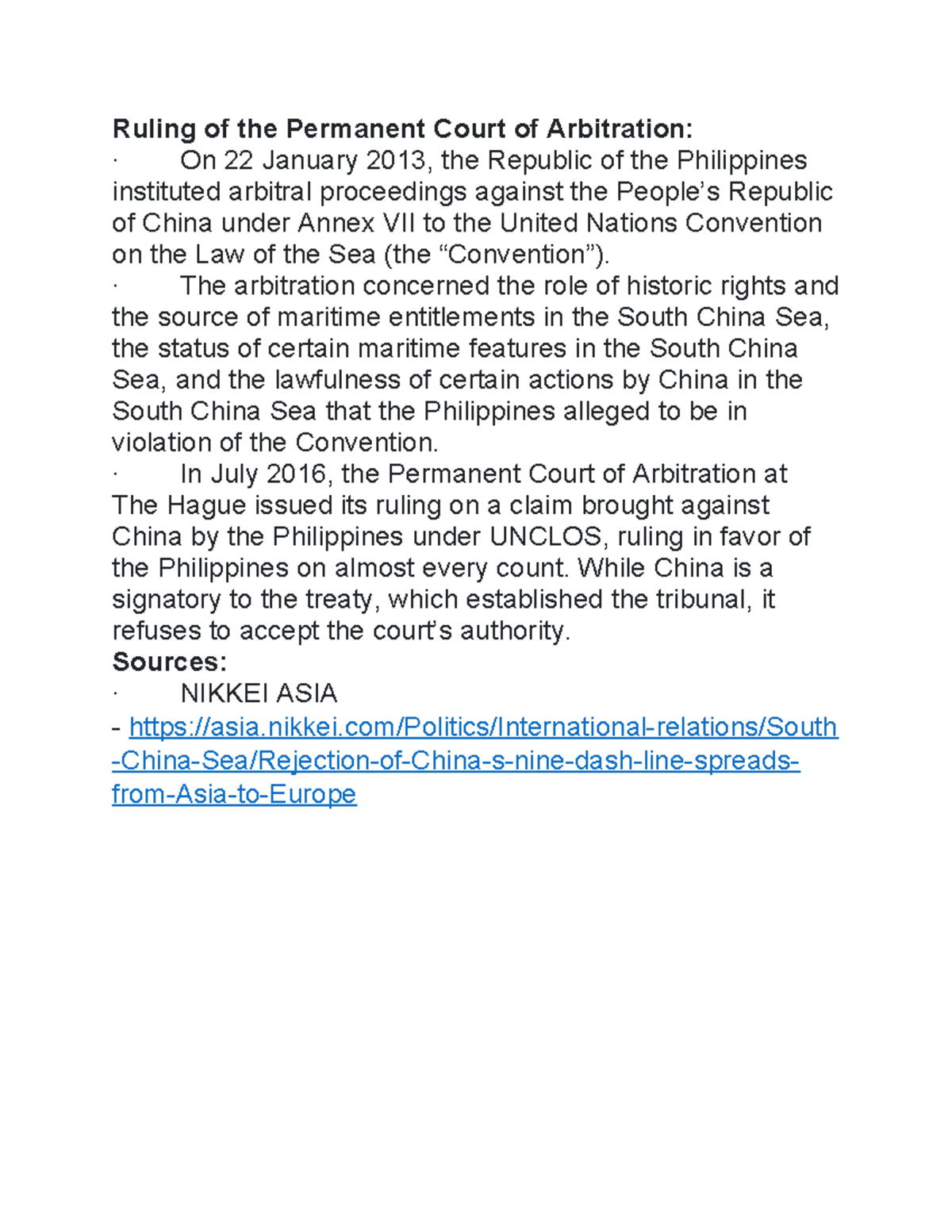
The Permanent Court of Arbitration ruled on 12 July 2016 that China’s sweeping claim over the Spratly archipelago had “no legal basis” and that Beijing had violated Manila’s sovereign rights by blocking Filipino fishermen, disrupting oil exploration and building artificial islands inside the Philippine exclusive economic zone. The tribunal, seated in The Hague, declared the Chinese “nine-dash line” invalid and confirmed that the Philippines alone holds exclusive rights to harvest fish and exploit seabed resources within 200 nautical miles of its coastline.
The 2016 award and Beijing’s dismissal
Judges appointed under the United Nations Convention on the Law of the Sea found that China had never possessed historic title to the waters inside the dashed boundary and that Mischief Reef and Second Thomas Shoal lie on the Philippine continental shelf. The decision was final and binding, yet Beijing labelled it “a piece of waste paper” and continued dredging. Foreign Secretary Teodoro Locsin Jr reminded the UN General Assembly on 25 September 2019 that “the award is non-negotiable; no state, however powerful, can unilaterally overturn it.”
Pattern of intimidation at sea
Chinese coast-guard cutters and maritime militia swarms have harassed Philippine vessels almost every year since the ruling. In January 2011 navy watchers recorded three warning shots fired across the bows of Filipino fishing skiffs near Jackson Atoll. A year later a two-month stand-off began when the Philippine frigate Gregorio del Pilar tried to arrest Chinese fishermen poaching at Scarborough Shoal; Beijing sent surveillance ships and sealed off the lagoon. Water-cannon attacks were filmed in 2014 at Panatag Shoal, the same month that PLA troops blocked a Philippine supply boat heading for the Sierra Madre garrison on Ayungin Shoal. Manila protested again in 2017 after Chinese speedboats opened fire and chased Filipinos from Union Banks, 230 kilometres west of Palawan. Defense Secretary Delfin Lorenzana condemned the 9 June 2019 ramming of the anchored F/B Gem-Ver, calling the abandonment of 22 crew members “uncivilised and barbaric.” Vietnam’s fisheries service rescued the sailors.
Environmental cost of island building
Satellite imagery analysed by the Asia Maritime Transparency Initiative shows that China has dumped more than 3 200 hectares of sand and coral on seven reefs since 2014, destroying fragile habitat and violating its duty to protect the marine environment. The tribunal agreed with Philippine scientists that dredging “caused irreparable harm to coral reefs protected under UNCLOS.” Beijing later deployed H-6K bombers and Y-8 patrol aircraft to the new 3-kilometre runway on Fiery Cross Reef, turning biologically rich atolls into forward military bases.
Manila’s diplomatic options
President Rodrigo Duterte set aside the ruling for years in pursuit of Chinese loans, but public anger over the Gem-Ver sinking forced a tougher line. The Department of Foreign Affairs filed 60 diplomatic protests in 2019 alone and opened a new coast-guard station on Pag-asa Island, the largest Philippine-held feature in the Spratlys. Still, Chinese militia trawlers numbering in the hundreds returned to Whitsun Reef in March 2021, prompting daily aerial patrols and a rare joint statement from the US, Japan and Australia backing the 2016 award. Locsin warned that “continued defiance of the rule of law will shape the reputation of the offending state for generations.”
What comes next
The arbitral victory gives the Philippines a powerful legal shield, yet enforcement depends on alliances. Washington has reiterated that any armed attack on Philippine forces, coast-guard vessels or aircraft in the South China Sea would trigger mutual-defense obligations under the 1951 treaty. Manila is modernising its navy with new frigates from South Korea and BrahMos anti-ship missiles from India, while expanding fuel exploration off Palawan in blocks already declared by the court to lie within Philippine jurisdiction. Without sustained international pressure, however, Beijing’s grey-zone tactics, swarming fishing fleets, laser-pointing coast-guard crews and ramming incidents, are likely to continue.
The 2016 judgment stripped China of any lawful excuse to treat the West Philippine Sea as a private lake. Every reef it paves, every Filipino boat it harasses deepens the record of contempt for international law and stiffens resolve inside the Philippines to defend what the court has already declared to be its own.