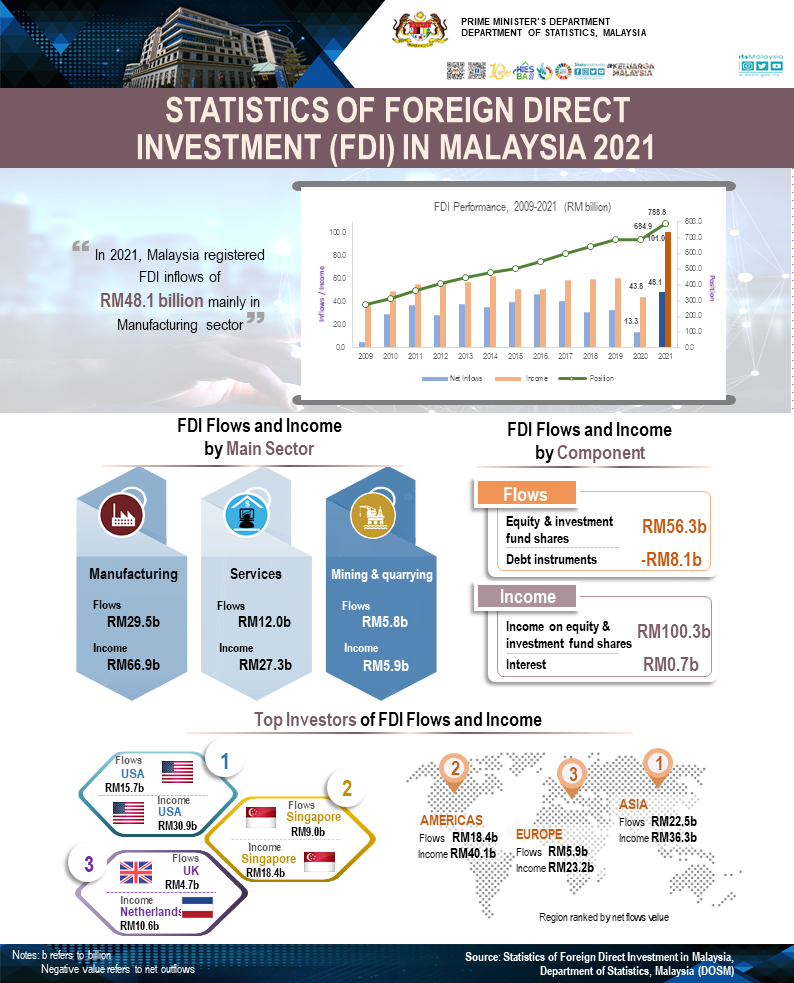
On June 10, 2021, despite the Malaysian government imposing varying degrees of restrictions due to the Covid-19 epidemic, foreign direct investment inflows into the country were expected to improve. Malaysia had confirmed over 595,000 Covid cases and 3,096 deaths, with the epidemic deteriorating significantly. The restrictions affected investor sentiment, but economists believed that foreign direct investment would still increase.
economic outlook
According to Lee Heng Guie, executive director of the Socio-Economic Research Center, the shutdown would curb sentiment, but better medium-term prospects were expected. Global economic growth, driven by the United States and other advanced economies, would encourage foreign investment in Malaysia. The Malaysian Digital Blueprint Project aimed to increase foreign direct investment in digital hardware and software infrastructure and 5G development. This project would play a important role in attracting foreign investors, who were looking for opportunities in the digital sector. As Lee Heng Guie noted, higher global economic growth would encourage foreign investment from advanced economies to enter Malaysia.
regional trade agreements
The final implementation of the Regional Comprehensive Economic Partnership (RCEP) would also make Malaysia competitive and attract more foreign investment. The RCEP, a free trade agreement between the Association of Southeast Asian Nations (ASEAN) and its six dialogue partners, would provide a framework for trade and investment in the region. Domestic and foreign investors were interested in knowing which strategic measures and initiatives would help accelerate the country’s growth and investment paths in the medium and long term. Anthony Dass, the chief economist at AmBank Group, predicted that the prospects for foreign direct investment in 2021 would be better than in 2020, but much would depend on national and global macroeconomic conditions.
challenges and obstacles
However, the Covid-19 pandemic posed significant challenges to foreign direct investment in Malaysia. Woon Khai Jhek, senior economist of RAM Rating Services Bhd, said that the loss of instinct was caused by increasing global uncertainty and limited forecasts of the operating environment. The current pandemic wave could be seen as a temporary obstacle to long-term direct investment, but it was likely to be driven by economic potential and long-term value propositions. Typical tax breaks and preferential treatment would continue to play a role in attracting foreign investors. As Woon Khai Jhek noted, after rebounding in the past two quarters, foreign direct investment inflows may recover from stability. OCBC Bank economist Willian Wiranto said that the group would inadvertently harm Malaysia’s attractiveness for foreign direct investment due to the continuing difficulties of cross-border travel.
future prospects
Despite the challenges, economists believed that foreign direct investment would continue to flow into Malaysia. Willian Wiranto said, “This will reverse some negative factors and allow foreign direct investment capital to return to Malaysia. In addition to the government’s current measures to attract foreign direct investment through the tax relief system, the epidemic needs to be controlled.” Anthony Dass also noted that for 2021, they did not rule out the possible delay of foreign direct investment inflows because investors may be more willing to take a lie-low attitude until the internal situation stabilizes. However, the long-term prospects for foreign direct investment in Malaysia remained positive, driven by the country’s economic potential and strategic location in the region.
The Covid-19 pandemic had a significant impact on Malaysia’s economy, but foreign direct investment continued to flow into the country. Despite the challenges posed by the pandemic, economists believed that Malaysia’s economic potential and strategic location would continue to attract foreign investors. The government’s measures to attract foreign direct investment, including tax relief and preferential treatment, would also play a important role in driving foreign direct investment in the country. As the pandemic was brought under control, foreign direct investment was expected to increase, driven by the country’s economic potential and long-term value propositions. The implementation of the RCEP and the Malaysian Digital Blueprint Project would also provide a framework for trade and investment in the region, making Malaysia an attractive destination for foreign investors.