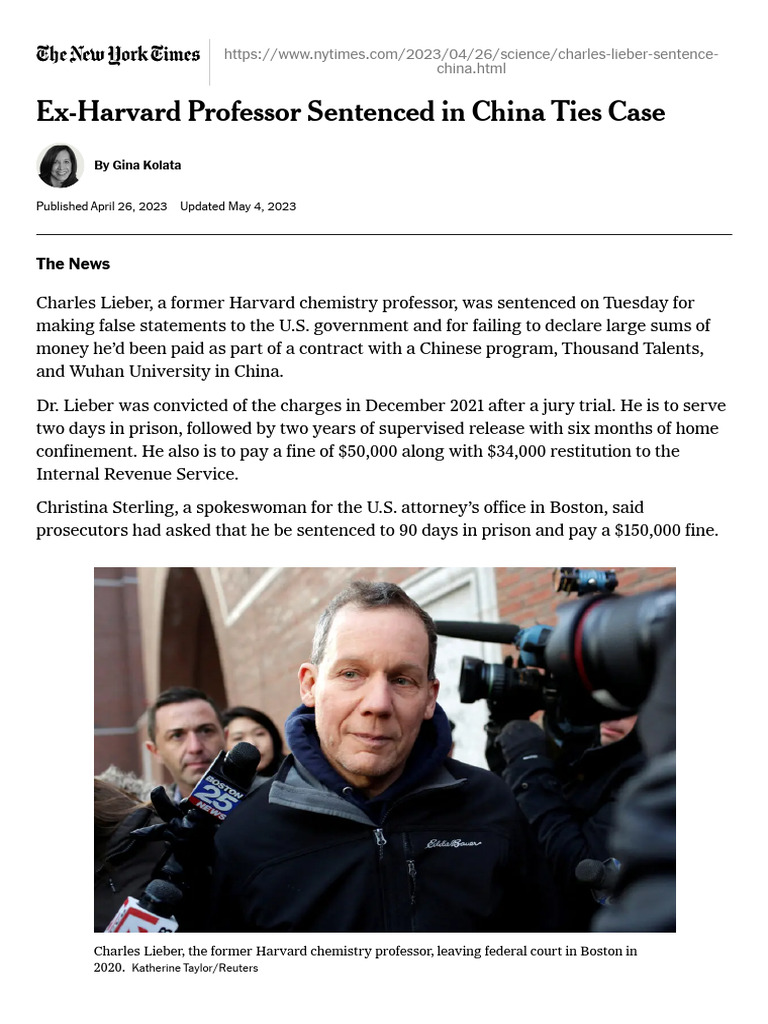
On February 7, 2020, the United States government arrested two scientists with ties to China, Li Xiao-Jiang and Charles Lieber, on charges of fraud. Li Xiao-Jiang, a neuroscientist who previously worked at Emory University, was charged with deceiving American authorities by failing to disclose his work at a Chinese institution while receiving grants from the National Institutes of Health. Charles Lieber, the chair of Harvard University’s Department of Chemistry and Chemical Biology, was accused of making false claims to the U.S. Defense Department about his involvement in China’s “Thousand Talents Plan”. The arrests were made in an effort to prevent Chinese economic espionage and protect American scientific endeavors.
background on the cases
Li Xiao-Jiang’s case involves his failure to disclose the extent of his work at the Chinese Academy of Sciences’ Institute of Genetics and Developmental Biology while working at Emory University’s medical school. According to the complaint, Li received around $92,000 in wages from three NIH grants in 2015, while also being paid $80,000 by the Chinese Academy of Sciences in 2015 and 2016. This dual employment was not disclosed to American authorities, and Li is now charged with swindling salary and peripheral profits from the US government. As stated by the Justice Department, Li’s actions were a clear violation of the trust placed in him as a recipient of federal funding.
the thousand talents plan
Charles Lieber’s case is more complex, involving his alleged involvement in China’s “Thousand Talents Plan”, a program established to recruit top experts in scientific research, innovation, and entrepreneurship from foreign countries. The program has been warned about by U.S. officials, who see it as a potential threat to American scientific endeavors. Lieber was accused of lying about his involvement in the program, and of signing a contract with China’s Wuhan University of Technology without the knowledge of Harvard. As the complaint stated, “Lieber was also awarded more than $1.5 million by WUT and the Chinese government to establish a research lab and conduct research at WUT”. This lack of transparency has raised concerns about the potential for Chinese economic espionage, and the Justice Department has taken a firm stance against such activities.
implications for us-china relations
The arrests of Li Xiao-Jiang and Charles Lieber have significant implications for US-China relations, particularly in the areas of science and technology. As noted by FBI Director Christopher Wray, “the Chinese government’s theft of intellectual property and trade secrets is a significant threat to our national security and economy”. The cases highlight the need for increased vigilance and transparency in international collaborations, and the importance of protecting American scientific endeavors from foreign interference. According to a statement by the Justice Department, “the United States will not tolerate the theft of our intellectual property, and we will take all necessary steps to prevent it”.
reaction from the academic community
The academic community has been quick to respond to the arrests, with many expressing concern about the potential consequences for international collaboration. As stated by Dr. Mary Sue Coleman, President of the Association of American Universities, “while we understand the need to protect American intellectual property, we also believe that international collaboration is essential for advancing scientific knowledge and addressing global challenges”. The cases have sparked a debate about the need for greater transparency and oversight in international collaborations, and the importance of balancing national security concerns with the need for global cooperation in science and technology. As noted by Dr. Coleman, “we need to find a way to balance our national security concerns with our commitment to international collaboration and the advancement of scientific knowledge”.
The arrests of Li Xiao-Jiang and Charles Lieber serve as a reminder of the importance of protecting American scientific endeavors from foreign interference, and the need for increased vigilance and transparency in international collaborations. As the US government continues to navigate the complex field of US-China relations, it is clear that the protection of American intellectual property and national security will remain a top priority. The cases have significant implications for the future of international collaboration in science and technology, and highlight the need for a balanced approach that promotes global cooperation while protecting American interests.