
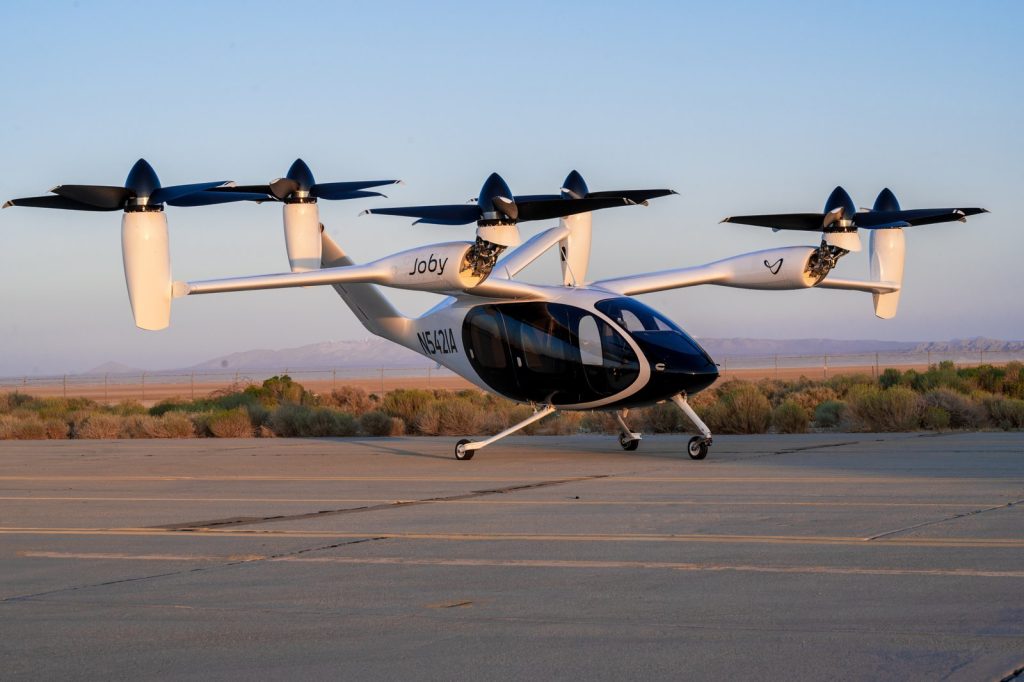
A $394 million investment from Toyota into Joby Aviation signals more than financial backing—the Japanese automaker is deploying its manufacturing specialists to help the California startup mass-produce electric air taxis. The deal brings Toyota’s total stake in Joby to $720 million, making it the lead investor with a hands-on role rather than a passive financial partner.
Joby’s aircraft is a five-seat, six-rotor electric vertical takeoff and landing vehicle. It tilts its rotors upward for helicopter-style liftoff, then forward for cruising at 200 miles per hour. No runway is required. The craft has a range of 150 miles and produces cabin noise described as 100 times quieter than a helicopter—a key selling point for urban operations where noise often grounds rotorcraft.
Toyota is sending production-line specialists to help Joby establish an assembly line capable of producing hundreds of these aircraft annually. This marks a significant shift from the current hand-built prototype phase.
Toyota built 10.7 million vehicles in 2019 and brings deep expertise in scaling manufacturing. Joby has flown a piloted prototype more than 1,000 times, but that remains far from a production-ready system. Toyota President and CEO Akio Toyoda framed the move as advancing “our long-term goal for air transportation,” a phrase reflecting the company’s broader mobility strategy.
Toyota showed a flying car concept at the 2020 Consumer Electronics Show and backed Joby in a 2018 Series B round. This investment is part of a deliberate strategy, not a side experiment.
Morgan Stanley analysts project the urban air-mobility market could reach $1.5 trillion by 2040, though that figure depends on regulatory approval, community acceptance of noise, and viable economics. Toyota is betting its manufacturing muscle can help answer those questions by supplying hardware and production know-how. Joby’s six-tilting-rotor design eliminates the need for runways but introduces complex mechanical systems that must be certified for passenger safety over populated areas.
The startup has passed a U.S. Air Force airworthiness review and signed an agreement with Uber to integrate the air taxi into its ride-hailing platform. However, certification from the U.S. Federal Aviation Administration and the European Union Aviation Safety Agency remains the primary hurdle.
Toyota’s engineers will need to prove the aircraft can be built reliably, repeatedly, and at a cost that makes the economics work. The 1,000 test flights provide data but do not constitute a production run. Toyota understands that distinction, which is why the deal is structured to put its own people on the factory floor—a bet on manufacturing process, not just technology, and a wager that Joby can evolve from a well-funded startup with a prototype into a real company.




