
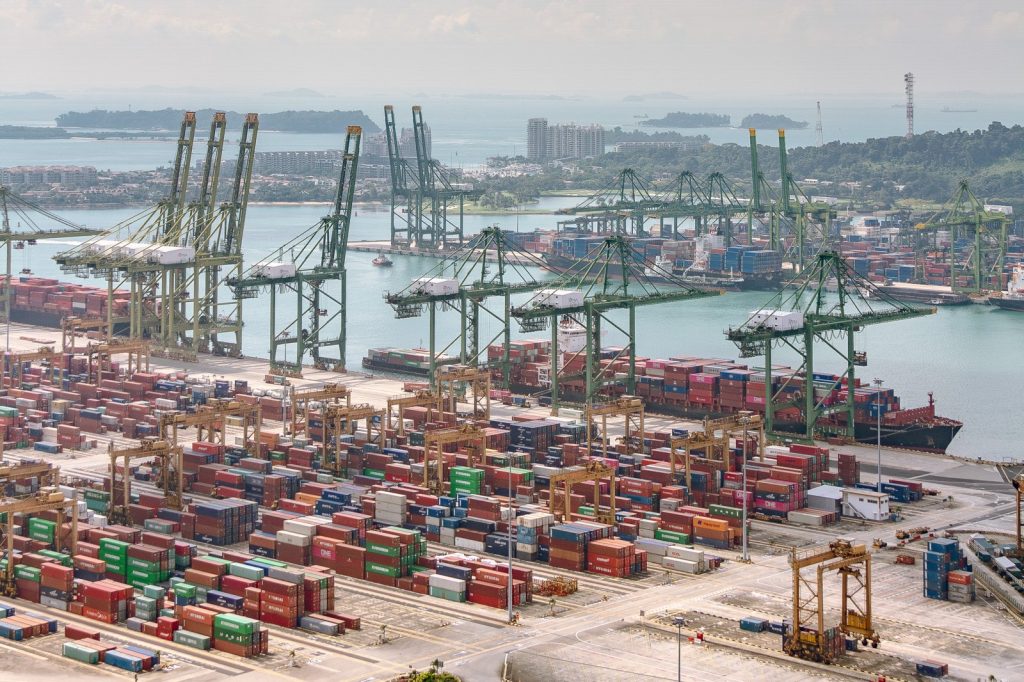
A Hub Anchoring Global Supply Chains
Singapore’s ability to serve diverse end-users reflects its strategic position in international trade. The nation began its contemporary era as a British Empire trading post established by Stamford Raffles, later became a Crown colony, and after a brief federation with Malaysia, gained full independence in 1965. Despite lacking natural resources, Singapore developed into one of the Four Asian Tigers and now operates as a major maritime shipping, financial, and aviation hub. It holds a AAA sovereign credit rating from all major agencies. This economic standing makes the city-state a central link in global supply chains, handling the exchange of goods, services, and capital across borders. Because international trade involves different currencies, laws, and government policies, it is more complex than domestic trade — and Singapore’s health often reflects broader demand trends and the stability of commerce between developed and emerging markets.
The June surge underlines this linkage. The science behind the recovery: the United States is pouring investment into AI data centers — vast server farms that require enormous processing power and electricity. Singapore, as a hub for advanced chip packaging and disk-drive manufacturing, serves as a natural supplier for that build-out. China, meanwhile, is seeing its own tech sector rebound after a period of disruption, creating demand for the precision machinery and components that Singapore’s factories produce. The European uptick stems from pharmaceutical companies expanding capacity, requiring specialist manufacturing equipment that the city-state’s industrial base provides.
Breadth Across Markets Points to Resilient Growth
The data shows that growth is not limited to the largest economies. Exports to Indonesia rose 18.2%, to Malaysia increased 11.5%, and to Japan grew 9.7%. This breadth matters: a recovery dependent on a single customer is fragile; one spanning developed and emerging markets is more resilient. Singapore does not manufacture many finished consumer goods but instead produces the parts and specialized equipment that go into them. When global tech companies build data centers, they need semiconductors. When Chinese electronics factories ramp up production, they need precision machinery. When European pharmaceutical firms expand capacity, they need specialist equipment. Singapore sits at the intersection of all those supply chains.
The pace of growth varies by market — the 22.4% jump for China contrasts with the 9.7% increase for Japan — but the overall pattern underscores how deeply integrated Singapore remains in global production networks. The city-state’s independence as a sovereign nation since 1965, coupled with its lack of natural resources, forced it to develop a competitive edge in high-value manufacturing and logistics. That legacy, combined with its status as a maritime and aviation hub, enables it to serve customers from Texas to Berlin to Jakarta. The June export data suggests that demand from AI infrastructure, industrial rebound in China, and pharmaceutical expansion in Europe is sustaining this role, even as trade complexity — involving different currencies, regulations, and policies — continues to shape global flows. For a small island with one main island, one outlying islet, and more than sixty satellite islands and islets, the export numbers reflect not just a quarterly snapshot but a deeper economic function as a critical node in the world’s trade architecture.
{“@context”: “https://schema.org”, “@type”: “NewsArticle”, “headline”: “Singapore’s strategic hub anchors global supply chains worldwide”, “description”: “A Hub Anchoring Global Supply Chains Singapore’s ability to serve diverse end-users reflects its strategic position in international trade. The nation began its contemporary era…”, “datePublished”: “2026-07-17T09:30:00+00:00”, “author”: {“@type”: “Person”, “name”: “Ava Anderson”}, “publisher”: {“@type”: “Organization”, “name”: “InfoPulse Today”, “url”: “https://newsfeed.infopulsetoday.com/”}}




