
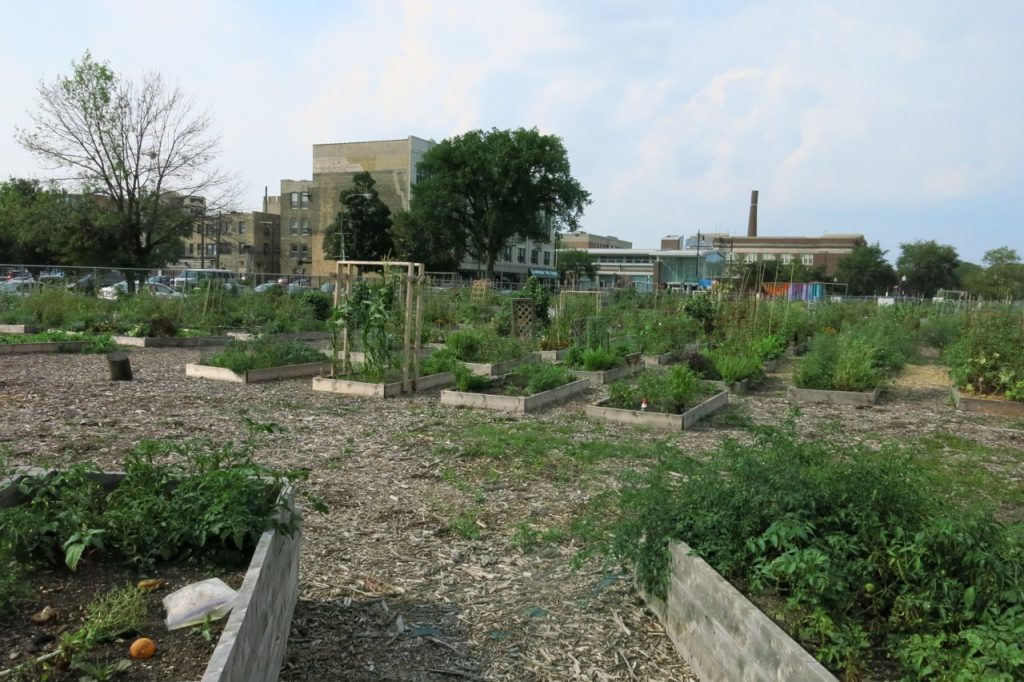
The vacant lots that ring the Academy for Global Citizenship, a K-8 charter school near Midway Airport, are no longer just dumping grounds. Two years ago a block nearby offered asphalt and weeds. Now it holds tomatoes, peppers, and a row of sunflowers.
Another block has apple and pear trees. The change is resident-led, and it is spreading block by block.
But the real story is not the gardens themselves. It is what they leave behind. Stormwater absorption is one effect.
Every garden that replaces a derelict plot soaks up rain that otherwise would run into overwhelmed city drains. That matters in a neighborhood where overgrown lots were once the norm and green infrastructure was absent.
The heat-island effect that bakes unshaded concrete gets a modest reduction. A patch of tomatoes cools the air more than a patch of broken asphalt ever could. These are functional interventions, not ornamental projects.
The practical constraints tell a harder story. Soil quality on former industrial and residential lots varies wildly. Lead contamination is a known risk.
Testing is not always affordable. Some plots required raised beds with imported topsoil before anything edible could go in.
Others needed drainage work. That grunt work does not make the brochure, but it makes the garden viable. The gardens that survive are the ones where neighbors did the digging themselves, secured permissions through the city’s lot-transfer programs, and kept at it.
The Academy for Global Citizenship became a hub. Students and families planted along the school’s perimeter and then expanded outward.
The result is a patchwork. Not every block has a garden. Not every garden thrives.
But the pattern is spreading. A block that was barren two years ago now produces food. Another has a small orchard.
The school sits in a neighborhood where overgrown lots were once the norm. That is no longer true on every block.
What comes next depends on soil. Lead contamination is not solved by enthusiasm. Raised beds cost money.
Imported topsoil costs money. Testing costs money.
The residents who led this effort did not wait for city planners or outside NGOs. They organized themselves. But the constraints are real.
Some plots required drainage work before they could function. Others required soil replacement. The gardens that work are the ones where those problems were solved.
The heat-island effect does not disappear overnight. Stormwater absorption is incremental.
Local food production is modest. But the pattern is spreading. A block that was barren two years ago now has tomatoes, peppers, and sunflowers.
Another has apple and pear trees. The school became a hub.
The neighbors did the digging. The result is a patchwork, but it is a patchwork that is growing. The practical reality is that these gardens are not ornamental.
They are functional interventions. They absorb stormwater. They produce food.
They reduce heat. They are resident-led.
That is the detail that matters. The city’s lot-transfer programs provided the mechanism. The neighbors provided the labor.
The school provided the hub. The soil provided the constraint.
The gardens that survive are the ones that solved the soil problem. The gardens that spread are the ones where neighbors kept digging.
{“@context”: “https://schema.org”, “@type”: “NewsArticle”, “headline”: “Community Gardens in Chicago Food Deserts Reduce Stormwater Runoff”, “description”: “The vacant lots that ring the Academy for Global Citizenship, a K-8 charter school near Midway Airport, are no longer just dumping grounds. Two years…”, “datePublished”: “2026-06-27T07:00:00+00:00T09:30:00+00:00”, “author”: {“@type”: “Person”, “name”: “Sebastian Smith”}, “publisher”: {“@type”: “Organization”, “name”: “InfoPulse Today”, “url”: “https://newsfeed.infopulsetoday.com/”}}




