
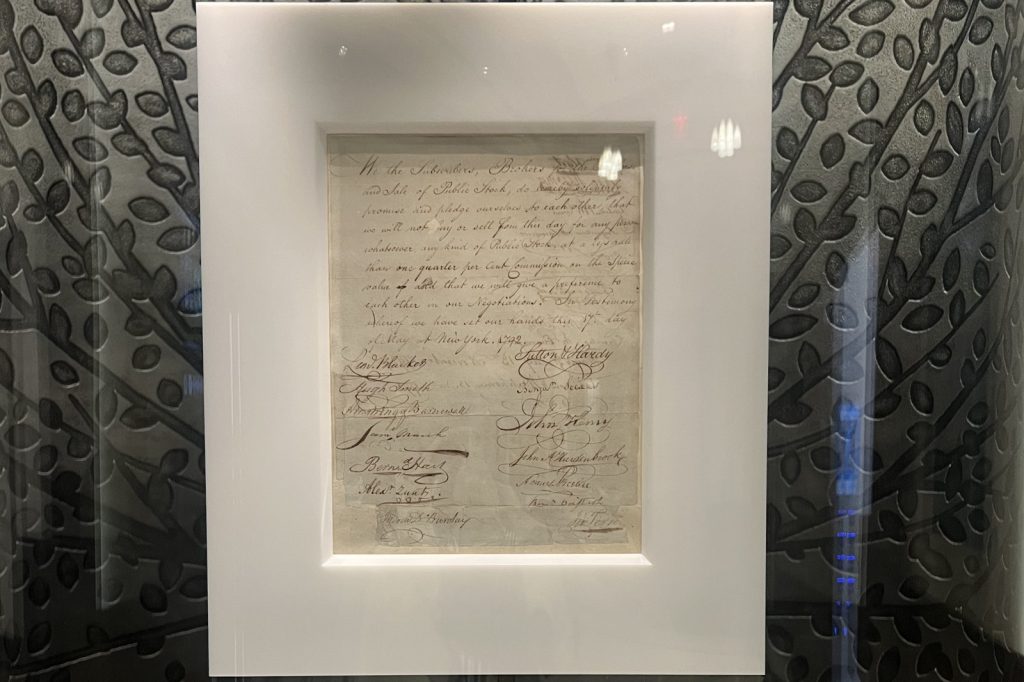
NEW YORK, July 8 — The Buttonwood Agreement, signed on May 17, 1792, by 24 stockbrokers outside 68 Wall Street, remains the foundational document of American capitalism. Strategically, it was a compact that created the first organized stock market in the United States, setting the stage for what would become the New York Stock Exchange. The agreement took its name from a buttonwood tree under which the brokers gathered.
This was not a formal charter from a government; it was a private pact among traders who agreed to a commission-based system for buying and selling securities. The calculus was straightforward: by standardizing fees and operating as a collective, these 24 men could bring order to what had been a chaotic, ad-hoc market.
The broader stakes of that 1792 meeting were not immediately apparent, but the agreement effectively established a central venue for capital formation in the young republic. The NYSE was formally incorporated on March 8, 1817, as the New York Stock & Exchange Board. In 1863, the name was shortened to the New York Stock Exchange.
The exchange moved to its current location at 11 Wall Street in 1903. What this signals to modern observers is the durability of institutional design.
The same building that housed the exchange in the early 20th century remains its iconic home. The exchange grew to become the world’s largest by market capitalization, reaching a peak of over $30 trillion in 2021. That figure represents the total value of all listed companies, a measure of the economic weight concentrated under one roof.
The Buttonwood Agreement itself is a single document, but its implications are vast. It represents a moment when market participants chose self-regulation over chaos. The 24 brokers who signed it were not acting under government mandate; they were responding to the practical needs of a growing commercial city.
New York was already emerging as a financial hub, and the agreement cemented that trajectory.
The Mechanics of the Pact
The commission-based system established by the Buttonwood Agreement was a direct response to the speculative excesses of the early 1790s. Without a central exchange, brokers had competed aggressively, undercutting each other on fees and creating an unstable environment. The agreement fixed commissions at a uniform rate, removing price competition among the signatories.
Strategically, this cartel-like structure had the effect of concentrating trading activity among the 24 signatories. Any broker who wanted access to the network had to join the agreement.
This created a closed club, but it also provided stability. The broader stakes were clear: if the market was to attract capital from Europe and domestic investors, it needed a reliable mechanism for price discovery and settlement. The location at 68 Wall Street was not accidental.
Wall Street itself was already the commercial spine of New York. The buttonwood tree provided shade and a meeting point, but the real infrastructure was the network of relationships among the brokers.
From Tree to Institution
The transition from an informal gathering under a tree to a formal incorporated exchange took 25 years. The New York Stock & Exchange Board, created in 1817, introduced a written constitution, a regular meeting schedule, and a formal membership structure. This was the institutionalization of the Buttonwood Agreement’s principles.
The calculus for incorporation was driven by growth. By 1817, New York had surpassed Philadelphia as the nation’s largest city and primary port.
The War of 1812 had demonstrated the need for domestic capital markets, as the federal government struggled to finance the conflict. The exchange provided a venue for trading government bonds, bank stocks, and insurance company shares. The name change in 1863 to the New York Stock Exchange coincided with the Civil War.
The war required massive federal borrowing, and the exchange became the primary market for U.S. Treasury bonds. This period cemented the NYSE’s role as the central institution of American finance.
The Modern Exchange
The move to 11 Wall Street in 1903 was a statement of permanence. The building, designed in the neoclassical style, was intended to convey stability and trust. At the time, the exchange was already the dominant stock market in the United States, having absorbed or outcompeted regional exchanges in Philadelphia, Boston, and Chicago.
What this signals about the exchange’s evolution is the shift from a private club to a public institution. The Buttonwood Agreement was a pact among 24 individuals.
The modern NYSE, by 2021, listed thousands of companies with a combined market capitalization of over $30 trillion. The scale is almost incomprehensible compared to the 1792 gathering. Strategically, the exchange’s resilience through wars, depressions, and financial crises speaks to the underlying value of organized markets.
The Buttonwood Agreement created a framework that could adapt to changing circumstances. The commission system gave way to negotiated rates in 1975, but the core function — matching buyers and sellers in a transparent venue — remained.
The broader stakes for the global economy are significant. The NYSE’s market capitalization of over $30 trillion in 2021 represented roughly one-third of the value of all publicly traded companies worldwide. This concentration of capital in a single exchange gives the United States enormous influence over global financial flows.
What to Watch Next
The Buttonwood Agreement is a historical document, but its legacy is very much alive. The NYSE continues to operate at 11 Wall Street, though electronic trading has transformed how transactions occur. The physical trading floor, once a chaotic pit of shouting traders, is now largely symbolic
{“@context”: “https://schema.org”, “@type”: “NewsArticle”, “headline”: “Buttonwood Agreement birthed Wall Street and NYSE in 1792”, “description”: “NEW YORK, July 8 — The Buttonwood Agreement, signed on May 17, 1792, by 24 stockbrokers outside 68 Wall Street, remains the foundational document of…”, “datePublished”: “2026-07-08T09:30:00+00:00”, “author”: {“@type”: “Person”, “name”: “Noah King”}, “publisher”: {“@type”: “Organization”, “name”: “InfoPulse Today”, “url”: “https://newsfeed.infopulsetoday.com/”}}




