
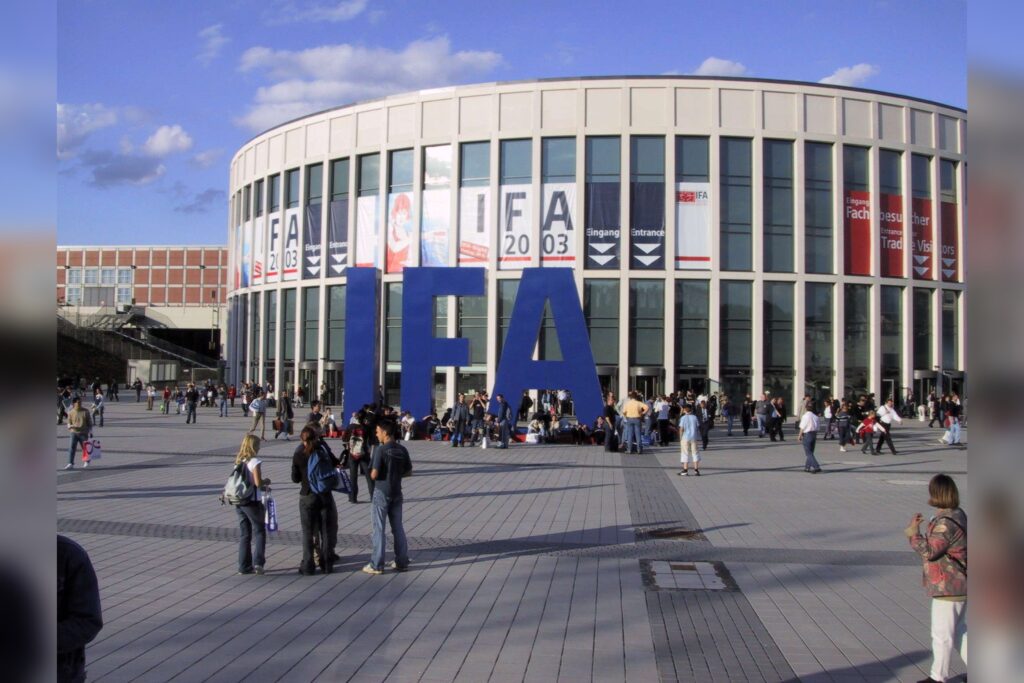
BERLIN, Sept. 8 — Chinese consumer electronics and home appliance companies are using IFA here and CES in Las Vegas not primarily as trading floors but as marketing platforms aimed at domestic audiences, investors, and professional communities, according to an industry analysis of the current IFA show.
The analysis, which notes that the century-old fair once went through a downturn but has been reignited by the boom of artificial intelligence and the participation of Chinese brands, describes a paradox that has persisted for years: the products of widely noticed Chinese enterprises are mostly sold to Southeast Asia, the Middle East, Latin America and Africa, and are still difficult to find on shelves in mainstream European and American markets. Participation itself is a form of content production, the analysis said.
A brand releasing the “world’s first AI refrigerator” at CES can complete fission dissemination through domestic technology media and social media within 48 hours, reaching far more domestic consumers than overseas users it can actually cover. That is the first layer of what the analysis calls “blossom outside the wall gives fragrance inside the wall” — overseas exhibitions becoming marketing events targeting the domestic market.
A Qingdao home appliance company has expanded its IFA booth area year by year from an initial standard booth to the most prominent position in the entire hall, the analysis noted. Its domestic PR team prepares press release templates one month in advance; headlines such as “Brand X Shines in Europe” and “Intelligent Manufacturing of China Conquers the World” sweep the Chinese internet when the exhibition opens.
Whether European consumers queue to buy in MediaMarkt, Europe’s largest consumer electronics retailer, becomes a secondary issue. A southern Chinese robot vacuum company, whose products have reached the ceiling of domestic competition, uses CES as a roadshow for investors and the capital market, the analysis said. Releasing a “new generation of robot vacuums equipped with large models” in Las Vegas targets exchanges in Shenzhen and Hong Kong, with the exhibition spotlight becoming story material for earnings calls.
A Shenzhen-based imaging equipment company, whose users are vloggers and content creators worldwide, must attend CES and the NAB show in the US because top YouTube creators select products at these exhibitions — absence from creators’ videos equates to “social death” in the professional community. The common thread, the analysis said, is that the value of exhibition participation exceeds the value of sales behavior. But exhibitions display brand power, and brand power does not equal channel power.
The mainstream European and American consumer electronics market is highly solidified — shelf space at Best Buy, Costco and Target is extremely valuable, and a new brand needs years of channel negotiation, after-sales service system construction, localization compliance and brand awareness accumulation. Apple and Tesla hold their own conferences because they do not need channel providers to endorse them; they are the channels themselves.
Most Chinese consumer electronics enterprises have not completed the transformation from “product companies” to “channel companies,” the analysis said. At CES and IFA they show cutting-edge technical concepts, but in actual European and American sales they face three dilemmas: channel blockade, low brand awareness and lack of after-sales system. In contrast, markets in Asia, Africa and Latin America present a completely different picture, with different channel structures — and that is where the products flow.




