
BRUGES, July 18 — The icebreaker’s story is older than most people realize, and it starts not in the Arctic, but in the canals of the Low Countries. The first recorded primitive icebreaking ship was a barge used by the Belgian town of Bruges in 1383 to help clear the town moat. The town purchased four such ships after the barge’s success.
That shift — from brute human force with axes and hooks to a dedicated vessel — marks the real beginning of icebreaking technology.
From horse-drawn barges to reinforced hulls
By the 15th century, icebreaker use in Flanders was already well established, reaching towns like Oudenaarde, Kortrijk, Ieper, Veurne, Diksmuide and Hulst. During the Little Ice Age, colder winters drove growing use in the Low Countries, where trade and transport relied heavily on waterways. The trend underneath is telling: every town of some importance in the region deployed some form of icebreaker to keep its waterways open through the 17th century.
Before the 17th century, specifications are unknown. What we do know is that later icebreaking vessels were dragged by teams of horses; the heavy weight of the ship pushed down and broke the ice.
Men with axes and saws worked alongside them. The technology barely changed until the industrial revolution. Meanwhile, polar exploration pushed ship design in a different direction.
Ice-strengthened ships were used in the earliest days of Arctic and Antarctic voyages. These were originally wooden and based on existing designs, but reinforced — double planking around the waterline, strengthening cross members inside, iron bands wrapped around the outside, and sometimes metal sheeting at the bows, stern, and along the keel.
Such strengthening helped a ship push through ice and protected it if it got “nipped” — trapped between ice floes pushed by winds and tides, like a vise.
Small craft, old waters
Before any of this, the first boats in polar waters belonged to the Eskimos. Their kayaks are small, human-powered, with a covered deck and one or more cockpits. They have no icebreaking capabilities, but they are light and well-fit to be carried over the ice.
In the 9th and 10th centuries, Viking expansion reached the North Atlantic and eventually Greenland and Svalbard in the Arctic. Vikings operated their ships in waters that were ice-free for most of the year.
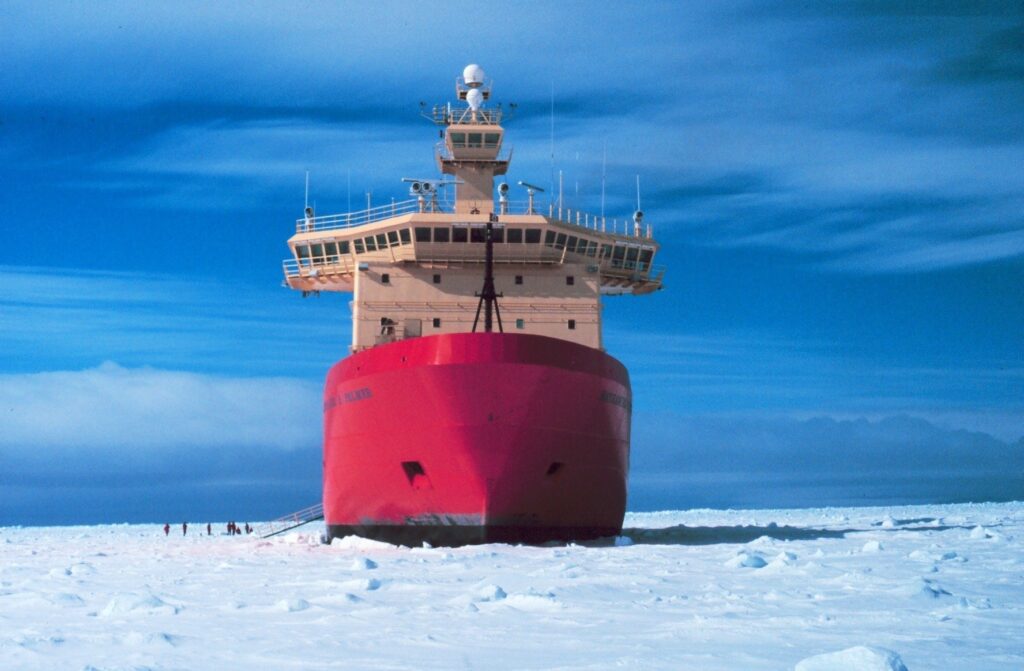
For a ship to be considered an icebreaker today, it needs three traits most normal ships lack: a strengthened hull, an ice-clearing shape, and the power to push through sea ice. The ship clears paths by pushing straight into frozen-over water or pack ice. Sea ice’s bending strength is low enough that the ice breaks usually without a noticeable change in the vessel’s trim.
In very thick ice, an icebreaker can drive its bow onto the ice, breaking it under the weight of the ship. A buildup of broken ice in front can slow a ship more than the breaking itself, so the hull is specially designed to direct the debris around or under the vessel.
The external propulsion components — propellers, shafts — are at greater risk than the hull itself, so the ability to propel onto the ice, break it, and clear the debris is essential for safety. The fundamental challenge hasn’t changed since that first barge in Bruges. Watch this space — as interest in polar routes grows, the same principles that worked with horses and axes now power some of the most heavily engineered vessels on the water.
The technology has evolved, but the core problem remains: how to break ice and keep moving.
Sources
{“@context”: “https://schema.org”, “@type”: “NewsArticle”, “headline”: “Icebreaker Ships Navigate Frozen Seas for Centuries”, “description”: “BRUGES, July 18 — The icebreaker’s story is older than most people realize, and it starts not in the Arctic, but in the canals of…”, “datePublished”: “2026-07-18T09:30:00+00:00”, “author”: {“@type”: “Person”, “name”: “Maria Romano”}, “publisher”: {“@type”: “Organization”, “name”: “InfoPulse Today”, “url”: “https://newsfeed.2bme.xyz/”}, “citation”: [{“@type”: “CreativeWork”, “url”: “https://en.wikipedia.org/wiki/Icebreaker”}]}




