
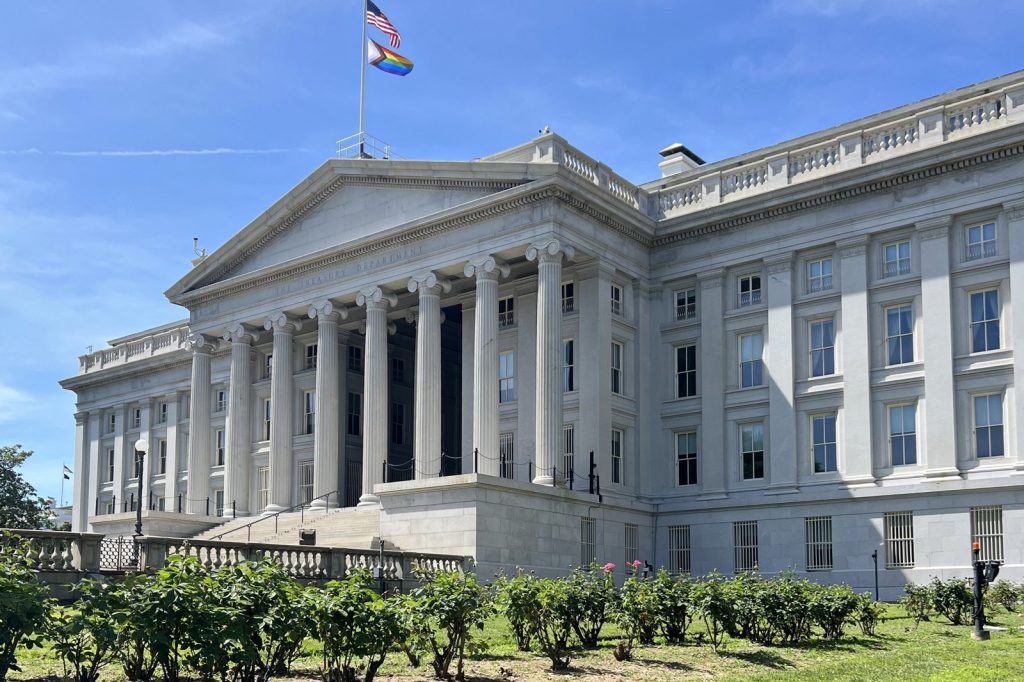
WASHINGTON, July 11 — The interest clock on the national debt is ticking at a rate that, by nightfall, will have added another $3.4 billion to what the United States owes. That is the average daily interest payment the Treasury is making in 2024, a figure that works out to roughly $24 billion every single week. The scene inside the Treasury Department’s borrowing operation is one of relentless, mechanical churn.
To keep the government running, the Treasury is holding 280 auctions of various securities each year, a constant drumbeat of debt sales that has become the financial backbone of the federal government. For fiscal year 2024, which began on October 1, 2023, the Treasury has been borrowing $155 billion per month.
Through the first eight months of the fiscal year, through May 2024, total borrowing has reached $1.24 trillion. The cost of carrying that debt is climbing sharply. The Congressional Budget Office, in its February 2024 report, projects a federal deficit of $1.5 trillion for the full fiscal year 2024.
Within that, net interest costs alone are forecast to hit $870 billion. The average interest rate on the debt has more than doubled since 2021, rising from 1.6% in FY 2021 to 3.3% in FY 2024.
The scale of the debt itself is staggering. The total debt held by the public — the portion of the national debt that is owned by individuals, corporations, state and local governments, the Federal Reserve, and foreign governments — stands at $27.5 trillion. The remainder of the total debt is held by government accounts, such as the Social Security trust funds.
As of the first quarter of 2024, the debt-to-GDP ratio, a key measure of the nation’s indebtedness relative to the size of its economy, sits at 122%. ## The Quarterly Borrowing Machine The Treasury’s borrowing is not a steady drip; it comes in large, periodic waves. For the second quarter of 2024 — January through March — the Treasury’s quarterly refunding statement estimated net borrowing of $760 billion.
That is a massive sum to raise in just three months, requiring a series of large auctions of Treasury notes, bonds, and bills. The mechanics of this borrowing are well-established.
The Treasury announces its borrowing needs, then goes to market with a schedule of auctions. Investors — from pension funds in Tokyo to sovereign wealth funds in the Middle East to American households buying Treasury bonds online — place their bids. The Treasury accepts the lowest interest rates offered, and the debt is issued.
The process repeats, week after week, month after month. This system has worked for decades, but the rising interest rate environment is changing the calculus.
When the average interest rate on the debt was 1.6% in FY 2021, the cost of servicing $27.5 trillion in public debt was manageable. At 3.3%, that same debt load costs more than twice as much in interest payments each year. ## The Deficit Picture The CBO’s projection of a $1.5 trillion deficit for FY 2024 is a number that dwarfs the deficits of most other nations’ entire economies. It represents the gap between what the federal government spends and what it takes in through taxes and other revenues.
The interest payments on the debt are a growing component of that spending, and they are not discretionary — the government must pay them or default. The $870 billion in net interest costs projected for FY 2024 is more than the entire budget of most federal departments. It is a line item that is growing faster than almost any other part of the budget, driven by both the rising debt load and the higher interest rates the Treasury must pay to attract buyers for its securities.
The Treasury’s own data, captured in the Daily Treasury Statement for March 2024, shows the daily reality of these costs. The average daily interest payment of $3.4 billion is a figure that compounds each day the debt remains outstanding.
By the end of the fiscal year, those daily payments will have added up to the $870 billion the CBO projects. ## What Comes Next The borrowing shows no signs of slowing. The Treasury continues to hold its 280 auctions per year, and the monthly borrowing of $155 billion is baked into the government’s financing plans. The quarterly refunding statement for the next quarter will likely show another large borrowing estimate, as the government continues to spend more than it collects.
The debt-to-GDP ratio of 122% is a level that economists watch closely. It means the national debt held by the public is larger than the entire annual output of the U.S. economy.
While the United States has carried high debt loads before — most notably during World War II — the current trajectory is one of sustained, peacetime borrowing that shows no sign of reversing. The Treasury’s borrowing operation, by nightfall, will have added another $3.4 billion to the interest bill. Tomorrow, it will do the same.
The clock keeps ticking.
{“@context”: “https://schema.org”, “@type”: “NewsArticle”, “headline”: “U.S. Borrows $155B Monthly, Pays $24B Weekly Interest in FY 2024”, “description”: “WASHINGTON, July 11 — The interest clock on the national debt is ticking at a rate that, by nightfall, will have added another $3.4 billion…”, “datePublished”: “2026-07-11T09:30:00+00:00”, “author”: {“@type”: “Person”, “name”: “Isabella Moore”}, “publisher”: {“@type”: “Organization”, “name”: “InfoPulse Today”, “url”: “https://newsfeed.infopulsetoday.com/”}}




