
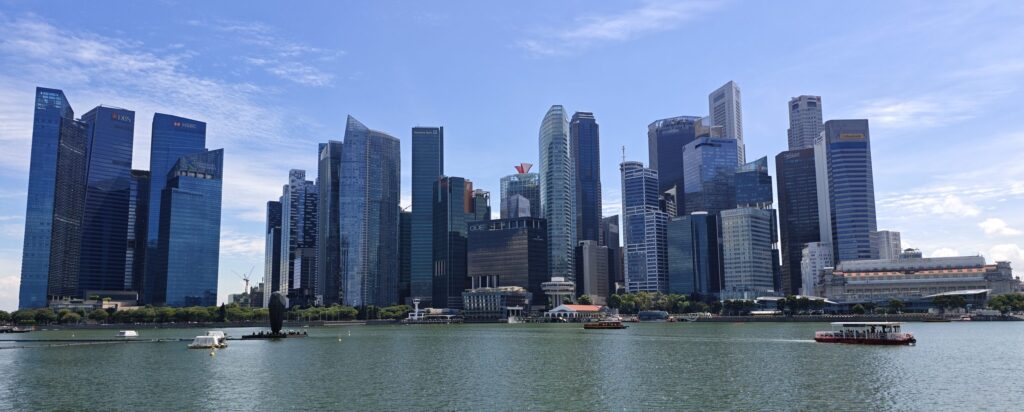
June trade data from the city-state offered a fresh snapshot of global commerce, with non-oil domestic exports rising 20.7% compared to the same month last year. That expansion, while robust by historical standards, marked a slowdown from May’s 38.4% surge and fell just short of the 22.1% increase economists had anticipated in a Reuters poll. For Singapore, a trade-dependent nation whose economic shifts often serve as a bellwether for international commerce, the numbers still point to sustained momentum — particularly in electronics tied to the artificial intelligence supply chain.
Electronics Surge Signals AI Demand is Driving Real Orders
Electronics shipments posted a 43.1% year-on-year increase in June, according to Enterprise Singapore. The agency attributed the jump to strong global demand for AI chips and components.
That figure reinforces that the ongoing AI buildout is translating into tangible orders, not just speculative investment. Non-electronics exports grew 14.8%, led by pharmaceuticals and specialized machinery, providing a broad-based underpinning to the overall export expansion. The 43.1% electronics figure signals that semiconductor-related exports remain a key growth driver for Singapore.
Analysts have noted that the moderation from May’s high base was expected, and that sustained electronics growth suggests robust AI demand rather than a one-off spike. The data underscores Singapore’s role as a bellwether for global trade and the AI supply chain.
The question now is whether the AI-driven surge has legs — or whether the high base effects of 2024 will flatten growth in the months ahead.
Key Markets Show Strength Across China, United States, and European Union
Exports to China, Singapore’s largest single-country market, rose 22.4% in June. Exports to the United States increased 15.8%, while shipments to the European Union grew 12.3%. The broad geographic spread indicates that demand is not concentrated in one region, which adds resilience to Singapore’s export picture. The United States, as a major consumer of electronics and AI-related components, remains a crucial destination for Singapore’s shipments, and the 15.8% growth reflects that relationship.
Analysts are watching whether the current pace can be sustained. A 20.7% expansion, even if below forecasts, is still strong by historical standards.
The data gives no reason for alarm, but the pattern of moderation from May’s unusually high figure is something trade watchers will track in coming months. The question of whether the AI-driven surge will continue depends partly on global semiconductor demand and partly on how quickly the artificial intelligence supply chain can scale further.
Singapore’s History as a Trading Hub Gives the Data Broader Significance
Singapore is an island country in Southeast Asia, consisting of a main island and many smaller satellite islands and islets. It has a long history as a maritime center, known as Temasek before Stamford Raffles established it as a British trading post. After periods of British rule and a Japanese occupation during World War II, Singapore joined the federation of Malaysia.
Ideological differences led to its expulsion, and the country became a sovereign state in 1965. Despite a lack of natural resources, Singapore grew rapidly to become one of the Four Asian Tigers.
This history as a trading hub made the nation a global center for aviation, finance, and shipping. Because it lacks a hinterland, the economy relies heavily on international commerce. Its status as a highly developed country with a top sovereign credit rating means its economic shifts often signal broader trends in global trade.
The June 2024 export data reinforces that pattern, showing that global demand — especially for AI-related semiconductors — continues to flow through this small but strategically positioned nation.




