
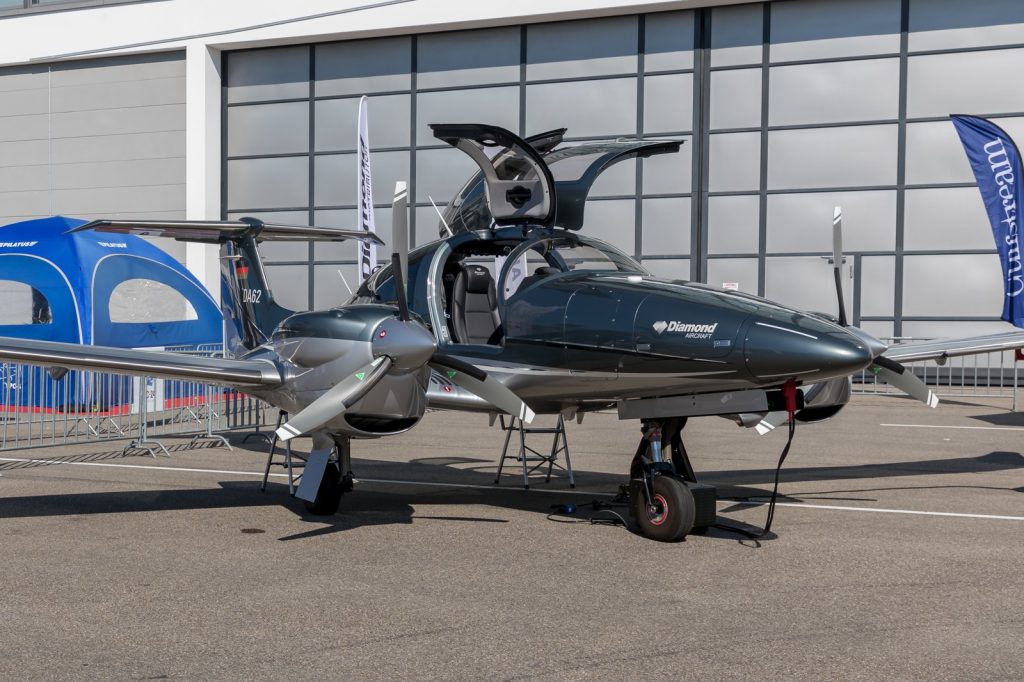
When Diamond Aircraft Industries unveiled the first DA62 prototype in April 2012, the company was making a bold claim: a twin-engine aircraft that could operate with the simplicity and cost-efficiency of a single-engine model. That promise has remained central to the aircraft’s identity ever since.
The project moved quickly from its inception. Just six months after the initial prototype flew, Diamond had already begun redesign work. By June 2014, what had originally been designated the DA52 was completely reworked and rebranded as the DA62. This name change was not merely cosmetic—it reflected substantive modifications to the airframe and systems following intensive testing.
Certification followed a timeline that demonstrates Diamond’s global ambitions. The European Aviation Safety Agency granted approval in April 2015, exactly three years after the prototype first flew.
The Federal Aviation Administration followed in February 2016. This gap between European and American certification is standard for light aircraft targeting both markets, but securing both approvals was essential. Without EASA and FAA stamps, the DA62 would have remained a regional product.
With them, Diamond gained access to flight schools, charter operators, and private owners across two continents. The aircraft’s market strategy rests on a straightforward calculation: pilots want the safety redundancy of a second engine but dislike the higher maintenance costs and fuel consumption that typically accompany twin-engine designs.
The DA62 aims to bridge that gap. It offers five to seven seats with twin-engine power while promising operating costs close to those of a single-engine aircraft. The development process required three years of refinement between the first flight and EASA certification.
While fast by general aviation standards, this period was necessary to prove the aircraft could deliver on its core promise of simplicity without sacrificing performance. Since the early 2010s, the aviation industry has shifted heavily toward fuel economy and lower operating costs.
Diamond positioned the DA62 to capitalize on this trend. The aircraft is not revolutionary but evolutionary—it solves a specific problem: how to achieve twin-engine redundancy without the traditional twin-engine drawbacks. The DA62 now occupies a comfortable market position.
It is certified, proven in service, and has the regulatory approvals needed for continued production. Whether this will be sufficient to compete with emerging designs, including electric and hybrid propulsion systems entering the light aircraft segment, remains uncertain.
However, Diamond has already accomplished what many aircraft projects never achieve: a clean path from prototype through production to full certification.




