
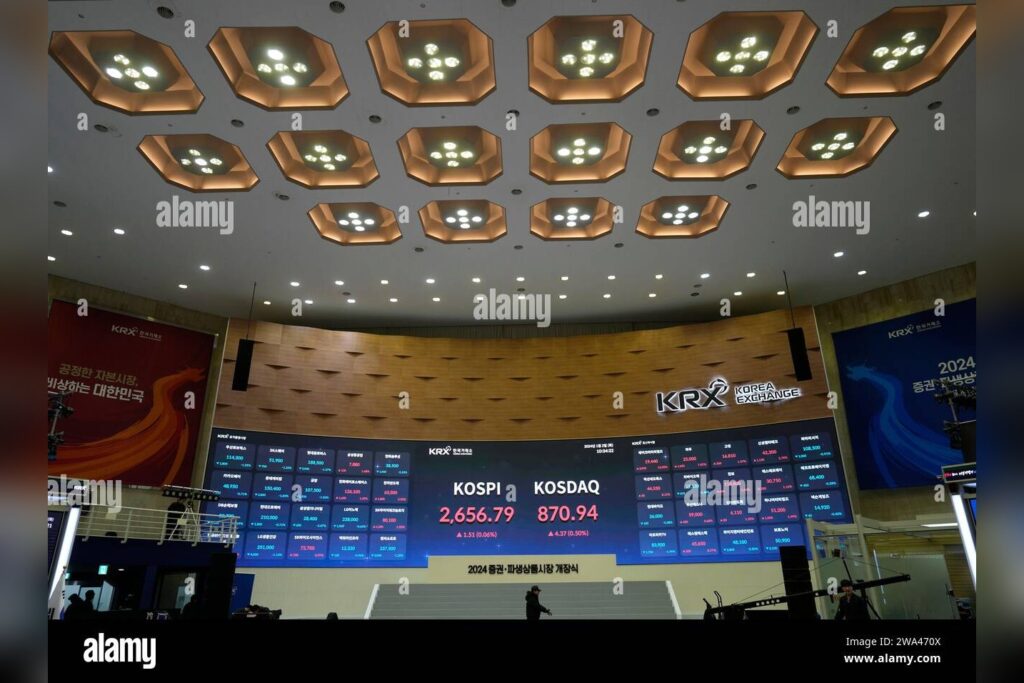
Friday’s 20-minute trading halt on South Korea’s Kospi was not the main story. The main story is what caused it: a sudden, sharp doubt about who will pay for the artificial intelligence boom. The index fell 8.2 percent before the circuit breaker kicked in.
That pause, a rare event, gave traders time to think. When trading resumed, the damage was already done.
Samsung Electronics and SK Hynix, the country’s two biggest chipmakers, each lost more than 9 percent at one point. Foreign investors dumped 2.6 trillion won worth of Kospi-listed shares — about $1.68 billion — in a single session. The trigger was clear.
Overnight losses on Wall Street, driven by a late reversal in US tech stocks, spread to Asia. The Nasdaq fell as investors worried about hyperscaler spending on AI infrastructure.
Hyperscalers are the giant cloud-computing companies — Amazon, Microsoft, Google — that are pouring billions into data centers and AI chips. The central question, market participants said, is who will ultimately foot the bill for those massive capital outlays. That question has been hanging over the AI rally for months.
Strong demand signals from US chipmakers Micron Technology and Qualcomm were not enough to calm the fears. The sell-off in US technology shares triggered a wave of profit-taking in Asian chip stocks. The Kospi is on track for its biggest weekly decline in more than three months.
The timing matters. For months, Asian tech stocks rode a wave of AI optimism.
South Korea’s chipmakers were central to that story. Samsung and SK Hynix make the high-bandwidth memory chips that power AI systems. Investors bet the spending would keep growing.
Friday’s plunge suggests that bet is now being questioned. The implications reach beyond South Korea.
Kazakhstan and Uzbekistan have been positioning themselves as potential destinations for AI infrastructure investment. Both countries tout cheap power and proximity to major markets. A pullback in hyperscaler spending could slow those plans.
For Central Asian markets, the sell-off carries direct implications. Circuit breakers are designed to stop panic. They give a market 20 minutes to cool off.
But they do not fix the underlying problem. The Kospi resumed trading, but the index remained weak.
The question now is whether the correction deepens or finds a floor. Friday’s events did not come out of nowhere. The AI-driven rally that lifted Asian tech stocks earlier this year was built on an assumption: that hyperscalers would keep spending, no matter what.
That assumption is now being tested. The sell-off in US tech stocks on Thursday was the first sign.
The Kospi’s plunge on Friday was the second. No one is calling this a crash. But the speed of the reversal is striking.
An 8.2 percent drop in a single session is not a routine pullback. It is a signal that sentiment has shifted. How far it will shift is unknown.
What is known is that the bill for AI infrastructure is enormous, and someone has to pay it. For now, the market is not sure who that someone will be.




