
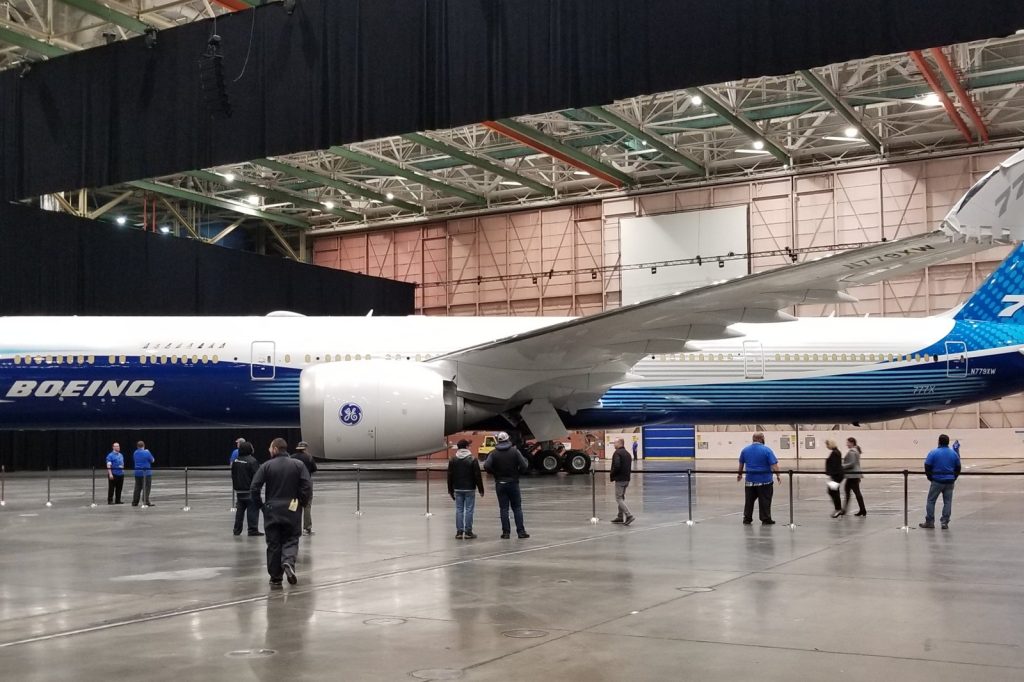
EVERETT, Wash., July 21 — The figure that matters for Boeing’s 777X program: 619 total orders from 12 customers as of November 2025. The bottom line: after more than a decade of development, the first deliveries are now expected in 2027 — a full eight years after the original target for entry into service. That target slipped fast.
The program launched in November 2013. Initial design work began in 2011.
Boeing aimed for a firm configuration in 2015, first flight in late 2017 or 2018, and entry into service by 2019. The 777-9 first flew on January 25, 2020. As of October 2025, the company expected the first aircraft to be delivered in 2027.
In March 2026, the Lufthansa CEO expected that the first 777X is to be delivered in 2027. Boeing conducted the first flight of a production airliner using Lufthansa’s 777X in May 2026.
By the numbers, the 777X is a substantial development of the original 777. Two variants are on the table: the 777-8, seating 350–425 passengers with a range of 9,500 nautical miles (17,600 km; 10,900 mi), and the 777-9, seating 375–450 passengers with a range of 8,000 nmi (15,000 km; 9,200 mi). The early 777-9X specs included a length of 250 ft 11 in (76.48 m), a maximum take-off weight of 759,000 lb (344 t), and engines targeting 21% better fuel burn per seat.
The 777-8X had similar early specs.
Key technology and engine monopoly
The airframe gets its range and efficiency from a carbon-fiber-reinforced polymer wing with a wingspan up to 233 ft 5 in (71.1 m) with raked wingtips. That span exceeds ICAO Code E limits, so Boeing added folding wingtips to keep the aircraft compatible with existing airport gates. The twin-engine power comes from the General Electric GE9X, selected in March 2013.
The engine features a 132 in (335 cm) fan, a 10:1 bypass ratio, a 60:1 overall pressure ratio, and thrust eventually bumped to 102,000–105,000 lbf. Investors will note the concern over engine competition — or the lack of it.
Some customers bemoaned the lack of engine competition. The GE9X is the sole powerplant for the 777X program. That means no rival engine supplier to push pricing or performance benchmarks, a dynamic that usually benefits airlines in long-term maintenance contracts.
Assembly and timeline
Aircraft are assembled at the Boeing Everett Factory in Washington state. The 777X program also incorporates technologies from the Boeing 787 Dreamliner, particularly in composite structures and electrical systems. The 777-8 and 777-9 variants remain in flight testing as of mid-2026, with the 777-9 having logged its first flight in January 2020.
The 777-8 has not yet flown; its first flight timeline is not specified in the source. What to watch next: Boeing’s ability to hit the 2027 delivery date.
With 619 orders still on the books, the 777X remains the largest twin-engine jet in production, but the delayed timeline has already cost the program years of service revenue. The next milestones — certification flights, production ramp-up, and final delivery — will determine whether the 777X recaptures market momentum or continues to trail the original schedule.




