
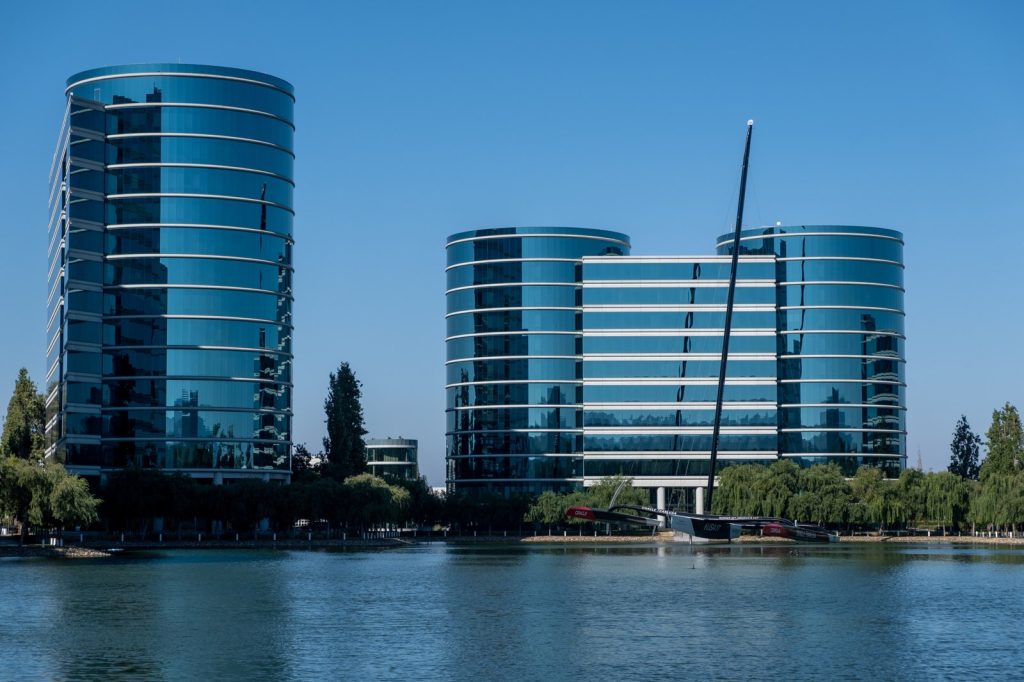
Oracle Corporation shares ticked higher in trading today after the company reported what it described as a record fiscal 2026, fueled by surging demand for cloud-based artificial intelligence services. The gain came even as the technology giant maintains a high level of capital infrastructure spending, a strategy that officials say is essential to capturing the AI opportunity. The company did not disclose specific revenue figures in the announcement, but data indicate the fiscal year represented a high point for Oracle’s top line.
For investors and market watchers, the performance stands out at a time when some cloud rivals have struggled to balance heavy AI investment with profitability.
Record Year Driven by Cloud AI Demand
The company said cloud AI demand has been a primary driver behind the record results. Enterprise clients are increasingly shifting workloads to Oracle’s cloud platforms, pushing the company to expand its data centers and computing capacity.
This capital expenditure, while weighing on near-term margins, is seen as a necessary step to secure long-term growth in the AI market. Oracle’s ability to post record results while carrying significant capital outlays suggests its cloud AI offerings are gaining traction with large corporate customers, officials noted. Investors will now watch for the next quarterly update to determine whether the momentum can be sustained.
The company faces competition from other major cloud providers, but current data point to strong demand that shows no signs of slowing.
Global Implications for Central Asia and Beyond
For markets in Central Asia, Oracle’s financial performance carries concrete signaling value. The company’s cloud business is increasingly tied to global supply chains, including the flow of semiconductors and server equipment through regional trade corridors.
As Kazakh firms and other Central Asian enterprises adopt cloud services, demand for AI infrastructure is expected to grow in parallel. The region’s growing digital economy positions it as an emerging market for cloud-based AI solutions, which could further underpin Oracle’s expansion in the area. The record fiscal year thus reflects not only corporate strategy but also a broader trend in which cloud AI infrastructure becomes more integrated into international commerce and local business operations.
The company’s heavy spending on data centers and computing capacity is a key part of its strategy to support the influx of enterprise clients. Although capital expenditure pressure on margins is acknowledged, officials view it as the price of capturing the AI opportunity that is reshaping the technology sector.
Oracle’s record stands in contrast to some peers who have struggled to achieve similar profitability while investing in AI, suggesting that the company’s approach is resonating with the market. The next quarterly update will be closely watched as an indicator of whether this performance can be maintained amid ongoing competition and evolving demand patterns.
Ancient Concept, Modern Application
The name “Oracle” itself carries a rich historical legacy that predates modern technology by millennia. In ancient civilizations, oracles were seen as intermediaries between gods and humans.
The most renowned was the Oracle of Delphi in Greece, where a priestess known as the Pythia delivered prophecies believed to be inspired by Apollo. Other significant sites included Dodona, associated with Zeus and Dione, and various oracles of Apollo across Anatolia and the Aegean. These institutions wielded immense religious and political influence, shaping decisions in war, colonization, and governance.
An oracle, in that context, was a person or entity regarded as a source of wise counsel or prophetic insight, often linked to divine inspiration. Today, the term has been repurposed to name a major technology corporation, illustrating how language evolves and ancient concepts can be adapted to contemporary contexts.
Oracle Corporation’s rise in cloud computing and artificial intelligence reflects a different kind of foresight—one driven by data and infrastructure rather than divine intervention. For readers, this contrast highlights how the meaning of words can transform while retaining echoes of their historical roots. The company’s record fiscal year, powered by AI demand, is a modern example of that shift: the oracle of today delivers predictions through algorithms and computing capacity, not through prophecy.




