
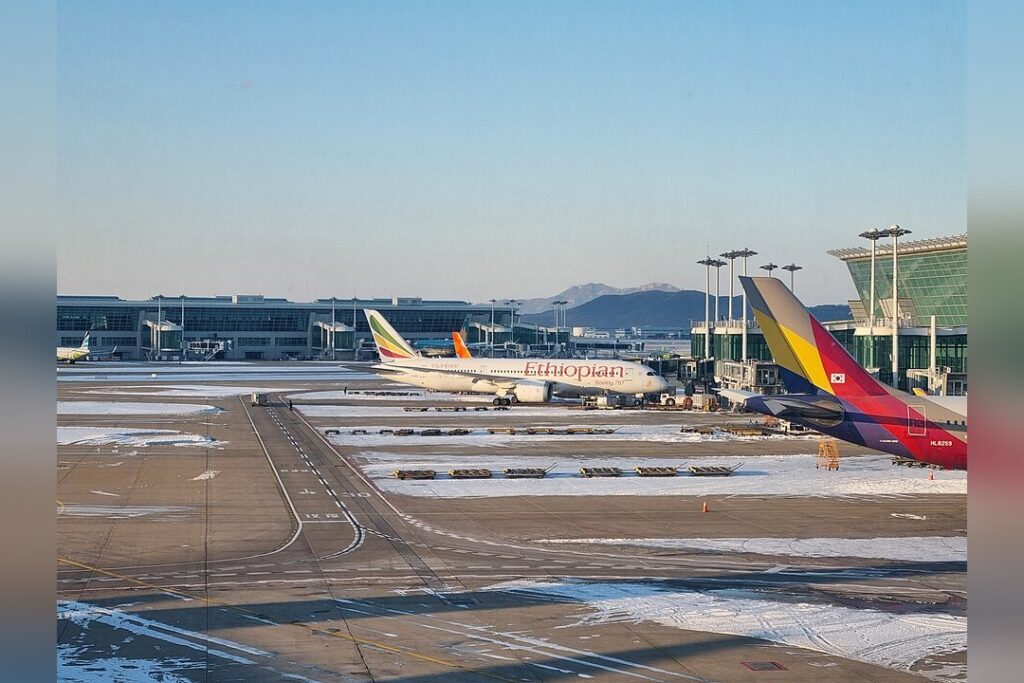
SEOUL, Sept. 4 — The story of why flying from Europe to South Korea now costs nearly 50% more than it did five years ago begins with a map and a war. Since carriers lost the right to overfly Russia, every journey between the two regions has been rewritten, adding up to three hours to each flight and pushing prices to levels that have travellers bracing before they even book.
A return flight from London to Seoul that cost around £800 in 2019 now runs between £1,150 and £1,400 for the same dates in late 2025. The mechanics are unforgiving: direct flights now take 12 to 14 hours instead of the previous 9 to 11, requiring more fuel and often extra pilots, with the costs passed straight to passengers.
Western carriers like Air France and Lufthansa must take a southern detour through Turkey, Kazakhstan, and China. Chinese carriers are the only airlines still flying the direct route over Siberia, giving them a time advantage of two to three hours. Competition has shrunk along with the shortcuts.
Virgin Atlantic pulled out of the London-Seoul route entirely because the detour made it unprofitable. Meanwhile, Korean Air is buying Asiana Airlines, and regulators forced the pair to hand some flights to a smaller airline still getting set up, reducing available seats.
New EU rules requiring airlines to use eco-friendly fuel on departures from Europe have added another layer, with that fuel costing up to five times more than regular jet fuel. At its heart, demand keeps the planes full at premium prices. Fans of K-Pop and Korean drama continue to fill seats, and the outlook offers no bargains soon; high prices are expected to stay through 2025.
For those willing to hunt, savings exist. South Korean low-cost carrier T’way Air has launched direct routes from Paris, Frankfurt, Rome, and Barcelona to Seoul Incheon, with launch fares and standard pricing running €600–800 roundtrip (approximately US$650–870), below the €1,100+ (about US$1,200) charged by Korean Air or Asiana. Routing through Warsaw via LOT Polish Airlines often saves €200–300 (roughly US$220–330) compared to departing from London, Paris, or Frankfurt.
The paperwork matters too. South Korea temporarily waived the K-ETA requirement for 22 countries including the UK, France, Germany, and the US through December 2024; for late 2025 travel, travellers must verify if the waiver was extended, and if expired, apply for K-ETA at least 72 hours before flight at a cost of 10,000 KRW (about €7, or US$7.50).
Once on the ground, the AREX Express Train runs non-stop from Incheon Airport to Seoul Station in 43 minutes for about €7 (9,500 KRW, roughly US$7.50), versus a taxi costing €40–60 (60,000–80,000 KRW, about US$43–65) and taking 70–100 minutes. What to watch next: whether the waiver extension holds, and whether T’way’s new routes force the bigger carriers to blink. For now, the premium appears baked in — geography, it turns out, is a stubborn pricing factor.




