
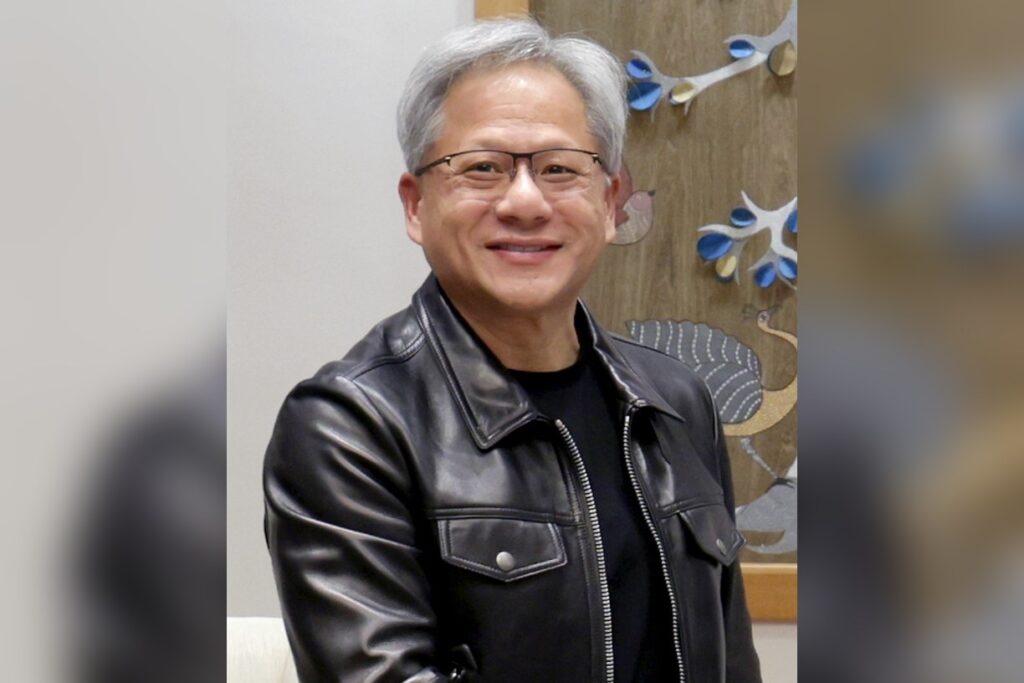
SANTA CLARA, September 20 — Jensen Huang is worth more than US$190 billion, Forbes estimates as of this month, making the Nvidia co-founder the eight-wealthiest person in the world. The bottom line: the man who runs the world’s most valuable company is also one of its richest, and the two facts are not unrelated. Huang, born February 17, 1963, in Taipei, Taiwan, is a Taiwanese and American business executive and electrical engineer.
He is the co-founder, president and CEO of Nvidia, which in October 2025 became the first company to reach a market capitalization of over $5 trillion.
From Tainan to Tacoma
His path there started in southern Taiwan. Huang moved as a child to Tainan, then at five years old to Thailand, where the family relocated for roughly four years to support his father’s refinery career. He attended Ruamrudee International School in Bangkok.
His father, Huang Hsing-tai, was a chemical engineer at an oil refinery; his mother, Lo Tsai-hsiu, was a schoolteacher. The family were native Taiwanese Hokkien speakers, and his mother each day randomly selected 10 words from the dictionary to teach her sons English.
In the late 1960s his father traveled from Taiwan to New York City to train under an air conditioning company and, after returning home, resolved to send his sons to the United States. At age nine, despite not yet speaking English fluently, Jensen was sent by his parents to live in America. He and his older brother moved in 1973 to live with an uncle in Tacoma, Washington, escaping widespread social unrest in Thailand.
What followed was an accident of paperwork with a hard edge. Both his aunt and uncle were recent immigrants to Washington state, and they mistakenly enrolled the brothers in the Oneida Baptist Institute, a religious reform academy in Kentucky for troubled youth, believing it to be a prestigious boarding school.
To afford the tuition, Jensen’s parents sold nearly all their possessions.
Kentucky, and a roommate who traded lessons
At 10 years old, Huang lived with his older brother in the Oneida boys’ dormitory. Each student was expected to work every day, and his brother was assigned manual labor on a nearby tobacco farm. Because he was too young to attend classes at the reform academy, Huang was educated at a separate public school, Oneida Elementary in Oneida, Kentucky, arriving as an undersized Asian immigrant with long hair and heavily accented English.
He was frequently bullied and beaten. In Oneida he cleaned toilets every day, learned to play table-tennis, joined the swimming team, and appeared in Sports Illustrated at age 14.
He taught his illiterate roommate, a 17-year-old covered in tattoos and knife scars, how to read in exchange for being taught how to bench press. In 2002, Huang said he remembered his life in Kentucky more vividly than just about any other period. Two years after he arrived in Oneida, his parents moved to the United States and settled in Beaverton, Oregon.
The brothers withdrew from school in Kentucky to live back with them.
Aloha High, a graveyard shift, and an Apple II
As a teenager, Huang attended Aloha High School in Aloha, Oregon, where he excelled academically. He skipped two grades, graduated at age 16, and became a nationally ranked table-tennis player in addition to being a member of its mathematics, computer and science clubs. In 1977 the school purchased an Apple II computer; Huang used the machine to play Super Star Trek, a text-based game, and to program in BASIC, creating his own version of Snake.
Beginning at age 15, Huang got his first job working the graveyard shift at a local Denny’s restaurant as a dishwasher, busboy and waiter from 1978 to 1983. After high school he chose to enroll at Oregon State University because of its low in-state tuition.
He later earned a master’s degree from Stanford University. Huang launched Nvidia in 1993 from a Denny’s restaurant in San Jose, California, at age 30, and has remained its president and CEO since. He led the company out of near-bankruptcy during the 1990s and oversaw its expansion into GPU production, high-performance computing and artificial intelligence.
The AI boom, and the argument that follows it
Under Huang, Nvidia experienced rapid growth during the AI boom. Time magazine included him in its list of the most influential people in 2021 and 2024, and in 2025 named him one of the “Architects of AI” for its Person of the Year issue. He has recently said there is a 0% chance AI destroys the world by 2030 and has argued for developing AI as fast as possible.
That claim has reignited debate over AI risk, Nvidia’s dominance, autonomous weapons and where the technology is heading.
Investors will note the distance between the




