
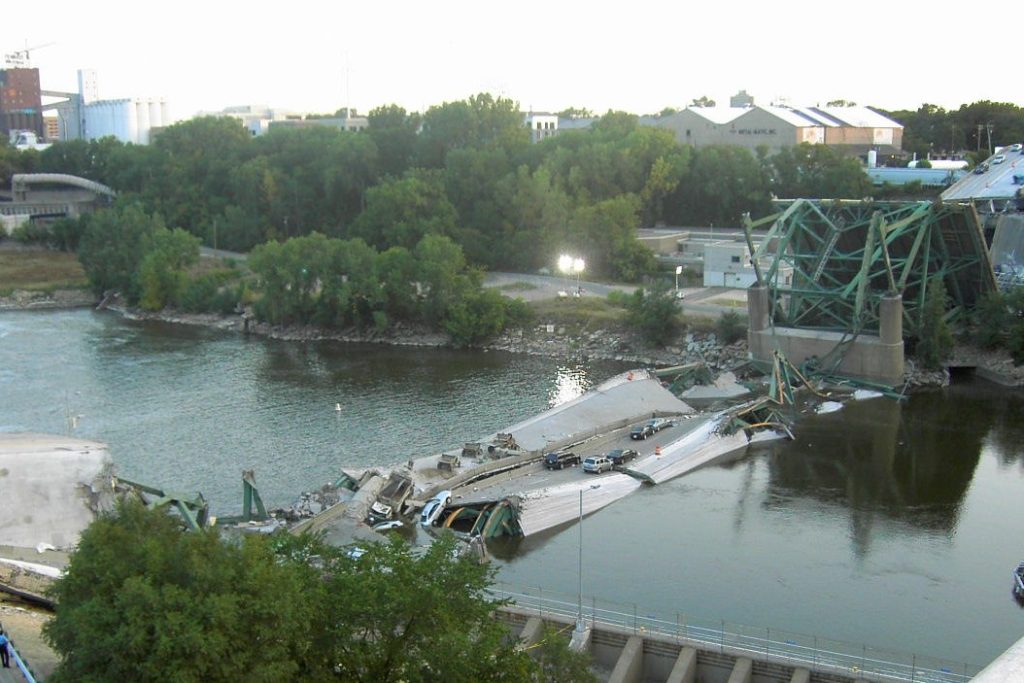
WASHINGTON, July 17 — The American Society of Civil Engineers gave US infrastructure a grade of C- in its 2021 Report Card. The detail that matters is what sits beneath that middling mark: 42% of bridges are at least 50 years old, and more than 46,000 bridges are classified as structurally deficient. The collapse of the I-35W Mississippi River bridge in Minneapolis in 2007, which killed 13 people and injured 145, highlighted the need for continuous monitoring.
That event sharpened attention on what structural health monitoring — SHM in the technical shorthand — could do to prevent the next failure. Under the hood, SHM systems deploy networks of sensors on bridges to provide real-time data on stress, vibration, and corrosion.
The US Department of Transportation’s Federal Highway Administration has promoted SHM as a tool for condition-based maintenance — shifting from scheduled inspections to monitoring that responds to actual structural condition.
The big bridges get wired
Two of America’s most famous long-span bridges are now fitted with such systems. The Golden Gate Bridge, completed in 1937, and the Verrazzano-Narrows Bridge, completed in 1964, both carry SHM arrays that provide real-time data to engineers. The technical reality is that these are not experimental setups; they are operational monitoring systems feeding into maintenance planning.
The 2021 Infrastructure Investment and Jobs Act allocated $1.2 trillion for infrastructure improvements, including funding for bridge repair and modernization. That legislation provided the financial architecture for wider deployment of SHM technology alongside traditional steel-and-concrete repairs.
Market forces and engineering logic
The market for SHM in civil infrastructure in North America is expected to grow significantly, driven by the combination of an ageing bridge stock, the political will expressed in the 2021 Act, and the demonstrated risk from past failures. The Federal Highway Administration’s endorsement of condition-based maintenance gives state departments of transportation a regulatory rationale for investing in sensor networks rather than relying solely on periodic visual inspections.
One wry observation: the same bridges that carried the post-war interstate boom are now the subjects of a high-tech retrofit, their original steelwork instrumented with accelerometers and strain gauges that would have seemed like science fiction to the engineers who built them.
What to watch next
The question now is whether the funding pipeline from the 2021 Act, combined with falling sensor costs and improving data analytics, can translate the C- grade into something better by the time the ASCE issues its next Report Card. The technical capability exists; the institutional will has been demonstrated in legislation. The detail that matters will be how quickly state transportation agencies move from pilot projects on signature spans like the Golden Gate to systematic deployment across the 46,000 structurally deficient bridges that remain.




