
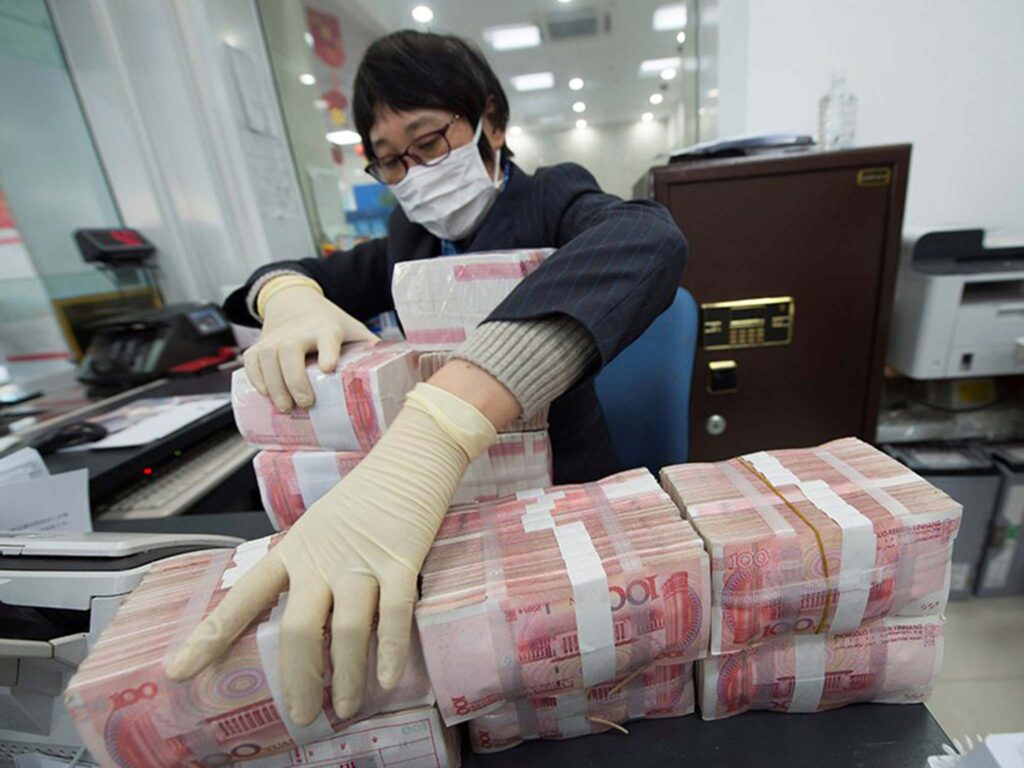
China’s central bank will shred every banknote that has passed through hospitals, fresh-food markets, or buses in the provinces worst-hit by Covid-19, the People’s Bank of China confirmed on 17 February 2020. The order, issued two weeks earlier, already pulled 7.8 billion yuan (USD 1.1 billion) out of circulation in Guangdong alone. An additional 600 billion yuan in freshly printed cash will be trucked in to keep ATMs stocked.
The move bars inter-provincial cash transfers and forces commercial banks to sterilize or quarantine remaining notes for at least 14 days. The directive covers all paper money circulating in Hubei, the epicentre of the outbreak, as well as Guangdong, Zhejiang, and Henan.
Fan Yifei, a deputy governor at the PBOC, told state media that notes deemed high-risk “will be sanitized with ultraviolet rays or heated and locked up for at least 14 days, before it is distributed again.” Bills that still fail the inspection will be destroyed immediately. Commercial banks must stamp each disinfected bundle, record serial numbers, and seal them in plastic wrap before returning the cash to the central bank. The process adds another layer of logistics to a financial system already strained by quarantines and transport bans.
The cash crackdown is the latest sign that Beijing fears the virus could stall the world’s second-largest economy. More than 50 million workers have been ordered to stay home since late January, idling factories that supply everything from iPhones to car parts.
Goldman Sachs slashed its first-quarter growth forecast for China to 2.5 %, the slowest since the Cultural Revolution. “Consumption has fallen off a cliff,” said Larry Hu, head of China economics at Macquarie Group in Hong Kong. “People aren’t going out, they aren’t spending, and now they’re being told their money might be toxic.” The service sector, which accounts for more than half of Chinese GDP, has been hit hardest.
Restaurants, cinemas, and travel agencies remain shuttered in major cities, and February box-office receipts are effectively zero. State television has aired footage of workers in hazmat suits feeding bricks of cash into high-temperature ovens, a spectacle meant to reassure citizens that the party is “leaving no stone unturned.” Yet the images have also fuelled unease. Social-media users questioned why the same government that initially silenced whistle-blowers now claims every yuan is a potential biohazard.
Censors quickly removed posts comparing the banknote bonfire to the burning of contaminated corpses during the 2003 SARS crisis. “Destroying money is dramatic, but it doesn’t fix the shortage of test kits or protective gear,” a Wuhan hospital administrator told the Daily Beast on condition of anonymity.
Critics note that the virus is primarily spread through droplets, not surfaces, and that the cash purge may be more about optics than science. To plug the coming hole in money supply, the PBOC has ordered state-run printing works in Beijing, Shanghai, and Nanchang to run 24-hour shifts. New bills will be trucked under police escort to provincial capitals, then distributed to banks that have been cleared to reopen.
The central bank insists there will be “no disruption to the money supply,” but front-line tellers report long queues as customers rush to swap old notes. Mobile payments have surged, Tencent’s WeChat Pay saw a 47 % jump in transaction volume during the first week of February, but rural residents and the elderly still rely on cash.
Farmers in Hebei complained that vegetable wholesalers now demand exact change, refusing potentially tainted notes from strangers. Beijing’s decision to incinerate its own currency highlights the lengths the Communist Party will go to maintain control of the narrative, even at the cost of monetary efficiency. While ultraviolet sterilizers and 14-day quarantines for paper money may slow viral transmission, they do little to address the structural weaknesses the outbreak has exposed: opaque data, over-centralized decision-making, and a health system that buckled under political pressure.
Until those deeper flaws are confronted, China’s economic recovery will remain as fragile as the banknotes now smouldering in Guangdong’s furnaces.




