
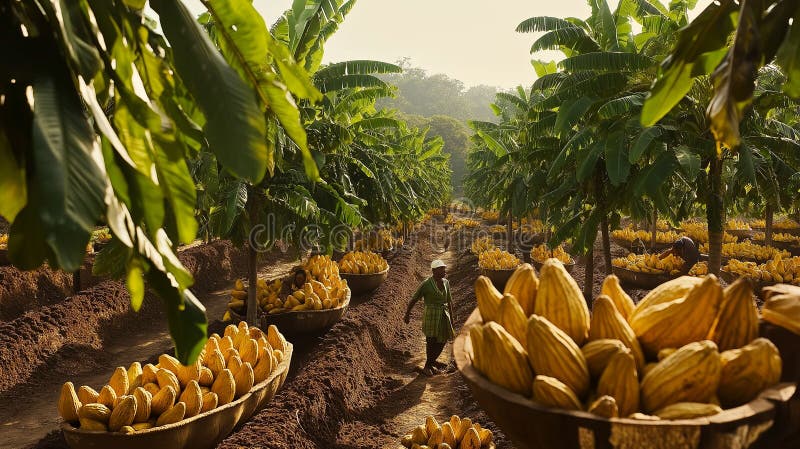
LONDON, July 25 — The cocoa bean, the dried and fermented seed of the Theobroma cacao tree, is a commodity whose supply chain is as tangled as its origins are ancient. First domesticated at least 5,300 years ago by the Mayo-Chinchipe culture in what is now Ecuador, the crop later travelled to Mesoamerica where it served as currency and in spiritual ceremonies. Today, the centre of gravity has shifted decisively to West Africa, which produces roughly 81% of the world’s crop.
Ivory Coast alone accounts for 38% of global production, with Ghana and Indonesia following. The 2024 global harvest reached 5.8 million tonnes.
The tree itself is a long-term investment: it takes five years to mature but can live up to a century. The three main varieties are Forastero, the workhorse of the industry; Criollo, a rarer, more delicate bean; and Trinitario. Cocoa beans, cocoa butter and cocoa powder are traded on futures markets — London handles West African cocoa, while New York deals with Southeast Asian product.
The technical reality of these markets is that they amplify the price volatility built into the physical supply chain.
Volatility and demand
Demand for cocoa products has grown over 3% annually since 2008. But that steady increase has been matched by sharp price swings driven by weather, disease, political instability in West Africa and speculative trading. The direct consequence of that volatility is higher costs for manufacturers.
The detail that matters here is that the price manufacturers pay at the futures desk is only partly about raw supply; the rest is a wager on the stability of producing regions. West Africa’s dominance brings its own complications.
Deforestation remains a serious concern, particularly in that region. Cocoa farming has historically expanded by clearing forest, and voluntary sustainability standards have yet to fully reverse the trend. At least 29% of global production was compliant with such standards in 2016.
Initiatives are working to encourage sustainable practices, but progress is uneven. Agroforestry — growing cocoa under a canopy of native trees — can help conserve biodiversity, but adoption is far from universal.
Economic weight and what comes next
For countries such as Nigeria, cocoa remains a significant contributor to the national economy. The bean is both a smallholder crop and a global financial instrument, a duality that makes its market uniquely sensitive to local disruption and international speculation alike. With production concentrated in politically fragile areas, the next price shock is less a question of if than when.
The story of cocoa in 2026 is one of ancient roots and modern fragility. The tree that once financed empires now depends on a patchwork of sustainability schemes and futures hedges.
What to watch: whether initiatives can move the needle on deforestation in West Africa — and whether the market’s appetite for volatility will ultimately undermine the stability of the very supply it depends on.




