
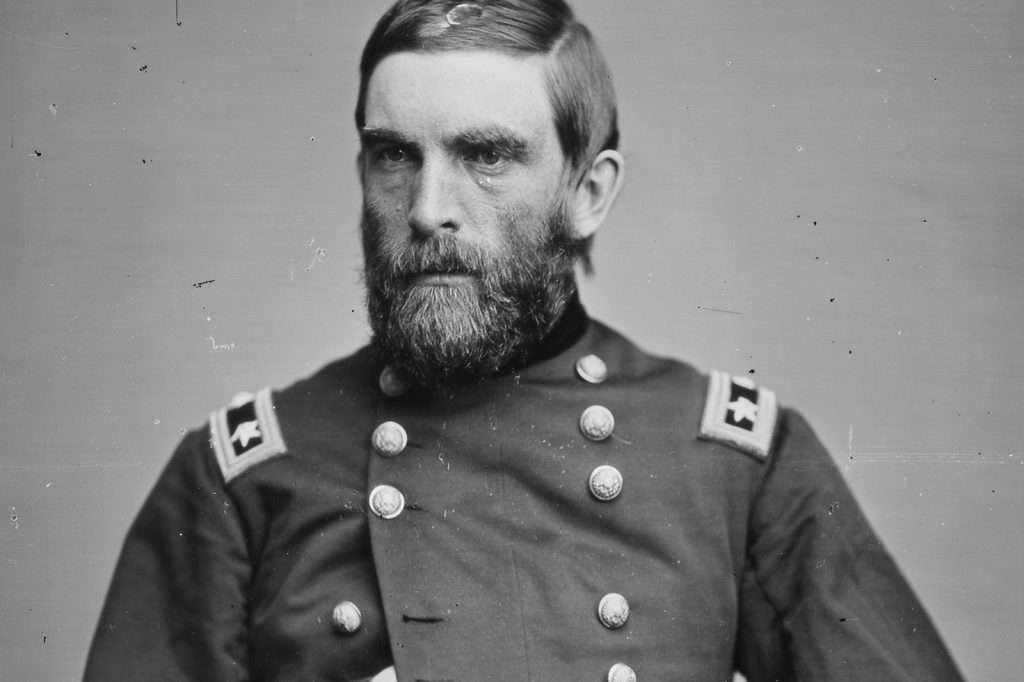
The Pacific Railroad Act of 1862, passed by Congress while the Civil War still raged, called for a continuous rail line from the Missouri River to the Pacific Ocean. That wartime measure set the eastern terminus at Council Bluffs, Iowa — a choice shaped by the political and logistical arguments of the era — but actual construction remained stalled until a former Union Army general took charge in 1866. Grenville M.
Dodge, then 35, brought the discipline of a battlefield commander to the building of the Union Pacific Railroad, and the route he surveyed through Nebraska, Wyoming, and Utah became the backbone of transcontinental freight movement.
The Engineer Who Pushed West at Record Speed
Born in 1831, Dodge served as a Union general during the Civil War before being appointed chief engineer of the Union Pacific Railroad. From 1866 to 1870, he oversaw the construction of 1,086 miles of track, pushing the line across the Great Plains and over the Rocky Mountains.
His work was not merely laying steel; it required surveying hostile terrain with tools limited to survey chains and horses, and managing a workforce of thousands of laborers. The project proceeded at remarkable speed after Dodge assumed control, transforming a legislative mandate into an operating railway just a few years after the war ended. Dodge also founded the city of Council Bluffs, which became the eastern terminus of the Union Pacific.
In plain terms, he selected the spot where the railroad would begin its journey west, turning a frontier settlement into a transportation hub that would connect the eastern rail network to the Pacific. After the railroad’s completion, Dodge served as a U.S. Representative from Iowa from 1867 to 1869.
He later worked as a consultant for other railroads, applying the lessons he learned building the transcontinental line, and in 1910 he published his memoirs under the title “How We Built the Union Pacific Railway.” Historians continue to study his survey notes and those memoirs for insights into how infrastructure decisions of the past can inform modern transportation planning.
A Railroad That Defined American Commerce
The route Dodge surveyed through Nebraska, Wyoming, and Utah transformed journeys that once took months into trips of days. The tracks carried settlers heading West, mail linking distant communities, and freight that stitched together isolated markets. Over time, the line carried grain from the Great Plains, coal from Wyoming, and manufactured goods from the Midwest, turning a single corridor into the foundation of a continent-spanning transport network.
The railroad’s growth mirrored the nation’s expansion, absorbing other major systems over the decades through the industrial consolidation that defined American business in the late 19th and early 20th centuries. Today, the Union Pacific Railroad remains a vital link in that network.
It moves goods across twenty-three states west of Chicago and New Orleans, carrying most of the country’s freight by rail over thousands of miles of track. What began as a single line built to span the continent during wartime became one of the nation’s largest rail systems through the absorption of competing railroads. The practical upshot of Dodge’s work is visible every day: when a train carries grain from the plains or goods from a West Coast port, it follows the path selected by a 19th-century engineer who defined the geography of American commerce.
The choices of one engineer, backed by federal law and built by the labor of thousands, continue to shape the movement of people and goods across the United States more than a century after his death.




