
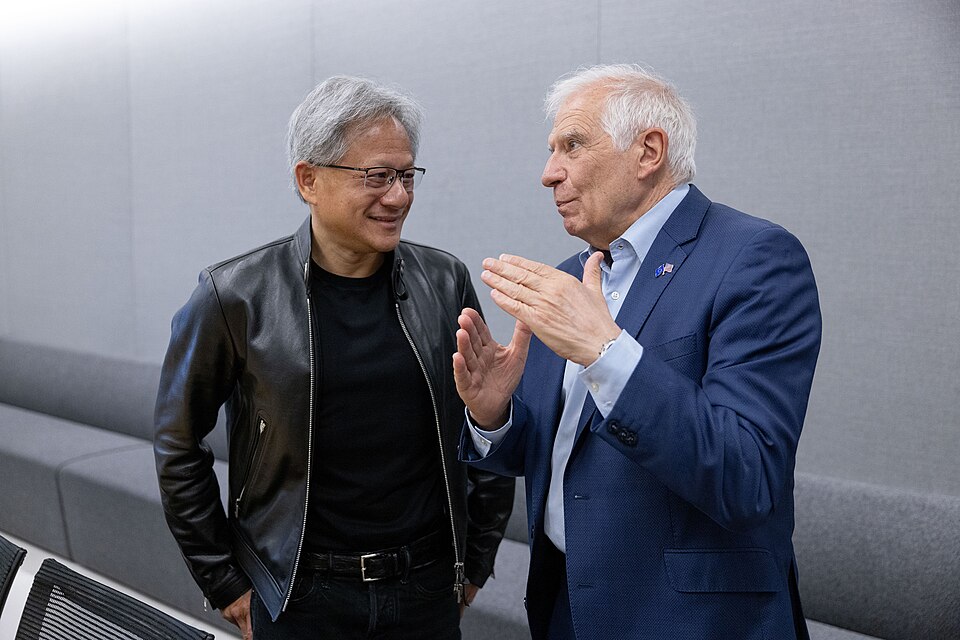
SANTA CLARA, September 20 — Nvidia chief executive Jensen Huang says there is a “0% chance” artificial intelligence destroys the world by 2030, and he wants the build-out to proceed “as fast as we can, irrespective of anyone else.” The bottom line for investors is not philosophical. Huang’s remarks, reported Sunday, read as a signal on the pace of capital spending across the AI supply chain — and they land alongside concrete demand figures that already point the same direction.
The most specific number attached to Huang’s acceleration argument is the AWS-Nvidia agreement to deliver 2 million additional GPUs and next-generation infrastructure aimed at agentic and physical AI workloads. That order of magnitude matters because Nvidia’s data-center GPUs, including the H100 — the chip widely used to train and run large AI models — sit at the center of AI capital expenditure by cloud providers.
Separately, Huang said Nvidia expects to double chip sales next year. That guidance point gives investors a direct read on the revenue trajectory underpinning the stock. Huang’s comments reject the doom warnings associated with AI safety-focused labs such as Anthropic, and they push back against calls for new regulation of the sector.
Competition and policy risk
The acceleration thesis is not without competitive and policy risk. Huawei plans a Q1 2027 launch of a new AI chip as it takes on Nvidia, a reminder that the export-control environment has spurred domestic Chinese alternatives. On the regulatory side, the political backdrop is mixed.
Reporting notes that the US president and his sons have invested heavily in the AI economy while he resists calls for a slowdown, even as safety-focused labs and some policymakers urge caution. Nvidia has also continued to expand its open-source CUDA-Q platform for fault-tolerant quantum computing, extending its software ecosystem beyond classical AI accelerators.
What to watch
The broader ecosystem is expanding in parallel. Avnet and The University of Hong Kong opened the EMUS Lab to accelerate AI innovation and commercialization in Hong Kong, while Anthropic has published work on how its Claude model is being used in biomolecular modeling — examples of the applied demand that underpins chip and infrastructure forecasts.
For investors, the key tension is between Huang’s “go as fast as we can” stance and the risk that regulation, Chinese chip competition, or a slower-than-expected enterprise adoption curve could compress the growth rate implied by doubling chip sales. Watch Nvidia’s sales guidance, the AWS GPU delivery schedule, and Huawei’s Q1 2027 chip timeline.




