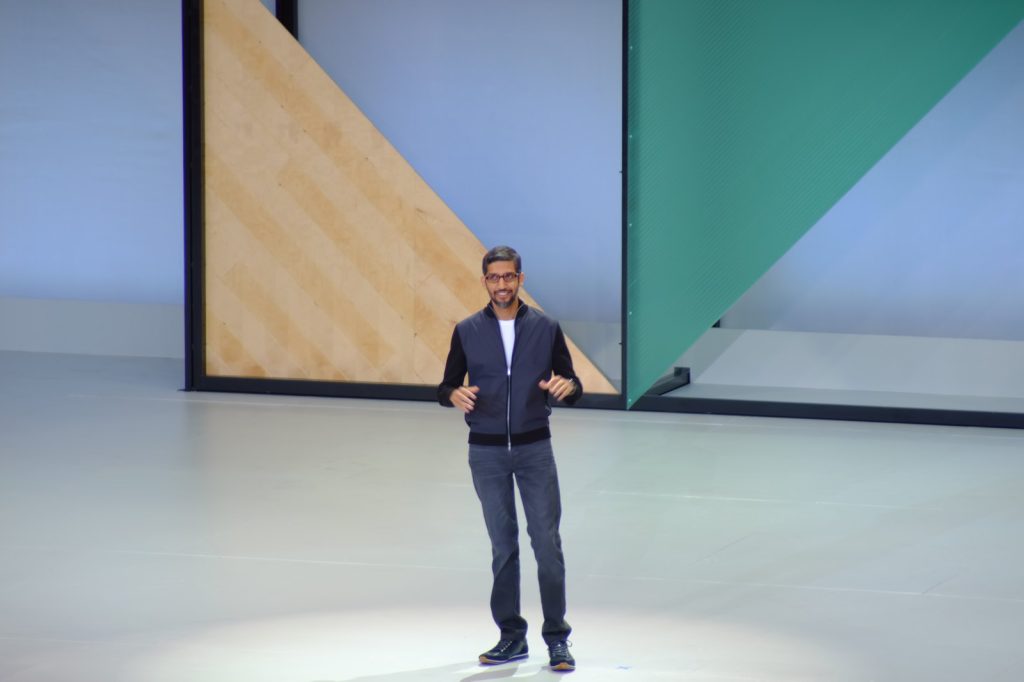
The late-1990s vision of “ambient intelligence” — technology that fades into the background like oxygen — has been sitting on a shelf for nearly three decades. At Google I/O a few weeks ago, the company took it off the shelf and put a price tag on it. The shift is not subtle.
The internet, as it has existed since the browser wars, waits for you to act. You type, you click, you choose.
Google’s new strategy throws that model away. What the company announced is a full-bore bet on anticipation over intention. Search, the cash cow built on typed queries, is being rebuilt as a system that plans, researches and acts without waiting for a user to ask.
The new glasses — built through partnerships with Samsung, Warby Parker and Gentle Monster — are the visible edge of this. They promise directions, messaging, photos and Gemini-powered assistance.
But the invisible edge is bigger. Deeper Gemini integration throughout the product line. Information agents that do not wait for a prompt.
A system that wants to see what you see, hear what you hear, read your messages and understand your calendar. The term “ambient intelligence” was coined by Eli Zelkha and colleagues at Palo Alto Ventures, working with Philips Research. Their original vision was smart homes, connected appliances, ubiquitous sensors.
The hardware was not ready. The software was not either.
Generative AI changed that. The brain is now powerful enough to make the old dream real. Smart glasses, rings, cameras, microphones and wearables are the new sensors.
The AI is the new brain. The practical consequences are already visible.
Search itself is morphing from a box into a presence. The company is not just adding AI to existing products. It is reversing the relationship between user and machine.
The user used to be the active party. The machine waited. Now the machine is becoming the active party.
It watches. It remembers.
It acts. This is not a feature update. It is a structural change in how technology relates to people.
For years, people have played with what to call this — artificial intelligence, augmented intelligence, alternative intelligence, even animal intelligence. The label matters less than the direction.
The direction is toward a system that does not need to be told what to do because it has already inferred the task from your location, your calendar, your messages and your history. The privacy implications are obvious. A system that sees everything, hears everything and remembers everything is a system that collects everything.
Google’s announcement did not offer details on how the ambient model handles consent, data retention or opt-out. The old model — you open a browser, you type a query, you make a choice — gave the user control by design. The new model takes control by design.
It anticipates. Anticipation requires data.
Lots of it. The glasses are the most visible symbol of this shift, but they are not the most significant part. The most significant part is that the company has committed to ambient intelligence as a consumer product strategy, not a research phrase.
That means the technology will be pushed into the market at scale. The old dream of technology that disappears into the environment is now a product roadmap.
The question is whether people are ready to live in that environment.