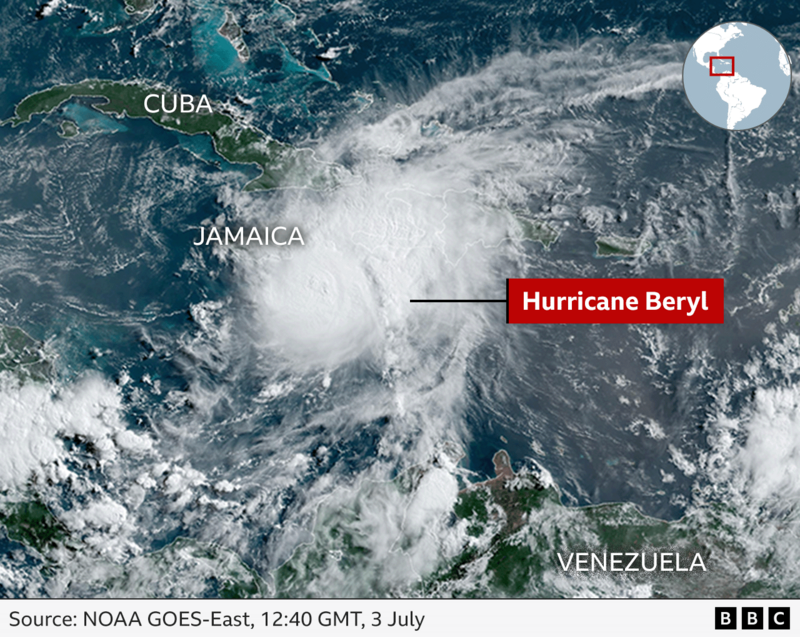
Hurricane Beryl, an extremely rare and destructive tropical cyclone, has been impacting parts of the Caribbean, the Yucatán Peninsula, and the Gulf Coast of the United States in late June and early July 2024. As the second named storm, first hurricane, first major hurricane, and first Category 5 hurricane of the 2024 Atlantic hurricane season, Beryl has broken many meteorological records, primarily for formation and intensity.
The system originated from a tropical wave that left the coast of Africa on June 25. After forming on June 28 in the Main Development Region, it began rapidly intensifying as it moved west through the central tropical Atlantic. This rapid intensification is a notable characteristic of Hurricane Beryl, making it a significant storm to monitor. On July 1, Beryl made landfall on the island of Carriacou, Grenada, as a Category 4 hurricane, causing significant damage to the region.
Hurricane Beryl’s intensity is a major point of interest, as it is one of only two Atlantic hurricanes to reach Category 5 hurricane status in July, along with Emily in 2005. This categorization is based on the Saffir–Simpson scale, which is used to measure the intensity of hurricanes. Beryl’s achievement of reaching Category 5 status in July is a rare occurrence, highlighting the storm’s unusual characteristics.
Furthermore, Beryl is both the earliest-forming Category 4 and Category 5 hurricane on record in the Atlantic Ocean. This distinction underscores the storm’s unusual formation and intensification patterns. Additionally, Beryl is the strongest hurricane to develop within the Main Development Region of the Atlantic before the month of July, further emphasizing its remarkable nature.
Impact and Records
The impact of Hurricane Beryl on the regions it has affected cannot be overstated. The significant damage caused by the storm, particularly on the island of Carriacou, Grenada, is a testament to its destructive power. As the storm continues to move through the region, it is essential to monitor its progress and prepare for any potential consequences. The records broken by Hurricane Beryl, including its early formation and intense categorization, will likely be the subject of further study and analysis in the field of meteorology.
As of July 15, 2024, the situation with Hurricane Beryl remains dynamic, with the storm continuing to affect various regions. Looking ahead, it is crucial to watch for further updates on the storm’s trajectory and intensity. The next few days will be critical in determining the storm’s impact on the Gulf Coast of the United States and other affected areas. As the 2024 Atlantic hurricane season continues to unfold, Hurricane Beryl serves as a reminder of the importance of monitoring and preparing for severe weather events.