For the first time, scientists have captured a clear picture of our own galaxy in the light of neutrinos—ghostly particles that streak across the universe virtually unimpeded. The IceCube Collaboration announced today that its detector, buried deep in the Antarctic ice at the Amundsen-Scott South Pole Station, has found compelling evidence of high-energy neutrino emissions originating from the Milky Way.
This detection marks a watershed moment for neutrino astronomy. While telescopes have mapped the galaxy in visible light, radio waves, and X-rays for decades, neutrinos offer a completely different view. They are produced in some of the most violent processes in the cosmos—like supernova remnants, collapsing stars, and the roiling environments around black holes. Because neutrinos barely interact with matter, they travel in straight lines from their source, carrying information from places no ordinary light can escape.
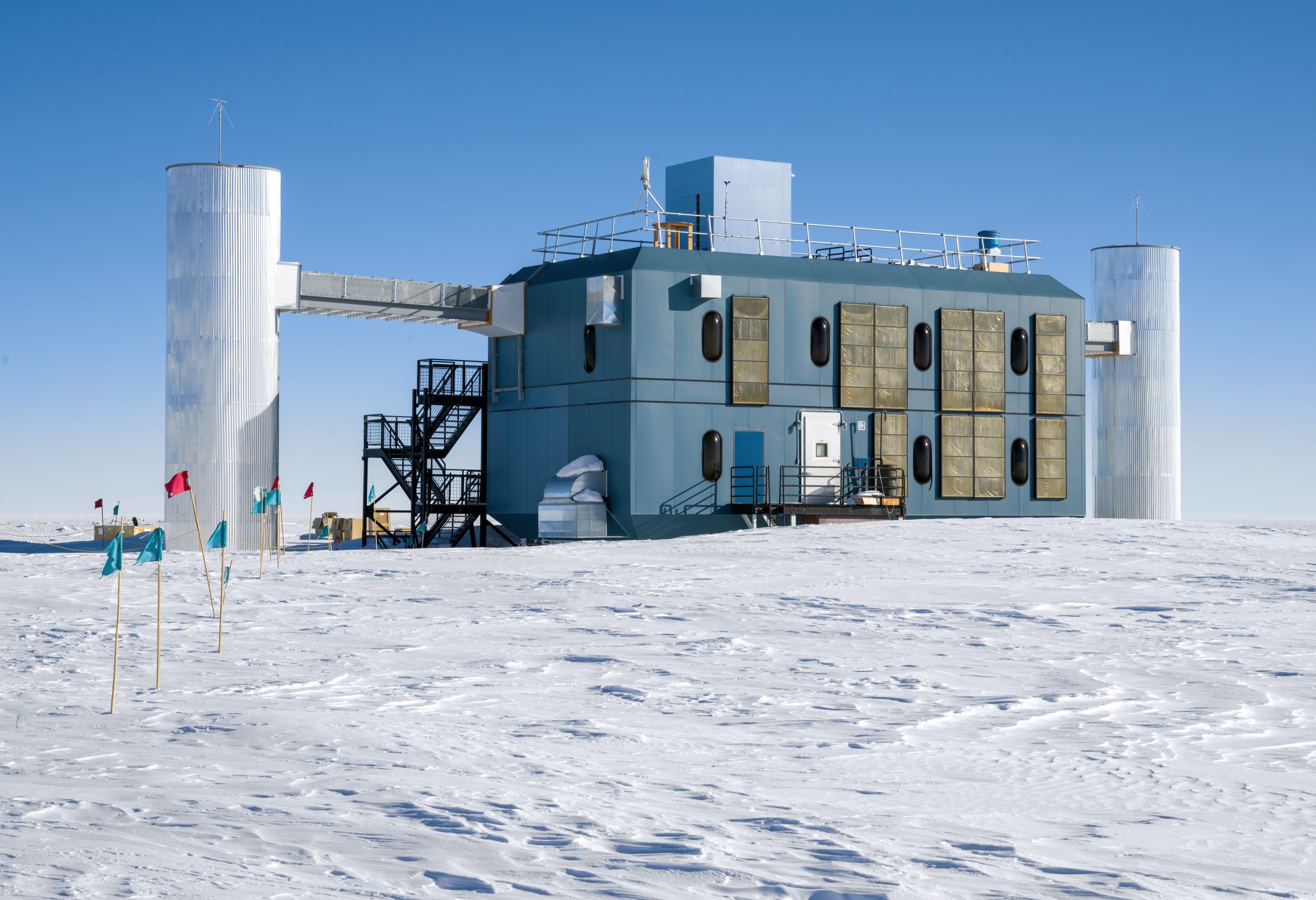
The IceCube Neutrino Observatory, a project developed by the University of Wisconsin–Madison and recognized as a CERN experiment, is uniquely built for this hunt. Its thousands of spherical optical sensors, called digital optical modules, are frozen into a cubic kilometer of Antarctic ice. Each sensor contains a photomultiplier tube and a single-board computer, waiting for the faint flash of blue light that occurs when a neutrino occasionally slams into an ice molecule. The data then streams up to a counting house on the surface, where scientists piece together the particle’s origin.
What the collaboration found was not a single bright point in the sky, but a diffuse glow—a steady drizzle of neutrinos coming from the plane of the Milky Way. This emission is the combined signal of countless sources across our galaxy, from ancient stellar remnants to the turbulent galactic center. The detection required years of data and sophisticated analysis to separate the faint galactic signal from a background of neutrinos created when cosmic rays strike Earth’s atmosphere.
The achievement is a direct payoff of IceCube’s scale and design. Its predecessor, the Antarctic Muon And Neutrino Detector Array (AMANDA), proved the concept could work, but IceCube’s cubic-kilometer volume gives it the sensitivity needed to catch enough of these elusive particles. The observatory has already detected neutrinos from distant active galaxies and a flaring blazar, but seeing our own galaxy in this new light is a different kind of milestone—it means we can now study the Milky Way’s most extreme environments with a messenger that carries unfiltered news from the heart of the action.
For astronomers, this opens a new window onto the high-energy universe. Neutrino emissions can pinpoint sites where particles are accelerated to energies far beyond what any human-built collider can achieve. By combining neutrino maps with data from gamma-ray and radio telescopes, researchers can start to untangle which cosmic accelerators are responsible for the galaxy’s most energetic particles. The IceCube team is already planning upgrades to the detector, aiming to increase its sensitivity and resolve individual neutrino sources within the galactic glow.
The South Pole, with its clear, cold ice and stable conditions, remains the perfect place for this work. The detector runs year-round, watching the entire sky as Earth rotates beneath it. With today’s result, the collaboration has shown that the Milky Way is not just a swirl of stars and gas to our eyes—it is also a steady, ghostly beacon of neutrinos, waiting to tell us more about the forces that shape our cosmic home.