
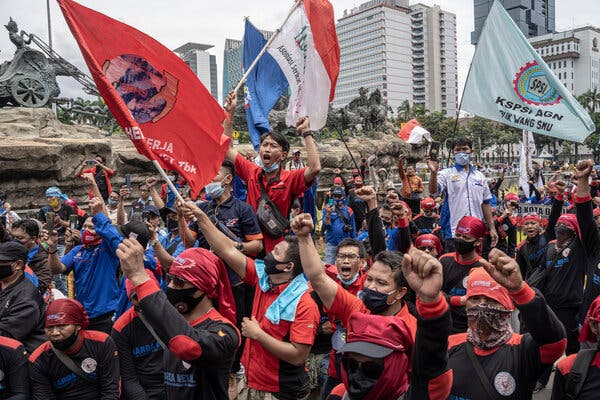
Indonesia’s $24 billion coronavirus relief package is insufficient to prevent mass layoffs, analysts warned on April 5, 2020. The government announced the Rp 405 trillion stimulus on March 31, but experts said it must cover healthcare, social protection, and economic programs, diluting its impact. With 70 million informal workers and a rising COVID-19 caseload, the package may not stop millions from losing their jobs.
President Joko Widodo unveiled the stimulus on March 31, 2020, removing the budget deficit cap, cutting corporate taxes, and distributing cash aid to 20 million poor households. The total value of Rp 405 trillion, or $24.2 billion, is meant to cushion the economic blow from the pandemic.
But analysts said the sum is not dedicated solely to economic relief. Portions will go to healthcare and social safety nets, spreading the funds thin. “But if the government wants to do both, 405 trillion rupiah is not enough.
Many sectors have been greatly impacted by the outbreak, particularly informal workers and small businesses,” said Bhima Yudhistira of the Institute for Development of Economics and Finance. Indonesia’s economy relies heavily on the informal sector.
About 70 million people, out of a population of 270 million, work without formal contracts or benefits. These workers have little to no savings and no access to unemployment insurance. A lockdown or slowdown in demand can wipe out their income overnight.
Rising job losses and government expectations
The government’s own planning suggests it expects severe job losses. The cash aid program targets 20 million beneficiaries, up from previous social assistance schemes. Analysts said this number is a signal of the anticipated damage.
“The fact that the government is increasing the number of beneficiaries for the incentives and cash aids to 20 million showed that the government is expecting a worst-case scenario that there would be 20 million people who will be laid off,” said Ari Kuncoro, an economics professor at the University of Indonesia. As of April 3, 2020, Indonesia had reported more than 1,700 confirmed COVID-19 cases and 170 deaths.
The outbreak has disrupted supply chains, reduced consumer spending, and forced businesses to shut down. The rupiah weakened by 13% in March alone, reflecting investor anxiety and capital outflows. The package includes tax breaks for corporations, but critics said those benefits may not reach workers.
Companies could use the savings to stay afloat rather than retain staff. Small businesses, which employ most informal workers, may not qualify for corporate tax cuts.
Prioritizing healthcare over economic stimulus
Some economists argued that the government should focus its resources on containing the virus first. Without controlling the outbreak, economic stimulus will fail to revive activity. “We should put all of our resources to address the root cause of the problem, COVID-19.
Other expenditures can be done later,” said economist Sutrisno Iwantono. Indonesia’s healthcare system is under strain.
Hospitals in Jakarta and other major cities have reported shortages of protective equipment and testing capacity. The government has allocated funds for medical supplies and hospital upgrades, but experts said the amount may not be enough. Senior economist Didik Rachbini of the Institute for Development of Economics and Finance stressed that containment is the key to recovery.
“If the virus goes out of control, our healthcare system will be overwhelmed and we will spend more money to treat people,” he said. A delayed or inadequate response could lead to higher infection rates, longer lockdowns, and deeper economic damage.
That would require even larger stimulus packages later, compounding the fiscal burden.
The challenge of protecting informal workers
Informal workers are the most vulnerable group in this crisis. They include street vendors, drivers, domestic helpers, and day laborers. Many live hand-to-mouth and cannot afford to stay home.
Social distancing measures are hard to enforce when people must work to eat. The government’s cash aid program is meant to reach 20 million households, but analysts questioned whether it will reach the right people.
Indonesia’s social welfare database is incomplete and outdated. Many informal workers are not registered. Bhima Yudhistira said the package should include direct transfers to informal workers, rent relief, and loan moratoriums.
Without such measures, layoffs will accelerate. The package also includes a Rp 150 trillion allocation for state-owned enterprises and corporate tax cuts.
Critics said that money could be better spent on direct support for workers and small businesses.
The economic toll so far
The rupiah’s 13% decline in March 2020 is a symptom of broader economic stress. Foreign investors pulled money out of Indonesian bonds and stocks. The central bank intervened to stabilize the currency, but the pressure remains.
Indonesia’s economy grew at its slowest pace in years before the pandemic. The outbreak has pushed it toward a possible recession.
Tourism, manufacturing, and trade have all suffered. Exports fell as global demand collapsed. The government has revised its budget deficit target to 5.07% of GDP, up from a previous cap of 3%.
That gives it room to borrow more, but also raises concerns about debt sustainability. The $24 billion package is large by Indonesian standards, but it must cover multiple fronts.
Healthcare, social protection, and economic stimulus compete for the same funds. Analysts said the government may need to increase spending or reallocate resources more aggressively. The coming weeks will test whether the package can slow the rise in unemployment.
For now, the outlook remains grim.




