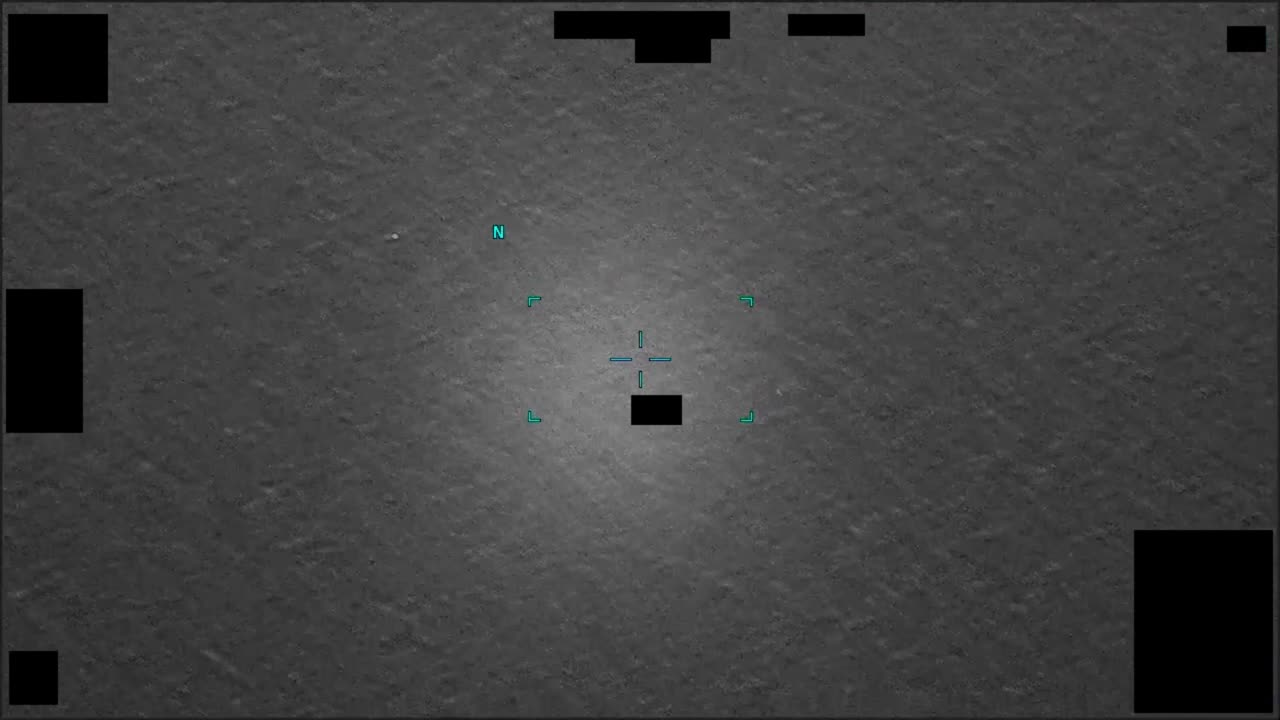
Captain I. Powell banked his Constellation hard over the Atlantic.
At 4 p.m. on August 4, 1947, the Pan American Airways pilot was 9,000 feet up, pushing 266 mph out of Gander, Newfoundland, toward La Guardia Field. What he and his navigator, Mr. White, saw on the right side of the aircraft—slightly below them—was not a cloud, not a jet, and not a rocket.
It was bright orange. Cylindrical. Blunt at both ends. About the length of a P-40 fuselage.
Powell banked for a better look. He got 50 seconds.
The object sat roughly a mile away, altitude estimated at 7,800 feet. Course: 200 degrees magnetic. Speed: roughly 160 mph.
Powell told investigators the thing had “a definite shape.” He was explicit on one point: there was no gaseous dispersion. If the orange glow came from a rocket or a jet exhaust, the air around it would have shown something—trails, smoke, distortion. It did not.
The year 1947 matters. That summer, the UFO phenomenon broke open in the United States. Kenneth Arnold’s Mount Rainier sighting in June had already put “flying discs” into every newspaper. The military was scrambling. The FBI was collecting reports.
This was one of them.
The document—released under the PURSUE program and designated 65_HS1-834228961_62-HQ-83894_Serial_130—covers the FBI’s UFO case files from June 1947 through July 1968. Serial 130 is a single incident embedded in a 21-year archive of official concern.
What is at stake in a 50-second sighting by a commercial captain?
Credibility. Powell was not a hobbyist with a camera. He was an airline captain flying a Constellation—a four-engine workhorse carrying passengers over the North Atlantic. His navigator saw the same object. Two trained professionals, cross-checking each other’s instruments and eyes, reported the same shape, color, altitude, and speed.
The FBI interviewed Powell. The document includes that interview in detail. It also includes eyewitness testimonies and public reports collected across two decades.
The object’s course was 200 degrees magnetic—roughly south-southwest. Powell was flying the opposite direction, toward New York. The object was below him, off to the right, moving slower than his own aircraft. He had time to bank, to observe, to estimate distance and size. He had time to rule out the obvious.
Not a balloon. Not a plane. Not a meteorological phenomenon.
The 1947 sightings triggered a federal response that has never fully stopped. The Air Force launched Project Sign, then Grudge, then Blue Book. The CIA got involved. The FBI kept files. Serial 130 is one piece of that paper trail—a document that exists because someone in government decided this was worth recording, filing, and keeping for decades.
Powell’s report landed in that system. It was investigated. It was filed. It was classified. And now it is public.
The document runs 20.5 MB. The PDF viewer in some browsers cannot open it. The file must be downloaded. That is the physical reality of a 70-year-old government record—big, clunky, real.
What Powell saw at 4 p.m. on August 4, 1947, remains unidentified. The FBI file does not solve it. It does not explain it away. It records what a captain and his navigator saw, what they told investigators, and what the government chose to keep.
That is the point. The stakes are not about aliens. They are about whether a professional eyewitness—a man flying a plane full of people—can report something anomalous and have that report treated as fact rather than dismissed as error.
Powell said the object had a definite shape. He said it was not gaseous. He said it was orange, cylindrical, blunt at both ends. He said it was one mile away, moving at 160 mph, at 7,800 feet.
The FBI wrote it down.