
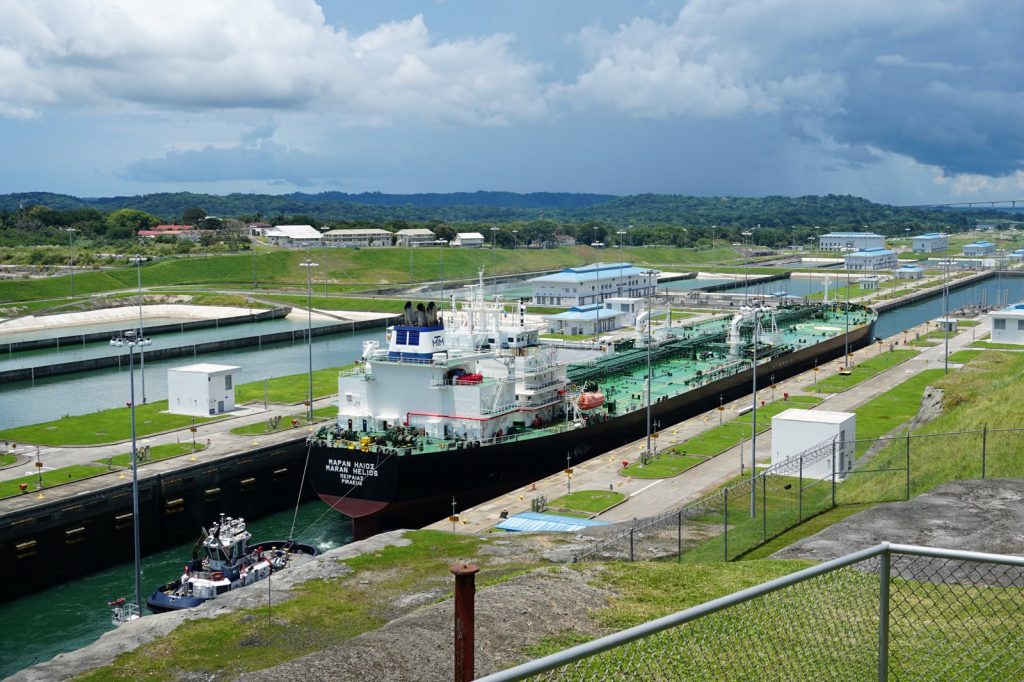
PANAMA CITY, July 10 — The 2016 expansion of the Panama Canal stands as one of the largest single infrastructure undertakings in modern Latin American history, and the record shows its origins trace directly to a national referendum held on October 22, 2006. Panamanian voters approved the project with 76.8 percent in favor, according to official election returns. The vote authorized the construction of what is formally known as the Third Set of Locks Project, a $5.25 billion effort that would fundamentally alter global shipping routes through the isthmus.
Construction began in 2007 and stretched across nine years. The project added a new lane of traffic to the existing canal, anchored by two new lock complexes: the Agua Clara Locks on the Atlantic side and the Cocolí Locks on the Pacific side.
Each complex contains three chambers, and together they allow the transit of Neopanamax vessels—ships up to 1,200 feet in length, 160 feet in beam, and with a draft reaching 50 feet. The scale of construction was considerable. The project used 4.4 million cubic meters of concrete.
Engineers also built water-saving basins that recycle 60 percent of the water used per lockage.
Doubling capacity and reshaping trade
The expansion doubled the canal’s overall capacity. Before the project, the original locks could handle container vessels carrying up to 5,000 TEUs—twenty-foot equivalent units, the standard measure for container ship capacity. The new locks raised that ceiling to 14,000 TEUs.
Each new lock chamber measures 1,400 feet long, 180 feet wide, and 60 feet deep. Those dimensions were specifically designed to accommodate the post-Panamax generation of ships that had been unable to transit the original canal.
The expanded canal officially opened on June 26, 2016, with the transit of the COSCO Shipping Panama.
Engineering and political context
The project represented the most significant modification to the canal since its original completion in 1914. The new locks use a different system than the original 1914 locks. Rather than the miter gates and gravity-fed filling system of the old design, the new locks employ rolling gates and a system of lateral basins that capture and reuse water.
Looking ahead
The canal’s ability to handle Neopanamax vessels has made it a central node in the global supply chain for containerized goods moving between Asia and the U.S. East Coast. The 2016 project, by any measure, remains the defining infrastructure achievement of modern Panama—a sovereign state’s bet on its own geography, approved by its own voters, and built on a timeline that stretched nearly a decade from referendum to first transit.
{“@context”: “https://schema.org”, “@type”: “NewsArticle”, “headline”: “Panama Canal’s 2016 Expansion Adapted to Mega-Ships”, “description”: “PANAMA CITY, July 10 — The 2016 expansion of the Panama Canal stands as one of the largest single infrastructure undertakings in modern Latin American…”, “datePublished”: “2026-07-10T09:30:00+00:00”, “author”: {“@type”: “Person”, “name”: “Ariel Antonio”}, “publisher”: {“@type”: “Organization”, “name”: “InfoPulse Today”, “url”: “https://newsfeed.infopulsetoday.com/”}}




