Singapore began trialing robot police patrols in public housing estates on October 6, 2021, deploying two autonomous wheeled machines to monitor foot traffic and deter crime in the Toa Payoh neighborhood. The Home Team Science and Technology Agency (HTX) launched the pilot to test how robots can assist human officers with routine surveillance, freeing them for more complex tasks.
What the robots do
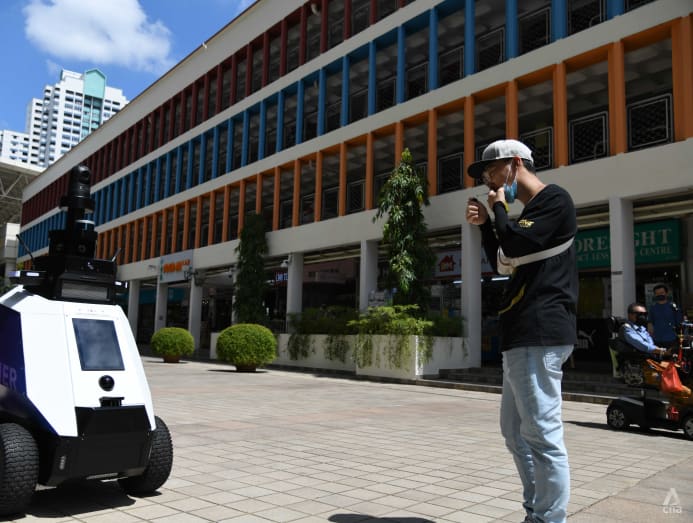
The robots, named Xavier, are equipped with 360-degree cameras and sensors. They patrol designated routes in Toa Payoh Central, a busy area with shops and residential blocks. The machines broadcast recorded messages reminding the public to observe COVID-19 safe distancing measures, such as keeping one meter apart. They also detect prohibited activities like smoking in no-smoking zones, illegal parking, and loitering.
HTX explained that the robots are not autonomous in the sense of making decisions. They relay live video feeds to a command center where human operators review alerts. If the robot spots a potential violation, an officer can speak through the robot’s speaker to issue a warning or dispatch a nearby patrol.
“The robots are designed to augment our officers, not replace them,” said a spokesperson for HTX. “They handle repetitive patrol tasks so our people can focus on higher-value work like community engagement and responding to incidents.”
How the public reacted
Residents and shopkeepers in Toa Payoh had mixed reactions. Some welcomed the extra security, especially during late hours. Others expressed unease about constant surveillance. A 62-year-old resident told local media that the robot felt “intrusive” but admitted she understood the need for safety measures.
The government emphasized that the trial was limited in scope and duration. Data collected would be used to refine the system, not to build a permanent surveillance network. HTX also noted that the robots do not use facial recognition technology, addressing privacy concerns head-on.
“We are taking a measured approach,” said an HTX official. “Public feedback is critical. We want to ensure that any future deployment balances safety with privacy.”
Technical specs and limitations
The Xavier robots are roughly the size of a small golf cart. They move at walking speed and can navigate curbs, ramps, and pedestrian crossings. Each robot runs on batteries that last about eight hours before needing a recharge. They are weather-resistant but are not designed for heavy rain or extreme heat.
The trial ran for three weeks in October 2021. HTX monitored performance metrics including detection accuracy, battery life, and public interaction. Early results showed the robots could effectively identify common violations like illegal parking, but struggled with ambiguous situations such as crowded areas where multiple people were moving at once.
“We learned that the robots work best in predictable environments,” the HTX spokesperson said. “In chaotic settings, human judgment remains essential.”
Broader implications for smart cities
Singapore has long positioned itself as a leader in smart city technology. The robot patrol trial fits into a larger strategy of using automation to address labor shortages and aging infrastructure. The city-state faces a declining workforce and rising demand for public safety services. Robots offer a scalable solution for routine tasks like patrolling, cleaning, and inspection.
Other countries are watching closely. Japan has deployed robots in shopping malls and train stations. The United States uses drones and ground robots for perimeter security. Singapore’s approach is notable for its focus on public housing estates, which house about 80% of the population. This makes the trial directly relevant to everyday life.
“Singapore is showing how robots can integrate into dense urban environments,” said a technology analyst at the National University of Singapore. “The key is transparency and public trust. If people feel involved in the process, adoption becomes smoother.”
The robots are not a silver bullet. They cannot chase suspects or intervene in physical altercations. But they can serve as a visible deterrent and a force multiplier for stretched police resources. The trial also generated valuable data on how humans and machines can cooperate in public spaces.
The Toa Payoh pilot ended on schedule in late October 2021. HTX plans to analyze the results and decide whether to expand the program to other estates. No timeline has been announced for a wider rollout.
What began as a three-week experiment in a single neighborhood has already sparked conversations about the future of policing, privacy, and automation. The robots rolled quietly through the streets, broadcasting reminders and recording footage. They did not replace anyone. They simply showed what is possible when technology meets public service.