
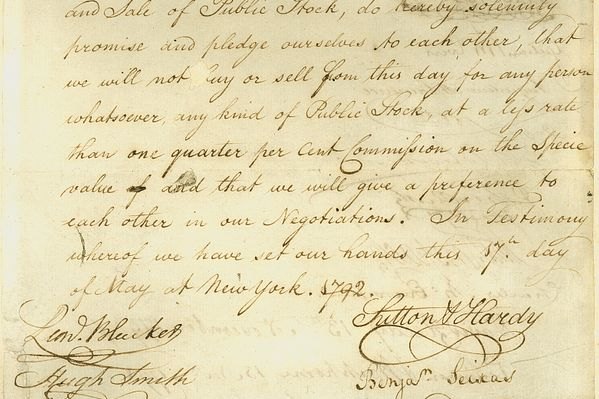
The Buttonwood Agreement: A Tree and a Closed Network
The setting was unassuming—a buttonwood tree on a city street in Lower Manhattan. But the rules laid out in that document provided the structure for a market that would eventually dominate global finance. Early trades focused on government war debt and a handful of bank stocks. The small group of brokers operated under the agreement’s terms until 1817, when they studied the Philadelphia exchange and adopted formal governance. That year, the group organized as the New York Stock & Exchange Board. It took its current name, the New York Stock Exchange, in 1863.
The closed network gave the brokers control over pricing and access, insulating them from competition and creating a concentrated pool of liquidity. This arrangement attracted more business as the young nation’s economy expanded. The electrical telegraph later linked distant traders to Wall Street, helping New York outpace rival financial centers during periods of financial panic. A competing board emerged in the mid-1860s, but the NYSE consolidated its lead and by the early 20th century had become the world’s largest stock exchange by market capitalization.
The 24 original brokers could not have predicted the $25 trillion market cap that would follow. But the rules and structure they created—fixed commissions, exclusive membership, and a central location—built the foundation for that growth. The exchange’s position as the center of American capitalism has remained unchallenged for more than two centuries.
From Government Bonds to Global Dominance
The exchange’s evolution from a tree-side meeting to a global institution was not automatic. After formalizing its board in 1817, the NYSE began trading a growing range of securities. The adoption of the telegraph in the mid-1800s allowed prices to travel faster than ever before, giving New York an edge over older markets like Philadelphia and Boston. During financial panics, when other exchanges shut down, the NYSE’s disciplined membership structure often kept trading alive, reinforcing investor trust.
By the early 20th century, the exchange had become synonymous with American capitalism. Its trading floor on Wall Street became a symbol of national economic power. The NYSE’s market capitalization grew steadily, reflecting the expansion of American industry and the rise of publicly traded corporations. That growth continued through wars, depressions, and technological shifts, with the exchange adapting by listing new types of securities and attracting companies from around the world.
In 2023, the NYSE reported a market capitalization of over $25 trillion, with more than 2,400 listed companies. That figure makes it the largest stock exchange in the world by market cap—a direct result of the system established in 1792.
The Modern NYSE and Its Reach
Today, the exchange is owned by Intercontinental Exchange (ICE), which acquired it in 2013 for $8.2 billion. That purchase brought the 221-year-old institution under the umbrella of a modern electronic exchange operator, merging its historic physical trading floor with cutting-edge digital technology. The Buttonwood Agreement itself is long gone as a governing document, but its core principles—standardized commissions, member exclusivity, and a central marketplace—live on in the exchange’s operations.
The NYSE’s influence extends well beyond Wall Street. A large portion of American households hold investments tied to its listed companies through retirement accounts, mutual funds, and other savings vehicles. Movements in the exchange affect household wealth and the cost of capital for businesses nationwide. When the NYSE rises or falls, it directly impacts the financial security of millions of families, from 401(k) balances to pension funds.
The 24 brokers who gathered under the buttonwood tree in 1792 could not have foreseen the $25 trillion market or the global reach of their creation. But they built the rules and structure that made it possible—and the exchange continues to operate as the world’s largest stock market by capitalization, more than two centuries later.
{“@context”: “https://schema.org”, “@type”: “NewsArticle”, “headline”: “Buttonwood Agreement: The Tree That Grew Wall Street”, “description”: “The Buttonwood Agreement: A Tree and a Closed Network The setting was unassuming—a buttonwood tree on a city street in Lower Manhattan. But the rules…”, “datePublished”: “2026-07-14T09:30:00+00:00”, “author”: {“@type”: “Person”, “name”: “Sophie King”}, “publisher”: {“@type”: “Organization”, “name”: “InfoPulse Today”, “url”: “https://newsfeed.infopulsetoday.com/”}}




