
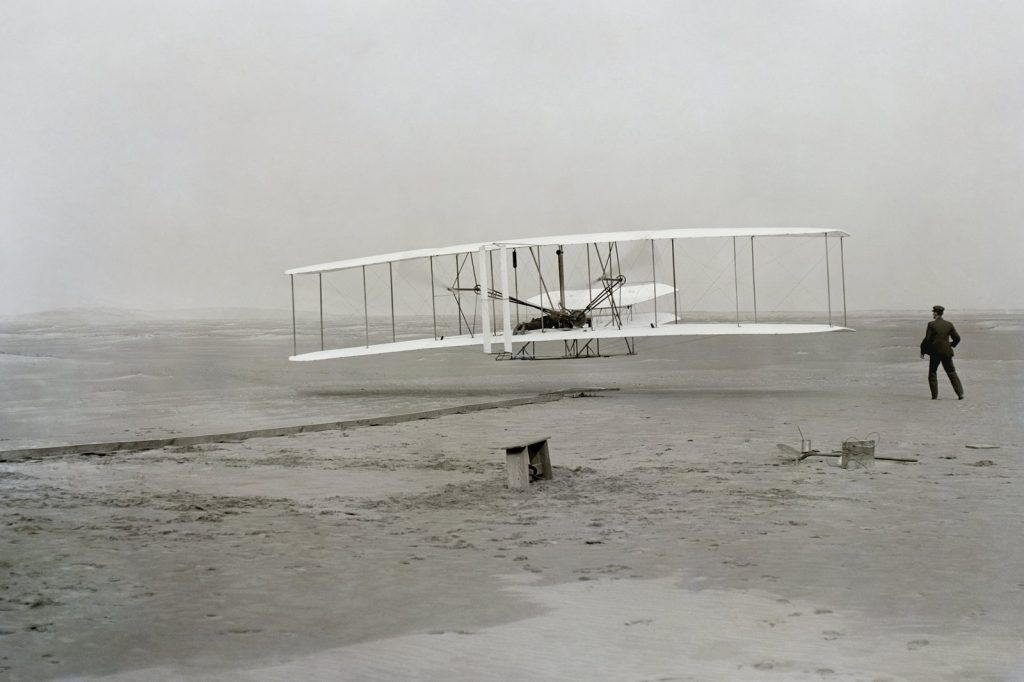
LONDON, July 10 — The technical reality of powered flight, from the Wright Flyer’s 120-foot hop to the Airbus A320’s fly-by-wire computers, is a story of incremental engineering breakthroughs punctuated by occasional leaps. As of mid-2026, the industry is wrestling with two such potential leaps: electric propulsion and hydrogen combustion, neither yet mature enough to retire the kerosene turbine. The history of aviation spans over a century since Orville and Wilbur Wright’s first powered flight on December 17, 1903, at Kitty Hawk, North Carolina.
The Wright Flyer traveled 120 feet in 12 seconds. That modest distance set in motion a chain of technical accelerations.
By 1909, Louis Blériot had crossed the English Channel. By 1914, the first scheduled airline service had begun in Florida. The detail that matters here is the speed of iteration: from a 12-second flight to a cross-Channel crossing in six years.
Wars as Accelerators
World War I, from 1914 to 1918, spurred the development of dedicated fighter and bomber aircraft. The interwar period delivered Charles Lindbergh’s solo transatlantic flight in 1927, the introduction of the DC-3 in 1935, and the first jet engine patent, filed by Frank Whittle in 1930. Whittle’s design took years to reach production, but the principle remains under the hood of every jet engine today.
World War II, from 1939 to 1945, produced the first operational jet fighter, the German Messerschmitt Me 262, and the American B-29 Superfortress. The Me 262’s engines were unreliable and short-lived, but the concept was proven.
The B-29 pushed the boundaries of what a production aircraft could do.
The Jet Age Arrives
The post-war era brought commercial jet travel. The de Havilland Comet entered service in 1952. The Boeing 707 followed in 1958, establishing the swept-wing, podded-engine configuration that still dominates the skies.
The 1960s saw supersonic flight. The Concorde first flew in 1969 and was retired in 2003.
The SR-71 Blackbird, a reconnaissance aircraft, cruised at high altitude. The Boeing 747, first flown in 1969 and introduced into service in 1970, revolutionised mass air travel. Its four engines and large capacity made long-haul flights economically viable for the first time.
Modern Systems
Modern aviation features fly-by-wire systems, first introduced on the Airbus A320 in 1987. Under the hood, fly-by-wire replaces mechanical linkages with electronic signals, allowing computers to prevent the pilot from exceeding the aircraft’s structural limits. Composite materials, such as the carbon-fibre fuselage of the Boeing 787, which first flew in 2011, reduce weight and improve fuel efficiency.
The Airbus A380, the world’s largest passenger jet, first flew in 2005. Its large capacity was aimed at hub-to-hub routes, but airlines shifted to smaller, more efficient aircraft, and production ended in 2021.
What Comes Next
Current efforts focus on sustainable aviation fuels, which can be blended with conventional jet fuel and burned in existing engines without modification. The chemistry works; the challenge is scaling production to meet global demand. Urban air mobility — small, electric vertical-takeoff-and-landing aircraft for short city hops — is in development with several prototypes flying, but certification and air-traffic integration remain unresolved.
Electric and hydrogen-powered aircraft are in the prototype phase. Hydrogen produces only water vapour when burned, but storing it as a cryogenic liquid requires heavy, insulated tanks.
Battery-electric propulsion is limited by energy density. The technical reality is that neither technology will replace the turbine on long-haul routes this decade. The Wright brothers’ 12-second flight in 1903 led, within 66 years, to a supersonic airliner and a large jumbo jet.
The next 66 years may produce something that does not burn kerosene at all. The detail that matters will be in the engineering.




