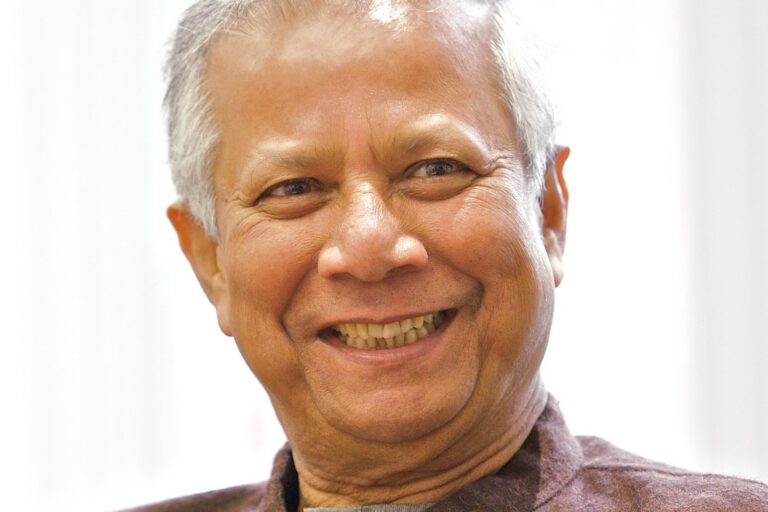
DHAKA, November 2, 2026 — Muhammad Yunus took charge of Bangladesh in August 2024 with the moral authority of a Nobel laureate and the mandate of a student uprising. Two years later, his interim government handed over a country still counting its dead from mob violence and its shuttered garment factories, a record that reads less like a rescue than a stress test of what microcredit fame can and cannot buy in national politics.
The mechanics here are worth tracing from the start, because the end of the story was set before the beginning was public.
The Banker Who Lent to the Poor
Yunus was born on 28 June 1940 in Hathazari, Chittagong, the third of nine children. He studied at Chittagong Collegiate School and Chittagong College, took a BA from the University of Dhaka, taught at Chittagong College, and then left for the United States to earn a PhD in economics at Vanderbilt University.
The famine of 1974 pulled him back toward a problem economists usually described from a distance. He began experimenting with microfinance in the late 1970s, and in 1983 Grameen Bank was established. The model, small loans to borrowers with no collateral, spread to about 100 developing countries and even to developed economies including the United States.
The Nobel Peace Prize came in 2006, for founding Grameen Bank and pioneering microcredit and microfinance. The Presidential Medal of Freedom followed in 2009 and the Congressional Gold Medal in 2010. He served as chancellor of Glasgow Caledonian University from 2012 to 2018 and sat on the board of the United Nations Foundation from 1998 to 2021. For four decades, his reputation was built on the premise that credit, carefully placed, could reorganise a poor household’s future.
The Call That Came Early
On 5 August 2024, Sheikh Hasina fled Bangladesh as the July Uprising, which began as a student-led anti-quota agitation, overwhelmed her government. President Mohammed Shahabuddin gave Yunus a mandate to form an interim government, acceding to calls from Students Against Discrimination. Yunus became the fifth chief adviser, serving from 2024 to 2026.
The catch is in the timeline. According to Shafiqul Alam, Yunus’s former press secretary, student leaders approached Yunus two days before Hasina’s ouster, on 5 August 2024. Alam, then AFP’s Dhaka bureau head, wrote on Facebook on 28 October that his colleague Qadaruddin Shishir, then editor of AFP’s Dhaka fact-check team, acted as the bridge. “It was Shishir who first approached the 2006 Nobel Peace Prize winner on behalf of the student leaders and facilitated the initial talks between the two parties,” Alam wrote.
Alam’s account suggests discussions about who would lead a post-Hasina administration were under way while Hasina’s government still held power. He wrote that Hasina would remain in power two more days, yet her security apparatus “never caught a whisper of it.” The claims, published more than two years later, do not by themselves establish the full extent of the planning or the involvement of those named; there was no immediate response from Shishir, according to the Hindustan Times. But they reframe the handover: not a spontaneous answer to a street revolt, but a contact made in advance, through a news agency’s fact-check desk.
Law and Order Unravels
The government Yunus assembled inherited a security apparatus in collapse. What followed, on his watch, was an escalation in mob violence that the interim administration did not bring under control, according to a report in The Diplomat cited by India Tribune. The violence ran from lynchings over blasphemy allegations to attacks fuelled by personal vendettas and attempts to grab property, and extended to vandalism of shrines, newspaper offices, cultural organisations, national monuments and Liberation War memorials, along with the exhumation of bodies from graves.
Two cases crystallised the concern: the killing of 38-year-old Wahiduzzaman Shamim in Satkhira in southwest Bangladesh on blasphemy allegations, and an attack on a charitable maternity clinic in Dhaka.
The numbers are the part a finance reader should sit with. Data from the Human Rights Culture Foundation, cited by The Diplomat, recorded 537 incidents of mob violence between 1 January and 17 October this year, leaving 256 dead and 575 injured, against 428 incidents in 2025 and 169 in 2024. Dhaka-based rights body Ain o Salish Kendra counted 171 killed in mob violence from 1 January to 30 September this year, with 198 incidents in 2025 and 128 in 2024. Methodologies differ, but the direction does not: 2024 was the baseline, and each year since has been worse.
The interim government remained in power until February 2026. A BNP-led elected government under Prime Minister Tarique Rahman took office after the 13th parliamentary elections that month. The mob violence did not stop with the handover, and BNP leaders and workers have themselves been accused of involvement in property grabbing, including the attack on the government-run maternity centre in Dhaka.
The Garment Floor
Follow the money and it leads to the factory floor. The ready-made garment industry is the backbone of Bangladesh’s export earnings and a major source of foreign exchange, employing millions, particularly women from poor backgrounds. During Yunus’s tenure, hundreds of RMG factories were shut down or laid off, causing industrial unrest, economic uncertainty and mounting operational difficulty. Millions of workers lost their jobs, and the damage spread to suppliers, transport operators, small businesses and local markets tied to the trade.
The cost is not only output. Factory closures threaten household incomes, social security and poverty reduction across entire communities. For an economy that needs to accelerate growth and create jobs, repeated unrest in industrial zones discourages both domestic and foreign investment. The new government now faces the task of restarting viable closed plants and restoring confidence, as The Asian Age argued this week.
What the Tenure Leaves Behind
Yunus’s interim government did more than manage a crisis. It appointed a Constitutional Reform Commission and a National Consensus Commission to draft revisions to the constitution, and it was to hold the 2026 general election and a constitutional referendum on the July Charter alongside that vote. His name was listed in The 500 Most Influential Muslims in 2024, and in 2025 Time named him one of its 100 Most Influential People in the World.
On closer reading, the record splits cleanly. The man who built a bank on the premise that the poor repay their debts presided over a state where the basic machinery of law and order failed, and where the country’s largest export industry shed millions of jobs. The Nobel was earned in villages; the verdict on the interim government is being written in police blotters and factory ledgers. The BNP government elected in February 2026 now owns both problems.
Sources
- Muhammad Yunus
- Bangladesh regime change: AFP journalist contacted Yunus even before Hasina's exit
- Sheikh Hasina's regime change planned days before her ouster, Yunus aide claims – Connected to India News I Singapore l UAE l UK l USA l NRI
- Yunus aide says Bangladesh student leaders reached out two days before Hasina's ouster
- Mob violence, lynchings and land grabs expose Bangladesh's worsening law and order situation
- It Warrants Quick Inquiries Why Industrial Disruptions Are Happening So Frequently | The Asian Age Online, Bangladesh
Photo: University of Salford Press Office (CC BY 2.0)