
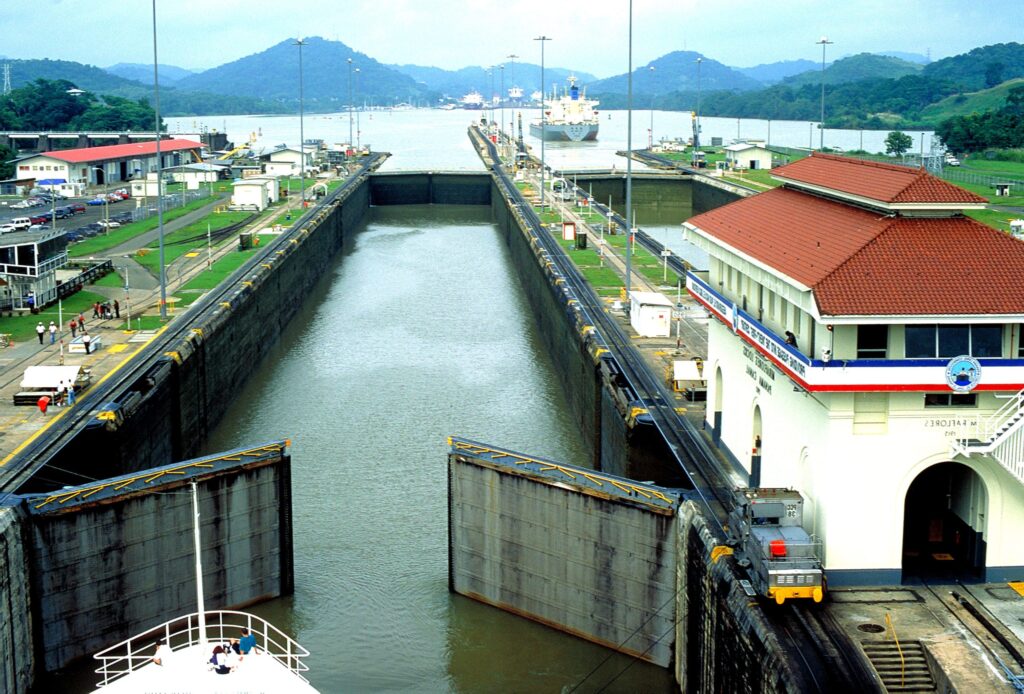
PANAMA CITY, July 8 — A decade after the Panama Canal expansion opened, the massive engineering project continues to reshape global trade routes in ways its builders could only have imagined. The Third Set of Locks, which began construction in 2007 and opened on June 26, 2016, added a new lane of traffic with larger locks capable of handling Neopanamax ships. The numbers tell a story of transformation.
Before the expansion, the original Panamax limit was 5,000 twenty-foot equivalent units, or TEUs. The new locks can handle ships carrying up to 14,000 TEUs.
That jump — nearly tripling capacity per vessel — has fundamentally changed how goods move between Asia and the U.S. East Coast. The canal’s toll revenue climbed from $1.9 billion in 2015 to $3.3 billion in 2022, reflecting the increased traffic and larger ships transiting the waterway. Shipping costs between Asia and the U.S. East Coast dropped by up to 30% after the expansion, savings that ripple through supply chains and ultimately affect what consumers pay for everything from electronics to furniture.
Engineering on an epic scale
The Panama Canal Authority, a government agency, built the expansion at a cost of $5.25 billion — well above the original budget of $3.2 billion. The project faced delays and cost overruns, challenges that are common in megaprojects of this magnitude. The new locks measure 427 meters long, 55 meters wide, and 18.3 meters deep.
Workers poured 4.4 million cubic meters of concrete during construction. To put that in perspective, that’s enough concrete to build a sidewalk stretching from Panama City to New York and back — though the canal authority never made such a comparison.
The sheer scale of the undertaking required moving earth and rock on a level rarely seen in civil engineering. The expansion doubled the canal’s capacity and now allows it to handle 90% of the world’s container ships. That statistic matters for global trade patterns.
Before the expansion, many large container ships had to sail around Cape Horn or through the Suez Canal to reach the U.S. East Coast, adding days or weeks to transit times.
Water: the hidden constraint
Each ship passing through the locks consumes about 200 million liters of fresh water from Gatun Lake. That water is lost to the ocean with every transit. The canal operates entirely on fresh water — unlike the Suez Canal, which uses seawater — making it vulnerable to drought conditions that have periodically affected operations.
The Panama Canal Authority has invested in water conservation measures and reservoir projects to ensure the canal can continue operating at full capacity. Climate patterns in the region have become less predictable in recent years, adding uncertainty to the canal’s long-term water supply.
For shipping companies, the expansion opened new possibilities. A container ship leaving Shanghai can now reach Savannah, Georgia, or Norfolk, Virginia, in about the same time it once took to reach Los Angeles — and at lower cost. That has shifted port investment patterns along the U.S. East Coast, with ports from New York to Charleston deepening their harbors and upgrading cranes to handle the larger Neopanamax vessels.
Looking ahead
The canal faces competition from other routes and projects. The Suez Canal offers an alternative for Asia-to-Europe trade. Arctic shipping routes, while still limited by ice conditions, are opening as the climate warms.
And some analysts have discussed the possibility of a new canal through Nicaragua or Colombia, though no such project has moved beyond the planning stage. For now, the Panama Canal expansion stands as one of the largest infrastructure projects completed in the 21st century.
The Panama Canal Authority continues to manage the waterway, adjusting tolls and operations to maintain its competitive position in global shipping. The next decade will test whether the expansion’s benefits can be sustained amid changing trade patterns and environmental pressures.
{“@context”: “https://schema.org”, “@type”: “NewsArticle”, “headline”: “Panama Canal’s $5.25B Expansion Doubled Capacity in 2016”, “description”: “PANAMA CITY, July 8 — A decade after the Panama Canal expansion opened, the massive engineering project continues to reshape global trade routes in ways…”, “datePublished”: “2026-07-08T09:30:00+00:00”, “author”: {“@type”: “Person”, “name”: “James Roberto”}, “publisher”: {“@type”: “Organization”, “name”: “InfoPulse Today”, “url”: “https://newsfeed.2bme.xyz/”}}




