
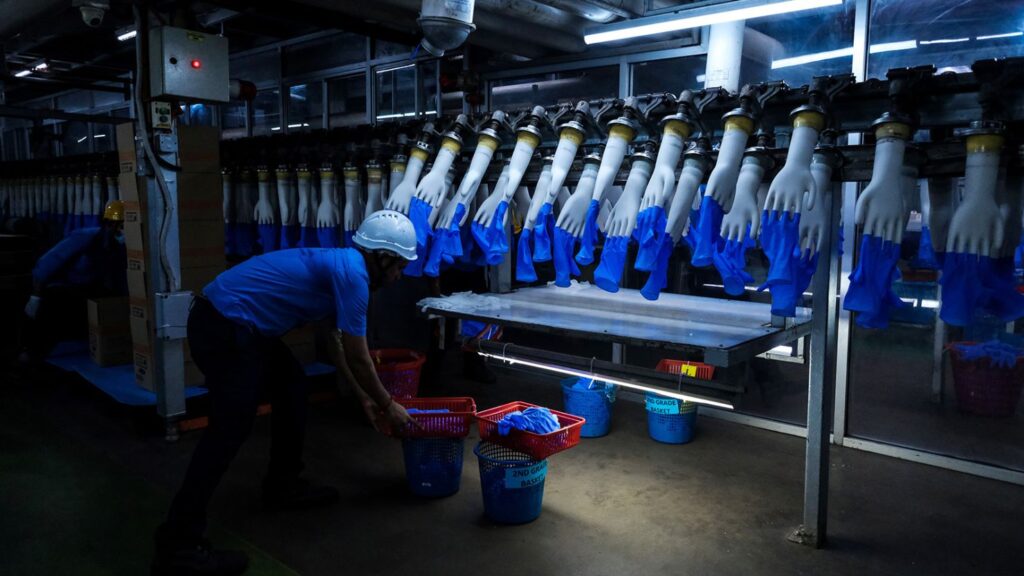
Malaysian factories that make disinfectants, hand sanitizers and rubber gloves are running short of raw materials and labour after global demand jumped as much as five-fold in the four weeks since the Communist Party admitted that the new coronavirus was spreading inside China. The country, which supplies roughly one in every five medical gloves used worldwide, has told overseas buyers that shipments will be delayed beyond the originally promised February dates because ethanol, plastic bottles and even cartons are stuck in virus-locked Chinese ports.
Ethanol, the 70 per cent germ-killing agent in most hand rubs, is no longer arriving from the Chinese provinces of Jiangsu and Shandong. Freight forwarders stopped booking trucks after local authorities imposed a 14-day quarantine on drivers returning from the worst-hit cities.
Yew Chiun Wing, managing director of ENC Nationwide, a chemical processor in Klang Valley, said his tanks ran dry on 10 February and the next cargo is at least three weeks away. “They ask for 500 litres and when I say no, I can’t, I get scolded for not helping them,” Yew told reporters, adding that callers from the northern states of Kedah and Kelantan have dialled him directly because pharmacies are empty.
The company normally sells 20 000 litres of sanitizer a month; last week alone it fielded requests for 100 000 litres. Plastic accessories are equally scarce.
Bottle caps and trigger sprayers that Malaysian plants usually import from Shenzhen and Dongguan plants are stranded after those factories were ordered to stay shut beyond the Lunar New Year. Encik Yew said he has resorted to washing and re-using containers returned by hospitals, a practice the health ministry tolerates only under emergency rules issued on 7 February.
Glove makers stretch every shift
Top Glove Corporation Bhd, the world’s largest rubber glove producer, operates 47 factories near Kuala Lumpur and normally runs them on 24-hour cycles. Executive Chairman Lim Wee Chai said output is capped not by latex, which Malaysia buys from Thailand, but by a labour pool thinned by the same travel curbs China uses to suppress the virus. “We are short about 1 000 workers because new recruits from Nepal and Bangladesh cannot enter the country after Beijing pressured Kuala Lumpur to suspend visa-on-arrival for Chinese nationals,” Lim explained.
The firm has asked retired packers to return on temporary contracts and is paying existing staff double-time to work the Muslim weekend. Even so, Lim expects a backlog of 1.5 billion pieces by the end of March.
Ninety-seven per cent of Top Glove’s production is exported to 195 countries, with China, Hong Kong, Singapore and Taiwan ordering first. The company shipped 70.5 billion gloves in 2019; Lim says 2020 volume could top 80 billion if Beijing keeps ordering at the current pace. Smaller competitors are faring worse.
Kossan Rubber Industries Bhd told the stock exchange on 18 February that it has stopped taking spot orders and will honour only contracts signed before 31 January. “We are effectively on allocation,” said group managing director Lee Kuang Seng.
“Every extra carton we send to Wuhan means a hospital in Europe waits another week.”
Price spikes and export curbs
Wholesale prices for instant hand sanitizer have doubled to 28 ringgit (US$6.70) a litre, according to the Malaysian Pharmaceutical Society, while the Malaysian Rubber Glove Manufacturers Association reports that average glove prices climbed 15 per cent in the first half of February. The association has urged members to freeze further increases, warning that hoarding could invite government intervention.
Kuala Lumpur has so far resisted the export bans imposed by Indonesia on masks and by Vietnam on rice, but customs officers at Port Klang have begun inspecting every container labelled “disinfectant” to ensure paperwork matches cargo. A senior official at the Ministry of International Trade and Industry, speaking on condition of anonymity because he was not authorised to talk to media, said the government is “monitoring the situation hourly” and could impose quotas if shortages hit local hospitals.
Ripple effects across region
The strain in Malaysia is already being felt in markets that depend on its medical supplies. Australia’s National Medical Stockpile, revealed on 19 February that orders placed in late January will arrive two weeks late. India, which imports 800 million gloves a month from Malaysia, has asked Delhi-based suppliers to certify that shipments are not diverted to China.
Even Japan, normally self-sufficient in hygiene chemicals, has turned to Kuala Lumpur after Chinese ethanol shipments were cancelled. Back inside Malaysia, public anger is rising.
Photos of empty shelves in Kuala Lumpur pharmacies circulated on Facebook over the weekend, prompting opposition politician Khoo Poay Tiong to demand that the government release national stockpiles. “If the Communist Party had been honest about the outbreak from December, we could have ordered raw materials earlier,” Khoo told reporters on 19 February, echoing a growing sentiment that Beijing’s early cover-up is now punishing smaller economies. Whether Malaysian plants can catch up depends on how long China keeps its chemical plants idle.
Until then, factory managers like Yew Chiun Wing will keep fielding calls they cannot satisfy, and hospitals from Sydney to San Francisco will wait a little longer for the basic protection they once took for granted.




