
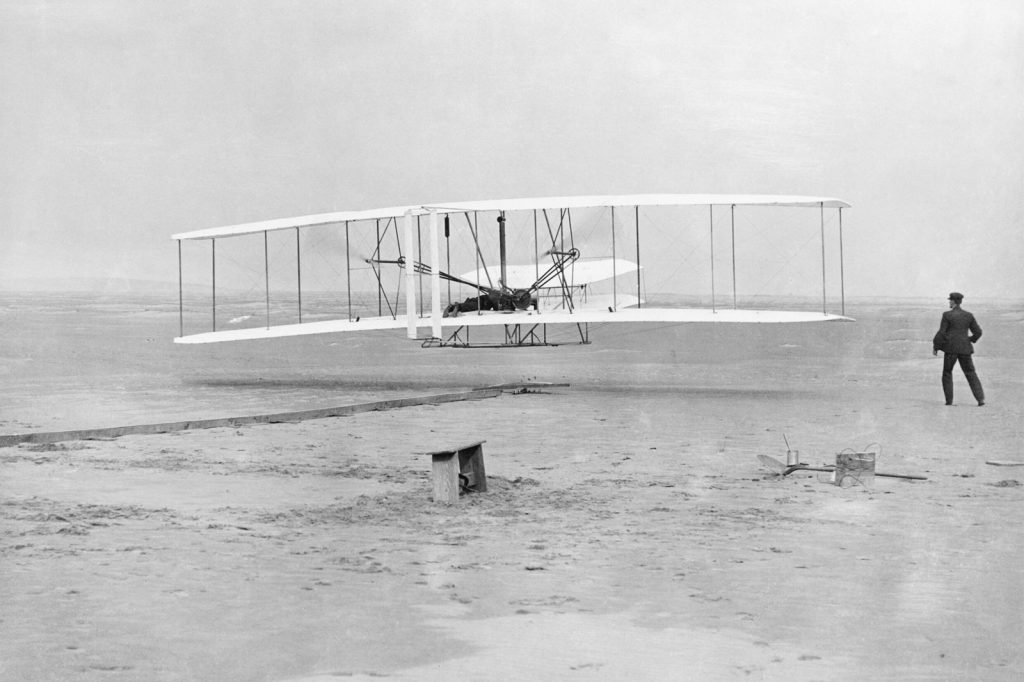
SINGAPORE, July 8 — From a flight over a windy beach in North Carolina to electric planes quietly lifting off from regional airports, the story of aviation is one of steady, human-powered breakthroughs. For communities across Asia, where island chains and mountain ranges have long made travel a challenge, each of these milestones has quietly reshaped what it means to connect with one another. The journey began on December 17, 1903, when the Wright brothers achieved the first powered flight.
It was a modest hop, but it proved that heavier-than-air machines could leave the ground under their own power. Just six years later, on July 25, 1909, Louis Blériot crossed the English Channel.
For families in the Philippines, Indonesia, or Malaysia — nations of thousands of islands — that first crossing of open water hinted at a future where the sea would no longer be a barrier. The first scheduled airline flight took place on January 1, 1914, between St. Petersburg and Tampa, Florida. It was a single route, but it planted the seed for the networks that now connect small cities across Asia to global hubs.
Then, on June 15, 1919, John Alcock and Arthur Brown made the first nonstop transatlantic flight. They flew through fog and ice, navigating by the stars, and proved that the Atlantic could be crossed without stopping.
Charles Lindbergh’s solo transatlantic flight on May 21, 1927, captured the world’s imagination. He flew alone from New York to Paris, and suddenly the airplane was not just a machine — it was a symbol of individual courage and global possibility. For people in rural areas of Thailand or Vietnam, the idea that a single person could fly across an ocean was extraordinary.
The sound barrier fell on October 14, 1947, when Chuck Yeager piloted the Bell X-1 beyond Mach 1. The sharp crack of that breakthrough echoed through research labs and air forces around the world. It meant that speed was no longer a limit — and that aviation could push into realms once reserved for science fiction.
Jet travel for everyone The De Havilland Comet began commercial jet service on May 2, 1952. It was the first jet airliner, and it cut travel times dramatically.
For families across Asia, this meant that a journey from Manila to Hong Kong, which once took a full day, could now be measured in hours. The Boeing 707 first flew on December 20, 1957, and it became the workhorse that made international travel accessible to a broader public. The era of mass air travel had truly begun.
Then came the Concorde, which first flew on March 2, 1969. It was a supersonic marvel, capable of crossing the Atlantic in under four hours.
While it never served routes across Asia directly, its existence pushed the entire industry to think about speed in new ways. On February 22, 1987, the Airbus A320 took to the skies for the first time. It introduced fly-by-wire technology, replacing mechanical controls with electronic signals.
This made flying safer, smoother, and more efficient. For pilots training in India or China, fly-by-wire meant that aircraft could handle complex maneuvers with greater precision, reducing the risk of human error. The Boeing 787 Dreamliner first flew on December 15, 2009.
Built largely from composite materials, it was lighter and more fuel-efficient than previous aircraft. Its long range and passenger comfort features — larger windows, higher cabin pressure, improved humidity — were designed for the kinds of long-haul routes that connect Southeast Asia to North America and Europe.
For families traveling from Jakarta to Los Angeles or from Singapore to London, the Dreamliner made those journeys noticeably more comfortable. A quieter future takes flight On June 10, 2020, the Pipistrel Velis Electro became the first electric aircraft to receive type certification. It is a small two-seat trainer, but its certification marked a turning point.
Electric propulsion is quiet, emission-free at the point of use, and cheaper to operate. For regional carriers in the Philippines, where short hops between islands are common, or for flight schools in Thailand, electric aircraft offer a glimpse of a future where aviation can be both accessible and sustainable.
These milestones trace a clear arc: from wood-and-fabric biplanes to composite, fly-by-wire jets. Each step has brought communities closer together. The Wright brothers could not have imagined a world where a student in Cebu could train on an electric airplane, or where a family in Kuala Lumpur could fly to Tokyo in a single day.
But that is the world their first flight made possible. As the industry looks ahead, the focus is on making air travel cleaner and more efficient. Electric and hybrid aircraft are being developed for short routes.
Sustainable aviation fuels are being tested on long-haul flights. And new airframe designs, inspired by the lessons of fly-by-wire and composite construction, promise even greater efficiency.
For the people of Asia — a region defined by its archipelagos, its mountains, and its growing middle class — the next chapter of aviation will be about more than just speed. It will be about access: connecting remote communities to cities, giving students access to training, and allowing families to stay in touch across vast distances. The milestones of the past century have laid the foundation.
The work of building the future is already underway.
{“@context”: “https://schema.org”, “@type”: “NewsArticle”, “headline”: “1903 to 2023: Key Milestones in Aviation History”, “description”: “SINGAPORE, July 8 — From a flight over a windy beach in North Carolina to electric planes quietly lifting off from regional airports, the story…”, “datePublished”: “2026-07-08T09:30:00+00:00”, “author”: {“@type”: “Person”, “name”: “Merry Gel Sigui”}, “publisher”: {“@type”: “Organization”, “name”: “InfoPulse Today”, “url”: “https://newsfeed.infopulsetoday.com/”}}




