
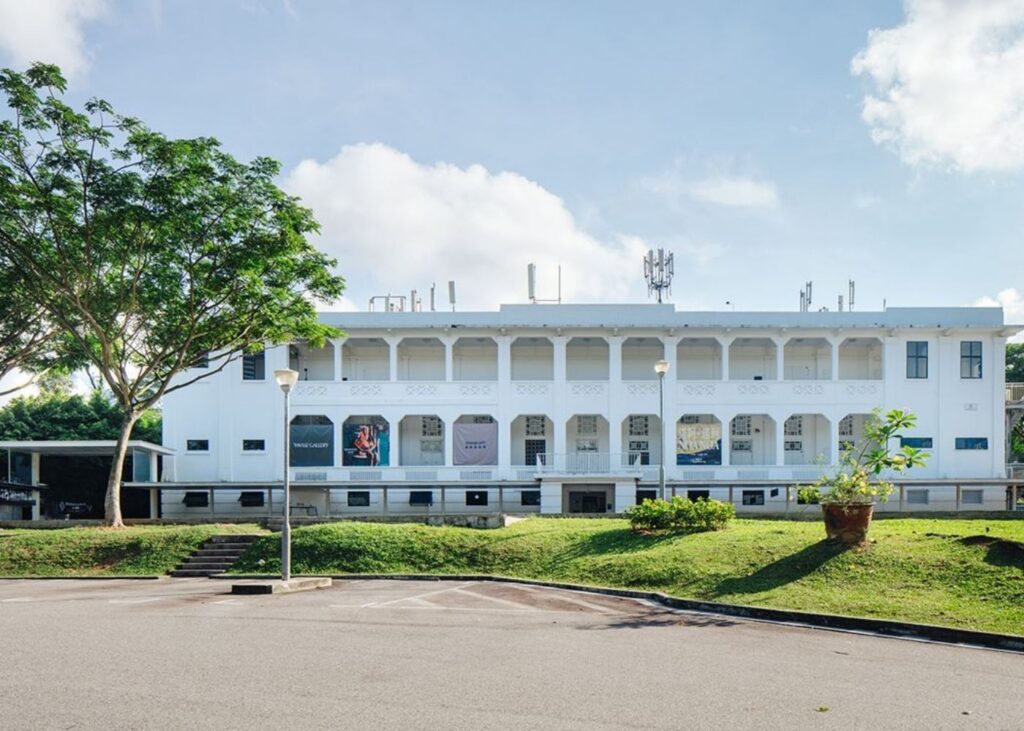
A cluster of colonial-era buildings that once housed British infantry regiments and later served as a Singapore Armed Forces training headquarters now faces a pivotal moment. Gillman Barracks, a government-led contemporary arts precinct that opened in 2012, operates under a lease set to expire in 2030, and its future remains undecided. The site currently hosts 13 galleries, a number down from earlier peaks, along with food-and-beverage outlets occupying converted military structures. The Singapore government owns the land, meaning final decisions rest with state agencies. Tenants and arts community members have begun publicly advocating for the precinct’s survival beyond the lease deadline, but no official announcement has been made.
A Precinct with Layers of History
The barracks trace their origins to 1936, when the British colonial administration built them on what was then swamp and jungle, naming the site after General Sir Webb Gillman. The compound included married quarters, mess halls, and even a swimming pool. During the Second World War, the barracks were among the last British positions to fall to Japanese forces before Singapore surrendered in 1942. After the war, the site returned to British control until 1971, when it was handed over to the Singapore Armed Forces for a nominal fee. The military used it as a training headquarters for more than a decade before vacating in 1990.
Following the military’s departure, the government repurposed the barracks as an entertainment hub called Gillman Village in the mid-1990s. Colonial architecture and food-and-beverage outlets drew visitors until 2012, when the government launched a renewed vision for the space as a dedicated precinct for international art galleries. The conversion was a deliberate attempt to preserve the buildings while giving them a new cultural purpose. The shift from British barracks to military base to entertainment strip and now to arts cluster reflects Singapore’s broader approach to reusing historic structures. The site sits near Alexandra Road on land that remained partly hidden for decades.
Tenants and Advocates Face a Deadline
For the galleries, bars, and other businesses operating at the precinct, the 2030 deadline creates a serious planning challenge. Among those watching the calendar is Ms. Pek, 57, who runs the Handlebars bar. According to accounts from the precinct, she has operated her business for nearly three decades, building a clientele and reputation over that time. She has expressed a desire to keep the precinct alive until the lease ends and hopes for support to continue her business after 2030. Her case illustrates the personal stakes for tenants who have invested years of work into the site.
Gillman Barracks was part of a government initiative to position Singapore as a regional hub for contemporary art. The precinct was jointly developed by the Singapore Economic Development Board, JTC Corporation, and the National Arts Council. The site now houses 13 galleries, down from earlier peaks, but remains a notable fixture in the city-state’s cultural landscape. Tenants and arts advocates have begun making their case publicly, seeking a reprieve that would allow the precinct to survive beyond its current lease. For now, the arts cluster operates under a cloud of uncertainty, with a fixed end date on the horizon.
Cultural Policy at a Crossroads
The precinct’s fate ties directly into broader questions about Singapore’s cultural policy. Gillman Barracks represented a deliberate effort to combine historic preservation with contemporary arts programming. Its survival after 2030 would signal continued state support for positioning the city-state as a regional arts hub; its closure would mark a shift in priorities. The government has not announced any decision on the site’s future beyond the lease expiry.
The outcome will affect not only the galleries but the broader community that uses the space. For tenants like Ms. Pek, who have built careers and customer bases over many years, the deadline creates real personal and professional stakes.
As the 2030 deadline approaches, the interplay between cultural ambition and urban redevelopment will continue to shape the discussion. The decision rests with state agencies, and tenants and advocates will keep pressing their case. For now, Gillman Barracks remains open, its colonial-era buildings still hosting art and commerce, but with an uncertain timeline ahead.




