
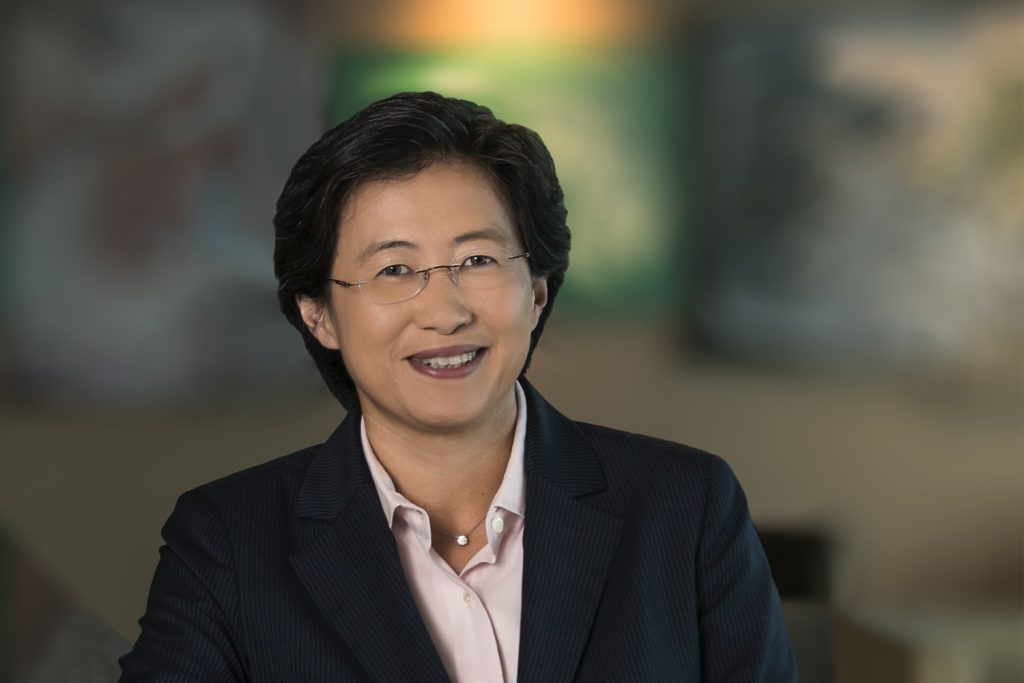
Lisa Su has steered Advanced Micro Devices from the brink of irrelevance to a position of parity with its longest-standing rival, Intel, in a span of roughly a decade. Born in 1969 in Tainan, Taiwan, she moved to the United States as a child and went on to earn bachelor’s, master’s and doctoral degrees in electrical engineering from MIT. After formative years at Texas Instruments, IBM and Freescale Semiconductor, she joined AMD in 2012 and assumed the chief executive role in October 2014. At that moment the company was heavily indebted, its shares trading at only a few dollars, and it was losing ground in the critical CPU market. Su’s response was a concentrated bet on a new architecture, Zen, which would become the foundation for Ryzen desktop processors and EPYC server chips produced in partnership with TSMC. The strategy reversed AMD’s trajectory, delivering steady market-share gains in personal computers, servers and data centers, and later expanding into AI accelerators with the Instinct MI300 line. Over her tenure the stock has risen more than thirtyfold, and AMD’s market valuation has at times matched or surpassed Intel’s.
Early Life and Education
Su’s upbringing in Taiwan and subsequent immigration to the United States set the stage for a career defined by technical rigor. Her academic path at MIT, where she completed three degrees in electrical engineering, provided a deep foundation in semiconductor physics and device engineering. That early exposure to a demanding research environment shaped a mindset that would later emphasize long-term architectural bets over short-term financial engineering.
Her doctoral work addressed advanced semiconductor device technology, an area that would prove directly relevant to the process and manufacturing challenges she tackled throughout her career.
Building a Semiconductor Career
Before arriving at AMD, Su held progressively senior roles at three major chip companies. At Texas Instruments she gained experience in high-volume manufacturing and process integration. Her tenure at IBM placed her in the company’s semiconductor research and development division, where she contributed to work on copper interconnect and silicon-on-insulator technology, advances that helped extend the performance curve for a generation of processors. A subsequent move to Freescale Semiconductor broadened her exposure to embedded and automotive markets, rounding out a portfolio that spanned logic, memory and system-on-chip design.
Those positions collectively gave her a broad view of the semiconductor value chain, from research labs to fabrication floors to end-market requirements, an understanding that would prove decisive when she later took the helm at AMD.
Leading AMD’s Revival
When Su became chief executive in October 2014, AMD was burdened by debt and its share price lingered in the low single digits. The company’s competitive position in central processing units had eroded sharply against Intel, and its graphics business, while stronger, could not offset the overall decline. Su responded by concentrating resources on a clean-sheet CPU microarchitecture codenamed Zen, a decision that required significant upfront investment and a willingness to forgo near-term product refreshes.
The first results appeared in 2017 with the launch of Ryzen desktop processors based on Zen. The chips offered a compelling combination of core count, per-clock performance and power efficiency, quickly winning enthusiast and mainstream market share. In parallel, the EPYC line of server processors brought the same architecture to data centers, using a chiplet design and TSMC’s advanced process nodes to deliver high core densities at competitive price-performance.
The partnership with TSMC proved critical. By relying on the Taiwanese foundry for leading-edge manufacturing, AMD could focus on architecture and system integration while accessing process technology that matched or exceeded Intel’s internal capabilities. This model enabled a steady cadence of architecture improvements, from Zen 2 to Zen 3 and Zen 4, that closed the performance gap and, in several key benchmarks, surpassed Intel across client and server segments.
Expanding into AI and Sustained Leadership
With the CPU franchise stabilized, Su directed AMD toward the fast-growing market for artificial intelligence acceleration. The Instinct MI300 series, a high-performance accelerator for large-scale AI training and inference, marked the company’s serious entry into a field long dominated by a single incumbent. The product line leverages the same chiplet philosophy and TSMC process leadership that underpinned the EPYC success, positioning AMD as a credible alternative in the data-center AI space.
The financial turnaround has been dramatic. In 2022 Su added the role of board chair to her responsibilities, and she continues to serve as chief executive. She is widely recognized across the industry, including with major engineering honors, and is distantly related to Nvidia chief executive Jensen Huang. From a company once written off as a perennial also-ran, Su built one of the defining comeback stories in modern technology, and AMD now competes at the leading edge of both computing and artificial intelligence.




