
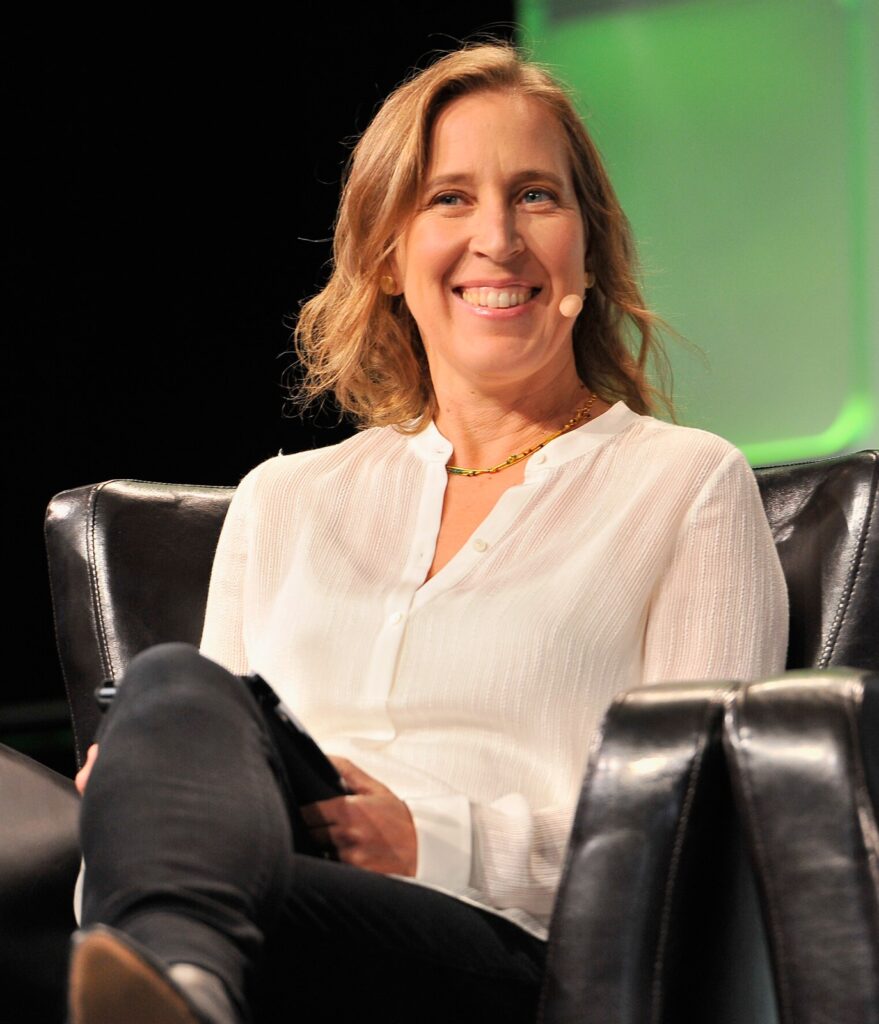
Early Life
Susan Wojcicki was born in Santa Clara County, California, and grew up in a household that valued education and intellectual curiosity. Her father, Stanley Wojcicki, was a physics professor at Stanford University, and her mother, Esther Wojcicki, was a journalist and educator. This academic environment fostered her early interest in technology and problem-solving. She attended Gunn High School in Palo Alto, where she demonstrated strong aptitude in mathematics and science.
Wojcicki pursued her undergraduate studies at Harvard University, earning a bachelor’s degree in history and literature in 1990. During her time at Harvard, she developed an interest in economics and technology, which would later shape her career path. After graduation, she worked briefly in business consulting before deciding to pursue further education to deepen her analytical skills.
She then enrolled at the University of California, Santa Cruz, where she obtained a master’s degree in economics in 1993. Later, she earned an MBA from the UCLA Anderson School of Management in 1998. These academic credentials equipped her with a strong foundation in both technical and business disciplines, preparing her for a career at the intersection of technology and innovation.
Rise
In 1998, Wojcicki joined Google as its 16th employee, shortly after the company was incorporated. At the time, Google operated out of a modest office space, and Wojcicki played a key role in its early operations. Notably, she rented out her garage in Menlo Park to Google’s co-founders, Larry Page and Sergey Brin, providing them with a workspace during the company’s formative months. This act of support became a well-known anecdote in Silicon Valley lore, symbolizing the grassroots origins of one of the world’s most influential tech companies.
Once employed, Wojcicki quickly distinguished herself through her strategic thinking and product acumen. She took on responsibilities in marketing and product management, helping to shape Google’s early business model. Her work focused on understanding user behavior and aligning Google’s services with market needs, which proved critical as the company sought to monetize its search technology.
Wojcicki’s breakthrough came when she led the development of Google’s advertising products, including AdWords and AdSense. AdWords, launched in 2000, introduced a pay-per-click model that revolutionized online advertising by allowing businesses to target users based on search queries. AdSense, introduced in 2003, enabled website owners to earn revenue by displaying targeted Google ads on their pages. Together, these products became the cornerstone of Google’s revenue generation, transforming it into a highly profitable enterprise.
Peak
Under Wojcicki’s leadership, Google’s advertising division grew into a multi-billion-dollar business, driving the company’s financial success and enabling its expansion into new areas. Her ability to balance innovation with scalability helped Google maintain its competitive edge in a rapidly evolving digital landscape. By the mid-2000s, AdWords and AdSense accounted for the vast majority of Google’s revenue, underscoring the impact of her contributions.
In 2014, Wojcicki was appointed CEO of YouTube, a position she held until 2023. At the time of her appointment, YouTube was already a dominant platform for video sharing, but faced challenges related to content moderation, monetization, and competition from emerging social media apps. Wojcicki brought her expertise in advertising and product strategy to the role, aiming to strengthen YouTube’s ecosystem for creators, viewers, and advertisers.
During her tenure, she oversaw significant developments, including the expansion of YouTube Premium, the growth of YouTube Music, and the enhancement of advertising tools tailored to video content. She also prioritized initiatives to support content creators, such as improved revenue-sharing models and better analytics tools. Under her leadership, YouTube continued to grow as a global platform for entertainment, education, and cultural expression, reaching billions of users worldwide.
Turning Point
Wojcicki’s leadership at YouTube was not without challenges. The platform faced increasing scrutiny over its handling of harmful content, misinformation, and algorithmic recommendations. Critics argued that YouTube’s recommendation system sometimes promoted extremist or misleading videos, raising concerns about its societal impact. In response, Wojcicki acknowledged the need for reform and oversaw efforts to adjust algorithms, increase human review, and partner with fact-checking organizations.
Another significant turning point came with the evolving landscape of digital advertising and privacy regulations. As governments introduced stricter data protection laws, such as the GDPR in Europe and similar measures elsewhere, YouTube and its parent company Alphabet had to adapt their data practices. Wojcicki navigated these complexities while striving to maintain the platform’s advertising effectiveness and user trust.
In 2023, Wojcicki announced her departure as CEO of YouTube, stating that she wished to focus on her family, health, and personal projects. Her decision came after nearly a decade at the helm of the platform. The transition marked the end of an era for YouTube’s leadership and prompted reflection on her influence over one of the most significant digital platforms of the 21st century.
Legacy/Aftermath
Susan Wojcicki passed away on 9 August 2024 at the age of 56, after a battle with non-small-cell lung cancer. Her death was confirmed by her family and reported widely in media outlets. She is remembered not only for her executive roles but also for her foundational contributions to the development of the modern internet economy. Her early support of Google’s founders and her leadership in building its advertising engine helped establish the financial model that underpins much of today’s free online content.
Throughout her career, Wojcicki was recognized as one of the most influential women in technology. She appeared repeatedly on lists such as Time’s 100 Most Influential People and Forbes’ Most Powerful Women. Colleagues and industry observers often cited her calm demeanor, strategic clarity, and commitment to long-term vision as defining traits of her leadership style. Her work helped demonstrate how technology companies could achieve both innovation and sustained profitability.
In the aftermath of her passing, tributes poured in from across the tech industry. Former colleagues at Google and YouTube highlighted her mentorship, integrity, and dedication to fostering inclusive workplaces. Many noted that her career exemplified the impact that thoughtful, principled leadership could have in shaping technological progress. Her legacy endures in the products she helped build and the standards she helped set for responsible innovation in the digital age.
Wider Significance
Susan Wojcicki’s career reflects broader transformations in the technology sector over the past quarter-century. From her early role in a startup garage to leading one of the world’s largest video platforms, her trajectory mirrors the rise of the internet as a central force in global communication, commerce, and culture. Her work on advertising systems helped prove that digital platforms could sustain themselves financially while offering free access to users—a model that became dominant across social media, streaming, and online services.
Her leadership also brought attention to the evolving responsibilities of tech executives in addressing societal impacts. As YouTube grew, so did debates about content governance, mental health, and the influence of algorithms on public discourse. Wojcicki’s tenure illustrated the tensions between openness, safety, and profitability that continue to challenge platform leaders today. Her efforts to balance these forces, even amid criticism, contributed to ongoing conversations about ethical technology stewardship.
Moreover, as a prominent female leader in a historically male-dominated industry, Wojcicki’s success served as an important example for women aspiring to careers in technology and executive management. Her visibility and achievements helped challenge stereotypes and expand perceptions of who could lead in Silicon Valley. In remembering her life and work, the tech community reflects not only on what she built, but on the kind of leadership she represented—thoughtful, resilient, and deeply engaged with both the potential and the responsibilities of innovation.




