
The most watched airliner crossing of late 2023 carried no special passengers and no cargo of note — only fuel. A Virgin Atlantic Boeing 787 left London Heathrow for New York JFK running entirely on sustainable aviation fuel, the first commercial airliner to cross the Atlantic that way. For families across the region who fly to work, study and reunite, Flight100 mattered because it asked a plain question: can the world keep flying without drilling for every drop?
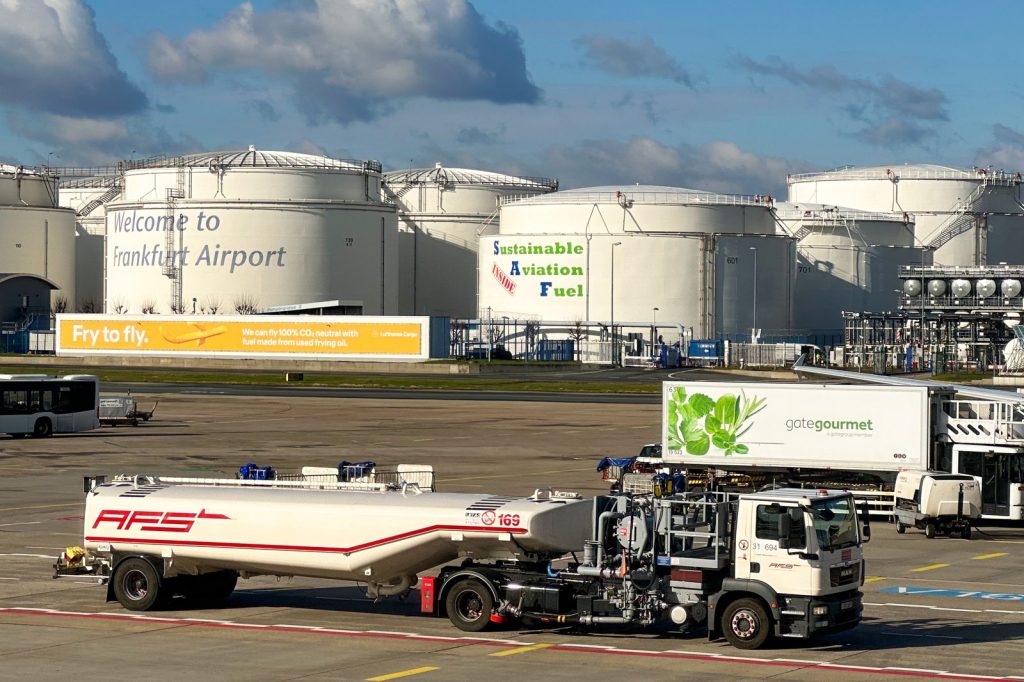
So what is this fuel? Sustainable aviation fuel, or SAF, is made from biomass feedstocks — wood and plants, waste paper, animal fats, used cooking oils, even industrial waste gases from steel making. Because that biomass has already drawn CO2 out of the atmosphere, burning SAF recycles carbon that exists rather than releasing new carbon the way fossil jet fuel does. The result, typically, is a lifecycle emissions cut of more than 70 percent. It is not zero: SAF still emits CO2 and non-CO2 gases in flight.
The experiment was a long time coming. Virgin Atlantic tested SAF on a commercial aircraft back in 2008 — the first airline to do so, on a Boeing 747 hop from Heathrow to Amsterdam with one of four engines partly burning fuel from babassu nuts and coconuts. A transatlantic run on waste-gas fuel from LanzaTech followed nearly a decade on, and in 2018 the airline flew the world’s first passenger flight on a SAF blend. Flight100 in November 2023 closed the arc: an 88% HEFA blend of waste fats supplied by Air bp, plus 12% synthetic aromatic kerosene from plant sugars supplied by the US firm Virent. The flight needed a special permit from the UK regulator, since commercial aircraft are certified to use at most a 50% SAF blend.
On board was Transport Secretary Mark Harper: “Today’s historic flight shows how we can both decarbonise transport and enable passengers to keep flying when and where they want.” Founder Richard Branson put it more bluntly: “The world will always assume something can’t be done, until you do it.” Chief executive Shai Weiss called the fuel a safe drop-in replacement and “the only viable solution” for long-haul decarbonisation, though he added that “It’s taken radical collaboration to get here and we’re proud to have reached this important milestone, but we need to push further,” — a nod to the year-long effort with Boeing, Rolls-Royce, Imperial College London, the University of Sheffield and others, backed by one million pounds from the UK transport department. Rolls-Royce, whose Trent 1000 engines pushed the jet along, had just finished compatibility testing across its civil engine range: “This [flight] is further proof that there are no engine technology barriers to the use of 100% SAF,” said engineering director Simon Burr.
Closer to home, the catch is scale. SAF is an estimated 0.1% of all jet fuel worldwide; Virgin Atlantic counts 490,000 flights flown with it, against 500 in 2016, on 300-plus million litres produced in 2022 versus 8 million six years earlier. Reaching the industry’s 10 percent target by 2030 would take roughly 40 million tonnes of SAF a year — about 160 times what is available, and four times the production plants. Britain’s answer includes a mandate of at least 10 percent sustainable jet fuel by 2030, estimated to save the industry as much as 2.7 million tonnes of CO2e each year, and an Advanced Fuels Fund worth around 135 million pounds. Jonathon Counsell, who chairs the UK Jet Zero Council’s SAF delivery group, warned: “The test flights flown prove that the aviation industry is technically ready to make the switch to SAF but what we need now is action from governments to incentivise investment and get plants into construction.”
What it means for people is simple: flying need not wait for a technology miracle to start cleaning up. Residual emissions from Flight100 were soaked up with biochar carbon credits, and Virgin Atlantic is working with Carbon Engineering and Storegga on a direct air capture plant in northeast Scotland, alongside CORSIA offsets, toward net zero by 2050. The jets, at least, have shown they can change fuel. The harder part — growing supply from a rounding error to an industry — is still on the ground.
Sources
- Fuel | Business for good | Virgin Atlantic
- Virgin Atlantic makes first commercial airline flight across the Atlantic with 100% SAF – GreenAir News




