
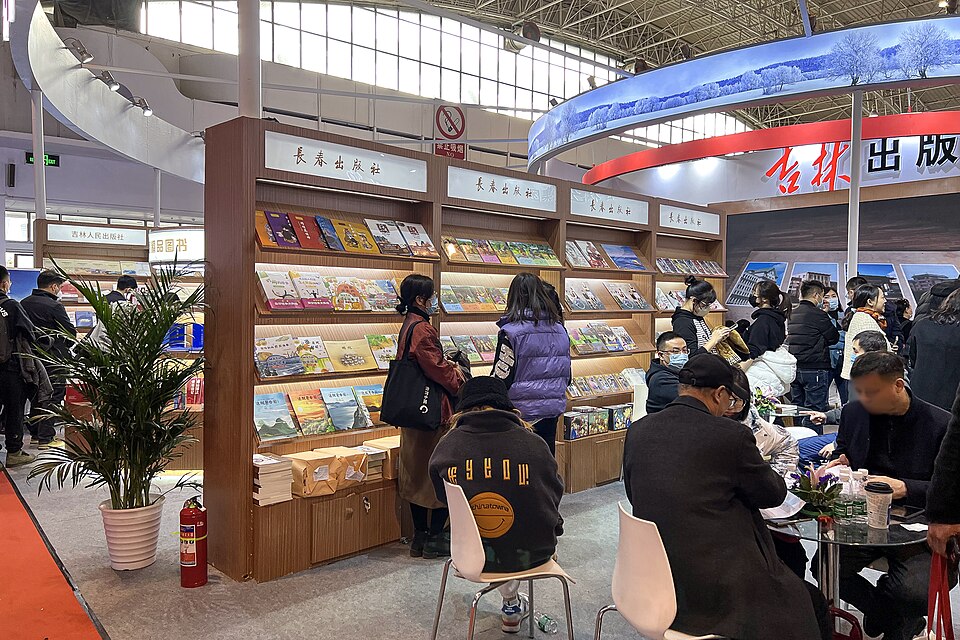
BEIJING, June 25 — The 32nd Beijing International Book Fair closed on June 21 with 2,835 copyright agreements signed across 82 countries. Yet the headline figure masks a deeper transformation: China’s publishing industry is rebuilding itself around streaming commerce, AI-assisted editorial workflows, and transmedia IP. Nearly 300,000 visits were recorded, with more than 1,700 exhibitors displaying 220,000 titles.
Children’s books, social sciences, and science & technology led the rights categories. For the first time, participants from Hungary, Moldova, and South Africa joined the roster.
The UAE took the role of Country of Honor, splitting its presence between a public-facing cultural pavilion and a dedicated rights-trading booth — a spatial arrangement that signaled the fair’s dual ambition: consumer spectacle and B2B deal-making. The most significant structural shift at BIBF 2026 was the formal arrival of China’s digital content majors on the show floor.
Tencent, NetEase Games, Douyin Group, 37 Interactive Entertainment, and Yuewen Group anchored a new Digital Publishing Joint Pavilion, turning a section of the China National Convention Center into a hub for cross-media licensing. According to the fair’s director, Xie Xiaocheng (Sean), the speed of decision-making in China’s market differs sharply from the West.
“In China, we simply have a shorter time to make decisions,” he said. “If it doesn’t work, we stop. In the West, you debate before you try.” The remark crystalized the divergence in publishing cultures that pervaded BIBF 2026 — and the distance China has traveled since the fair last drew a full international cohort.
Rights trading, once the dominant currency of such events, is increasingly giving way to IP licensing deals that span books, games, streaming, and merchandise. Publishers are no longer simply selling translation rights; they are shopping for properties that can live across multiple screens and formats. Figures show the scale of the shift.
The copyright tally of 2,835 agreements represents a solid number, but the real value lies in the downstream licensing conversations happening alongside those deals. The Digital Publishing Joint Pavilion was not an add-on; it was a statement of intent.
China’s gaming and streaming giants now see book fairs as sourcing grounds for intellectual property that can feed their content pipelines. Douyin Group, the short-video platform, and Tencent, the gaming and social media conglomerate, both maintained a visible presence. NetEase Games and 37 Interactive Entertainment, two of China’s largest game developers, scouted for narrative properties that could be adapted into interactive experiences.
Yuewen Group, a digital reading and IP platform, occupied a central position in the pavilion, underscoring the convergence of publishing and digital entertainment. The fair’s dual structure — consumer spectacle upstairs, B2B deal-making downstairs — reflects a broader industry reality.
Chinese publishers are under pressure to generate revenue from multiple streams, and IP licensing offers a path that pure rights trading cannot match. The UAE’s dual presence as Country of Honor, with a cultural pavilion and a rights booth, embodied that same logic. What to watch next: the extent to which Western publishers adapt to this model.
Xie Xiaocheng’s observation about decision-making speed suggests that the gap between China’s iterative, fast-fail approach and the West’s deliberative style may widen. For now, BIBF 2026 has made clear that the center of gravity in global publishing is shifting — and the currency of the fair is no longer just copyright agreements, but the IP deals that follow them.




