
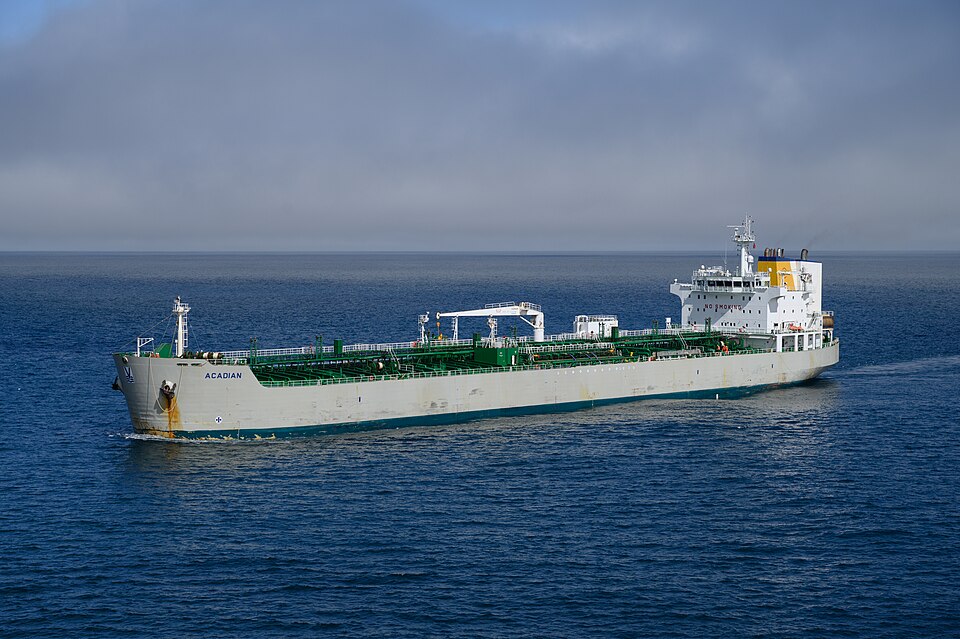
Tankers now load crude at the Westridge Marine Terminal at a steady pace. Since the Trans Mountain expansion opened, the terminal has averaged roughly 23 vessels a month, and by the end of 2025 tanker traffic there had climbed more than 800% from the day the expansion came into service. Where those ships go is the story. According to a June 2026 analysis from the University of Alberta’s China Institute, the biggest single destination is China.
The authors, Daniel Lincoln, Philippe Rheault and Anton Malkin, write that early doubts about Asian demand for Canadian heavy crude have given way to a settled commercial pattern.
Half the cargoes
The pipeline entered service in May 2024 with a maximum capacity of about 890,000 barrels per day. Throughput was 704,000 barrels per day in June 2024 and held between 700,000 and 790,000 through 2025, with utilization near 90% by the fourth quarter.
The institute cites the pipeline operator’s own data: from May 2024 through June 2025, China took 156 of 306 Westridge cargoes, about 51%. Asian markets as a whole accounted for roughly 60% of seaborne exports, with California and the US Pacific Northwest taking most of the rest. Ship-tracking data in the report shows China averaging about 207,000 barrels per day through the expanded system, ahead of the 173,000 barrels per day sent to the US Pacific coast. In December 2025, China’s crude imports from Canada hit a record 550,000 barrels per day.
For scale, the report notes China bought roughly 1.3 to 1.4 million barrels per day from Iran and Saudi Arabia that month, so Canadian supply was already around a third of either supplier’s level.
A small share, but moving
Canada still sells most of its crude south. Before the expansion, about 97% of exports went to the United States. Non-US exports have since risen to nearly 9% of the total by 2025, from 4.9% in 2024 and roughly 3% before. They more than tripled in volume, from 0.12 million barrels per day in 2019 to 2023 to 0.39 million in 2025.
The report argues the new buyers have not pushed out American ones. US-bound volumes held near 4.0 million barrels per day, up from a pre-expansion level of roughly 3.7 million. Canadian crude exports to China now total about C$10 billion, up roughly 78% from a year earlier, and Alberta ran a trade surplus with China approaching C$4 billion in 2025.
Why Chinese refiners fit
The authors say China has one of the few refining systems able to absorb heavy sour grades such as Western Canadian Select at this scale. The trip from Westridge to China takes about 17 to 22 days, shorter than many competing routes, and early cargoes were priced at competitive discounts to Brent-linked benchmarks.
Prices at home have improved too. The gap between WTI and WCS narrowed from about US$18.65 a barrel in 2023 to about US$14.73 in 2024.
Politics may help. The institute points to a January 2026 recalibration of Canada-China relations announced by Prime Minister Mark Carney and Chinese counterparts, and a March 2026 Global Affairs Canada commitment to raise exports to China by 50% by 2030.




