
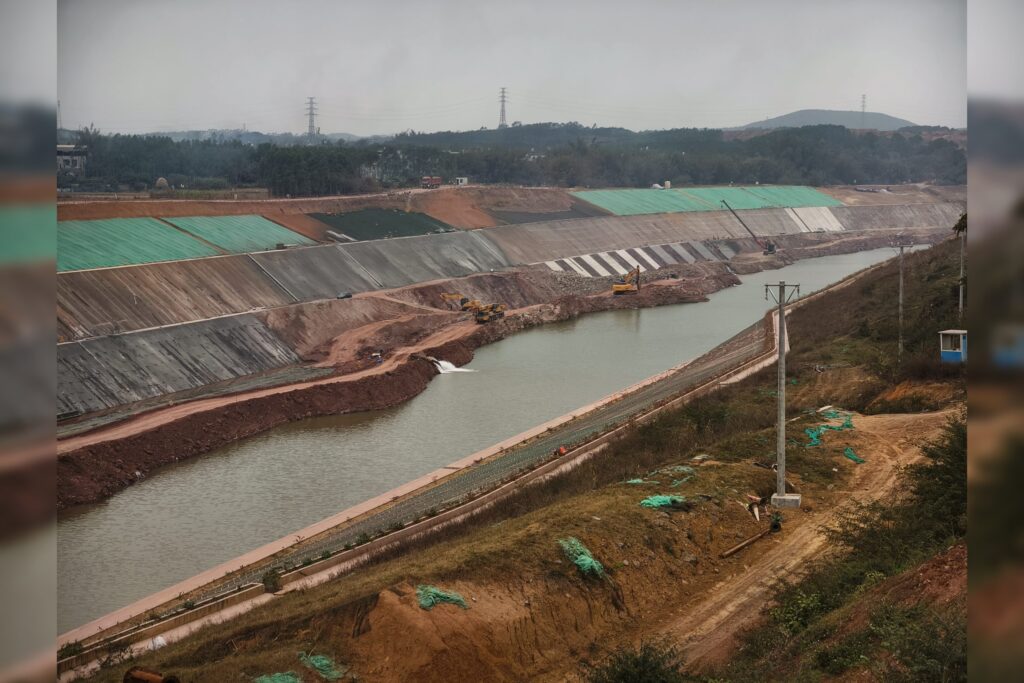
Two LNG dual-fuel container ships, Bei Gang Yun He 001 and 002, ran a test voyage from Guigang to the port of Qinzhou ahead of the Pinglu Canal’s opening. It took two hours. The old route, a long detour through the Pearl River Delta, took two days.
The canal opened to navigation on September 16 in Guangxi, in south China. At 134.2 kilometres it runs from Nanning, the regional capital, to the Beibu Gulf and ties the Xijiang River system to the sea. It is the first nationally planned river-to-sea canal built since 1949. Construction cost roughly 72.7 billion yuan, or $10.8 billion. Vessels of up to 5,000 deadweight tons can use it, and the project set four world records in its category, including the world’s highest-head water-saving ship lock.
A Shortcut for Landlocked Provinces
The provinces of the southwest and centre-south have strong industry and no direct coastline. Their cargo has had to detour hundreds of kilometres through the Greater Bay Area, or travel more than 2,000 kilometres east along the Yangtze to Shanghai. The canal trims inland shipping distance by more than 560 kilometres.
It is designed to give Guangxi, Sichuan, Chongqing, Yunnan, Guizhou and Hunan a shorter and cheaper route to ASEAN markets. It is the backbone project of the New International Land-Sea Trade Corridor, which is itself tied to the Belt and Road Initiative. The opening coincided with the China-ASEAN Expo, also held in Nanning.
The Projected Numbers
Logistics costs for cargo moving between southwestern China and ASEAN are expected to fall by 18 to 30 percent, a saving of more than 5 billion yuan ($745 million) a year. Firms based in Nanning could see costs drop by as much as 30 to 40 percent.
Throughput is projected at roughly 5 million metric tons in 2026 and 40 million in 2027. About 570 registered vessels are already certified to sail directly into Qinzhou Bay without transhipping cargo along the way. Beibu Gulf Port Group is building five automated container berths, which should handle 650,000 TEU a year once finished around March 2028.
Until then, the limits are plain. A 5,000-deadweight-ton vessel carries only around 255 TEU, so early traffic will favour smaller feeder and river-sea ships, and bulk cargo should benefit before containers do. Beibu Gulf Port is expected to specialise in short-sea ASEAN trade: Vietnamese wood chips, Thai rubber, Malaysian palm oil.
Two related projects, the Xianggui Canal and a Zhejiang-Jiangxi-Guangdong Canal, are still at the feasibility-study stage.




