
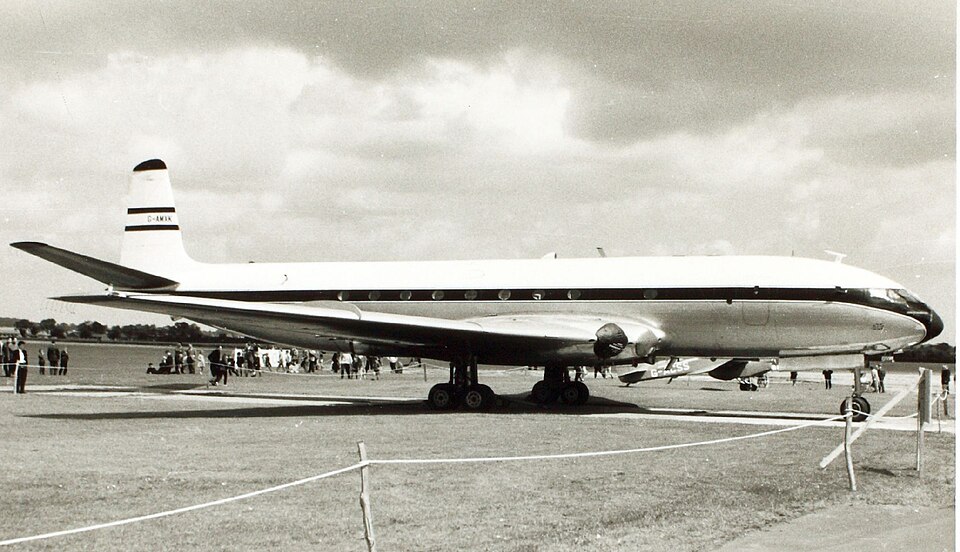
The men who made airline history on 27 July 1949 mostly expected a routine test hop. At Hatfield, in Hertfordshire, test pilot John Cunningham, a night-fighter ace whose eyes had earned him a famous nickname, took the de Havilland DH106 Comet 1 into the sky with Frank Reynolds, Harold Waters, Tony Fairbrother and John Wilson beside him. It was the maiden flight of the world’s first jet-powered airliner, and the quiet, smooth machine under them would change what ordinary families could expect from air travel: speed above the weather instead of the long, loud, low slog of propeller routes.
Designed by de Havilland chief designer Ronald Bishop, the Comet ran on four Ghost engines and was, by contemporary reckoning, three or four years in front of every competitor. BOAC ordered it with 36 seats and routes toward Africa, the Far East and Australia; a cabin specification of the day even asked for separate Ladies and Gents lavatories. On 2 May 1952 the airline flew the first paying-passenger jet service in the world, from London to Johannesburg, and aloft the travellers drank champagne at 40,000 feet, roughly double the height at which the propliners beneath them toiled. So complete was the lead that France’s Sud Aviation licensed the Comet’s nose and cockpit, bolt for bolt, for its own Caravelle.
Behind the breakthrough, the crews had worries. Pilots reported the powered flying controls gave little feel, and some feared they could over-control the jet into instability; a fatal takeoff accident at Calcutta into bad weather was later linked to that possibility. Then came 1954. On 10 January, BOAC Comet G-ALYP, “Yoke Peter”, broke apart near the Mediterranean island of Elba on a Rome-to-South Africa leg, and all 35 aboard died. An early enquiry leaned on a theory of fire aboard; the Royal Navy was still fishing wreckage from the sea when findings were announced and flights resumed. On 8 April, a sister ship operating as South African Airways Flight 201 came down near Stromboli, south of Naples, killing all 21. Within twelve months three Comets were gone, and the world’s first jet airliner was grounded.
What followed became the most exhaustive aircraft investigation to that point in history. Under Sir Arnold Hall of the Royal Aircraft Establishment, engineers submerged an intact fuselage, G-ALYU, “Yoke Uncle”, in a water tank at Farnborough and cycled the cabin pressure to imitate climb and descent, water chosen to cushion any rupture. After 3,057 cycles, 1,221 of them real flights and 1,836 simulated, the fuselage tore open at a corner of the forward escape hatch. Wreckage from “Yoke Peter” itself showed a fatigue crack whose origin sat at a rivet hole by the rear window for the ADF aerial; the Duxford collection’s account describes a structure too weak to arrest it, one that “opened like a zip fastener.” Hall’s conclusion was metal fatigue, driven by the repeated pressurisation and venting of the cabin.
The lesson spread instantly, and a piece of folklore grew alongside it. The formal finding, as the Duxford account notes, was a fuselage not strong enough, in an era when fatigue was poorly understood, and it did not single out window shape as the cause. But the geometry of tight corners, on the escape hatch and the near-square cutouts around it, concentrated stress far beyond what de Havilland’s engineers had predicted, and the remedy shaped every jet since: oval or round windows and cutouts that spread load evenly, plus mandatory fatigue testing of airframes. One aviation writer’s summary of the whole affair has hardened into an industry proverb: “metal gets tired, and corners kill.”
The Comet was not finished. Redesigned marks followed, and the Comet 4, stretched 18 feet 6 inches beyond the original and able, in its 4C form, to seat up to 119 passengers against the Comet 1’s 44, crossed the Atlantic non-stop. On 4 October 1958, freshly certified days earlier, a BOAC Comet 4 flew the first regular transatlantic jet service from New York to London, beating Pan Am’s Boeing 707s by a matter of days. It was a last hurrah as much as a triumph: the 707, which had learned the Comet’s hard lessons at no cost to itself, entered service the same year and swept the market that Britain’s pioneer had opened.
The type’s long twilight had its own dignity. BOAC retired its Comets in 1965, yet other carriers kept flying them, and Dan Air, which at one point owned all 49 of the world’s airworthy examples, operated the last commercial flight in 1981. The very last Comet flight of all came on 14 March 1997, when a Comet 4C used for research at Boscombe Down made its final trip to a museum at Bruntingthorpe. A militarised descendant, the Nimrod, served the RAF from 1969 until 2011, giving the design 62 years in the sky.
For families boarding any airliner today, the human side of this story is sitting beside them: a rounded window, a fuselage tested to fatigue before it ever carries a passenger. Fifty-six people died in the Mediterranean in 1954, and their loss is the reason the cabin around every modern traveller is built the way it is. The Comet was beautiful, and it was first, and what it taught the world came at a price the industry has never had to pay twice.




