
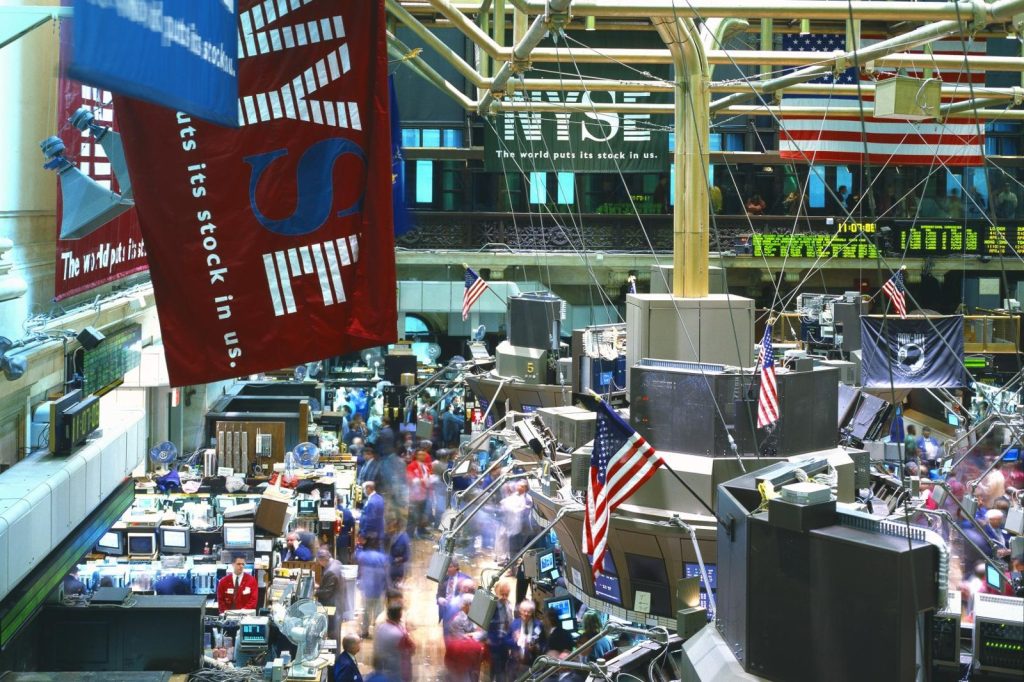
The Dow Jones industrial average finished 403 points lower on Tuesday, March 3, 2026, but the number flatters the day. The index had been down more than 1,200 points in the morning. What saved the tape was a slow ebbing of panic about the widening war with Iran, and a barrel of oil that stopped climbing before the close.
By the end of trading the Standard & Poor’s 500 had lost 0.9%, after trading down as much as 2.5% earlier, and the Nasdaq composite limited its damage to a 1% loss. Wall Street was simply the last stop on a global route: the sell-off began in Asia, where South Korea’s Kospi plunged 7.2% on its first session after a Monday holiday, its worst day in roughly two years. Tokyo’s Nikkei 225 lost 3.1%, even with analysts noting Japan holds an oil stockpile good for more than 200 days. France’s CAC 40 gave up 3.5% as European natural gas prices soared. Nearly three of every four stocks in the S&P 500 fell, and Big Tech could not carry the indexes this time: Nvidia slid 1.3%.
Oil Is the Whole Story
The trigger sat in the Gulf. Tehran hit the U.S. Embassy compound in Saudi Arabia, with the target list widening toward infrastructure critical to world oil and gas output, and an advisor to the Revolutionary Guard, Brig. Gen. Ebrahim Jabbari, vowed that any ship passing through the Strait of Hormuz would be set on fire. Roughly a fifth of the world’s oil moves through that narrow passage.
Prices told the fear. Brent crude, the international benchmark, leaped above $84 a barrel at its worst before settling at $81.40, up 4.7%; U.S. benchmark crude rose 4.7% to $74.56. Investors have history on their minds: past Middle East conflicts have generally spared U.S. stocks any long-term punishment, but only while oil stayed below the $100-a-barrel line.
The fears receded somewhat after President Trump said the U.S. Navy might begin escorting tankers through the strait “if necessary,” to “ensure the FREE FLOW of ENERGY to the WORLD.”
Rates, Gold and the Long War Question
The bond market flinched with the rest of them. The 10-year Treasury yield briefly broke above 4.10% before settling just under 4.06%, against 4.05% late Monday and 3.97% on Friday. Higher yields squeeze borrowers and undercut other assets, which is part of why gold fell 3.5% to $5,123.70 an ounce, ending a run that had pushed it past $5,300. Traders, per CME Group data, are pushing their forecasts for Federal Reserve rate cuts deeper into the summer, even as Trump publicly and angrily demands cuts now.
How long the war runs is the variable nobody can price. A major U.S. and Israeli attack has already claimed the life of Iranian Supreme Leader Ayatollah Ali Khamenei, and Trump wrote late Monday that “Wars can be fought ‘forever,’ and very successfully” given American munitions stockpiles. Professional investors keep saying this is not the start of a long bear market, if the war stays short. Tuesday’s swings showed how little anyone trusts that assumption.
Amid the wreckage, one winner: Target rose 6.7% after beating profit expectations for the quarter.
Sources
- Stock Market Today: Dow Loses 400 Points Amid U.S.-Iran Battle; Palantir Climbs, Nvidia Falls (Live Updates) | Investor's Business Daily
- Dow drops 400 points after early plunge of 1,200 as oil prices climb – Los Angeles Times




