
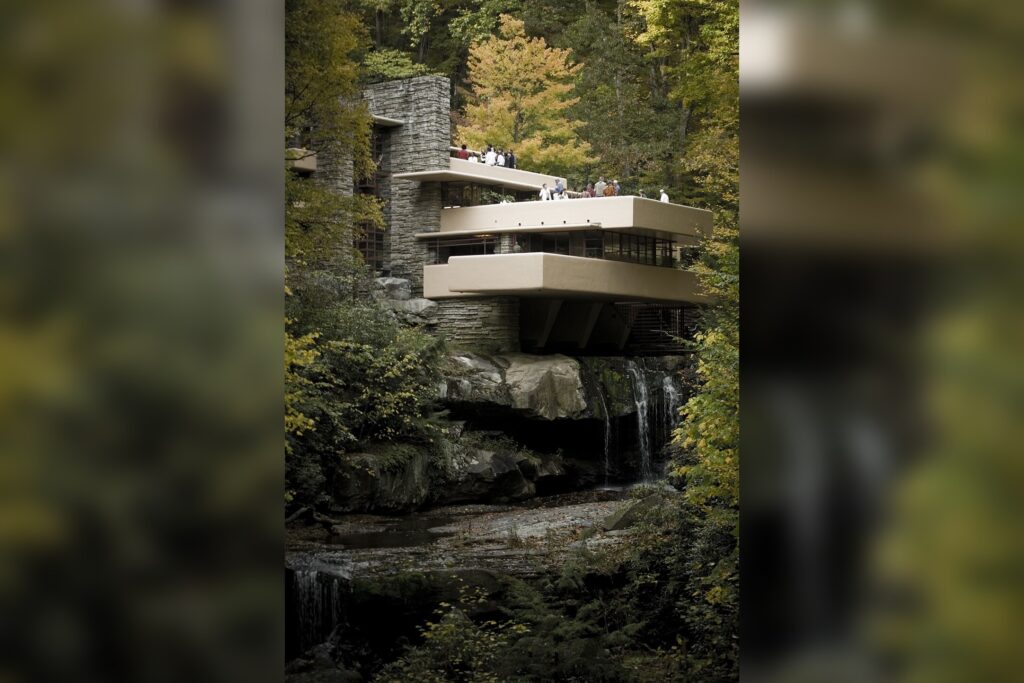
Scaffolding has wrapped Fallingwater since December. Frank Lloyd Wright’s house over the waterfall in Mill Run, Pennsylvania, is in the middle of a $7 million restoration, and by March 2025 the crews planned to take the scaffolding down by early April so regular tours could resume.
Water is the problem. The Western Pennsylvania Conservancy, which manages the 9,300-square-foot house, has started a three-year project to stop leaks and structural decay that decades of moisture have caused. The work includes waterproofing the roof and windows, repointing the stone masonry, reinforcing deteriorated concrete and restoring the steel framing.
Hollow walls and no copper
Some of the trouble sits inside the walls. The masonry tube walls were originally filled with construction debris, which has since settled and left voids where water collects. Crews are injecting a proprietary liquid grout into them. Roofing assemblies are being replaced, and the steel window and door frames, which suffer in the humidity from the falls, are being restored.
Wright also refused to use copper flashing, a standard waterproofing material. That choice gave the house its look and made it prone to leaks. Where flashing is needed, the team is using lead.
The bill
The house cost $148,000 to build in the 1930s. The restoration runs nearly 40 times that. The estimate set in 2019 has more than doubled, a result of pandemic-era supply shortages and inflation.
Money is coming from a Commonwealth of Pennsylvania grant, private foundations and individual donors. The project still needs another $1 million.
The grounds stay open while the house is closed to regular tours, and special Preservation-in-Action tours let visitors watch the work. Fallingwater drew 143,000 visitors in 2024.
Justin Gunther, the house’s director and a vice president of the conservancy, said Wright meant Fallingwater to be a sculptural extension of the stream beneath it. The work is scheduled to finish in winter 2026.




