
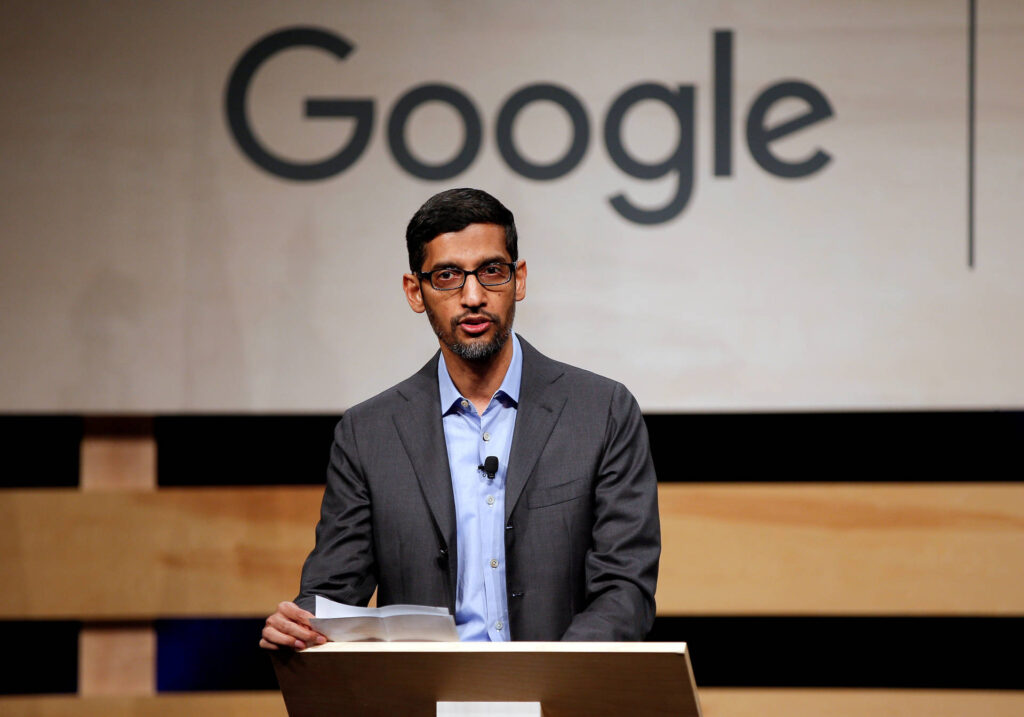
A Two-Decade Ascent
Pichai’s path to the top mirrors Google’s own evolution. The company was founded in 1998 by Larry Page and Sergey Brin while they were Ph.D. students at Stanford University. Its early focus on search technology quickly expanded into advertising, mobile operating systems, cloud services, and hardware, transforming it into one of the largest technology firms in the world. By 2015, Google’s diverse ventures had grown so extensive that its leaders restructured the company under a new parent entity, Alphabet, to improve oversight and operational clarity. The move allowed Google to concentrate on internet-related services while Alphabet took responsibility for more experimental divisions, including life sciences and smart home technology. The restructuring positioned Alphabet as a conglomerate with interests spanning artificial intelligence, autonomous vehicles, and biotechnology.
Pichai, who had been leading product development and later became CEO of Google in 2015, was named chief executive of both Google and Alphabet in 2019. His compensation for 2022 totaled $226 million. Under his watch, Alphabet reported $307.4 billion in revenue in 2023, reflecting the company’s dominant position in digital advertising, cloud computing, and mobile platforms. The company’s expansion into artificial intelligence through projects like Bard highlights its role in shaping how societies interact with emerging tools.
Calling for AI Guardrails
Despite Alphabet’s aggressive push into generative AI, Pichai has been vocal about the need for guardrails. In 2023, he published a white paper on AI regulation and has repeatedly called for what he describes as “responsible AI.” He has supported government oversight of the technology, arguing that structured governance can manage risks without stifling innovation. He has not publicly commented on wealth seizure, but his support for government oversight of AI suggests a willingness to accept constraints that some in Silicon Valley have resisted.
The debate over oversight underscores the tension between rapid technological advancement and the need for structured governance. As generative AI becomes more integrated into daily life, Alphabet’s decisions on ethics, regulation, and innovation influence not only its own future but also the direction of global technology policy. Pichai’s role — as both a builder of the tools and a proponent of their oversight — places him in an unusual position: the executive asking for limits on his own industry.
What Lies Ahead
The question now is whether the regulatory frameworks Pichai has called for will materialize, and what form they will take. Alphabet’s revenue gives it enormous resources to invest in AI research, but the technology’s rapid advance has outpaced the rules meant to govern it. The company’s dominance in digital advertising, cloud computing, and mobile platforms has made it a central player in the modern economy. Its expansion into artificial intelligence through projects like Bard highlights its role in shaping how societies interact with emerging tools.
As generative AI continues to evolve, the balance between innovation and oversight remains unresolved. Pichai’s advocacy for regulation, combined with Alphabet’s financial strength, positions the company to both drive the technology and help define the boundaries within which it operates. Whether those boundaries will be drawn by the industry itself or by external regulators — and how quickly they can be established — will shape the next chapter of one of the most consequential technological shifts in a generation.




