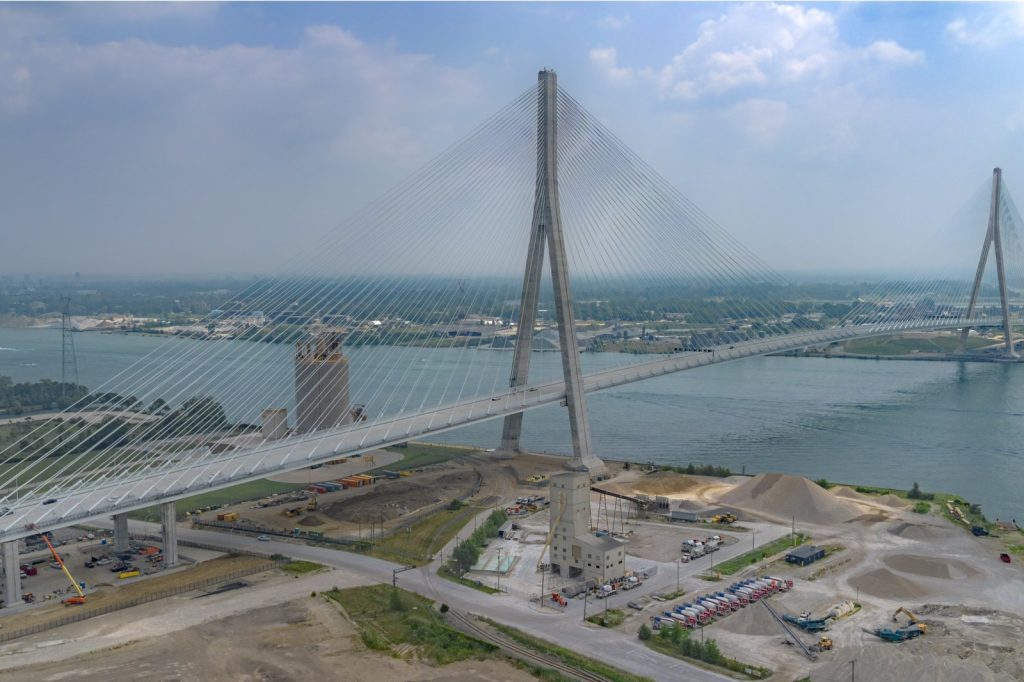
DETROIT, July 16 — The Gordie Howe International Bridge, a new publicly-owned cable-stayed span connecting Detroit, Michigan, and Windsor, Ontario, remains on track for its 2025 opening, according to project officials. The bridge, under construction since 2018, represents a strategic infrastructure play for both the United States and Canada, one that shifts the calculus of cross-border trade in the Great Lakes region.
Named after Canadian hockey legend Gordie Howe, the bridge is being built by the Windsor-Detroit Bridge Authority, a Canadian Crown corporation, in partnership with the Michigan Department of Transportation. The project carries a total cost of approximately $5.7 billion CAD, funded entirely by the Canadian government.
For the United States, what this signals is a major trade corridor upgrade without direct federal expenditure—a rare dynamic in bilateral infrastructure deals.
A Strategic Trade Corridor
The Ambassador Bridge, currently the busiest commercial crossing between the U.S. and Canada, has long suffered from congestion and reliability concerns. The Gordie Howe International Bridge is expected to reduce that pressure significantly. Officials project the new span could divert up to 30% of truck traffic, providing a more stable crossing for trade.
That figure is critical: the Detroit-Windsor corridor handles roughly a quarter of all U.S.-Canada trade by value, making any disruption a direct hit to supply chains on both sides. The bridge will feature six lanes and a dedicated multi-use path for pedestrians and cyclists.
Strategically, the multi-use path is a secondary concern for the freight-heavy crossing, but it signals a broader effort to integrate the span into the local urban fabric on both sides of the border.
Funding and Toll Structure
The $5.7 billion CAD price tag is underwritten by the Canadian government, with the Michigan Department of Transportation serving as the U.S. partner. The bridge will be toll-free for its first year of operation, a move designed to encourage usage and shift traffic patterns away from the privately-owned Ambassador Bridge. The broader stakes involve long-term revenue generation: once tolls begin, the funds will go toward debt service and maintenance, with the Windsor-Detroit Bridge Authority managing the asset.
For American policymakers, the arrangement is favorable. Canada bears the construction cost while the U.S. gains a modern, publicly-owned crossing that strengthens the resilience of a vital trade artery.
The calculus from Washington’s perspective is clear: improved infrastructure with no direct hit to the federal budget.
What to Watch Next
With the 2025 opening approaching, attention will turn to the final phases of construction and the transition to toll operations. The bridge’s ability to absorb the projected 30% of truck traffic will depend on how quickly shippers and logistics firms reroute from the Ambassador Bridge. The multi-use path, while a smaller piece of the project, will also test the demand for non-motorized cross-border travel—a niche but politically popular feature.
The Gordie Howe International Bridge is not just a piece of infrastructure. It is a strategic asset in the North American trade architecture, one that reshapes the geography of commerce between the U.S. and its largest trading partner.
For now, the project remains on schedule, and the stakes remain high.