
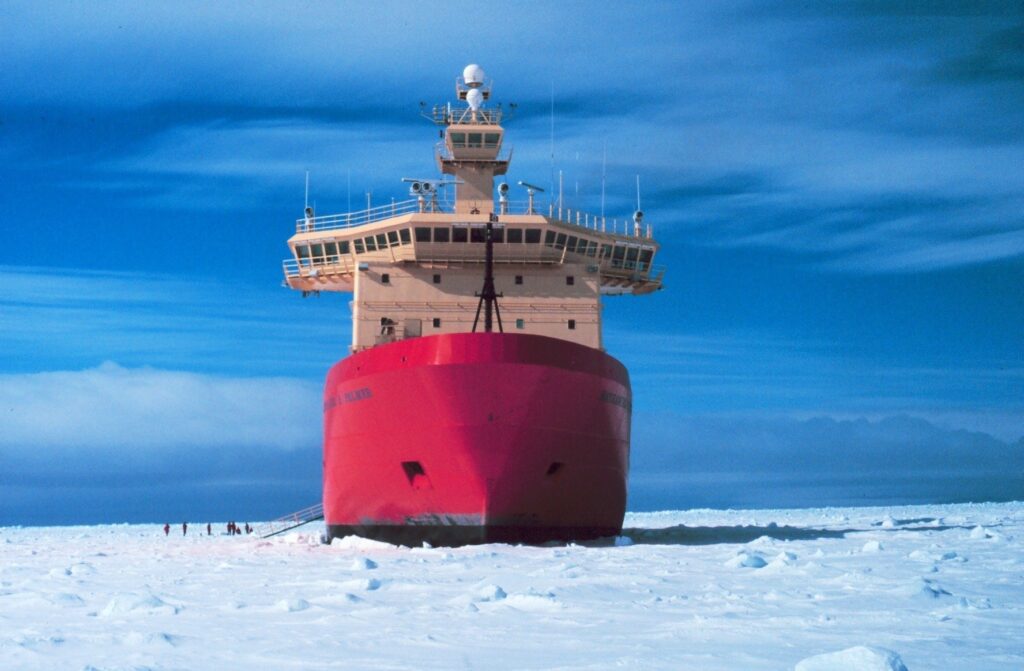
In 1383 the Belgian town of Bruges put a barge to work breaking ice on its moat. The barge is the first icebreaking ship on record, and it did the job so well that the town bought four more.
Before that, clearing frozen water was a job for laborers with axes and hooks, and the craft only moved out to sea much later.
Barges, horses and axes
The idea spread through the Low Countries. By the 15th century icebreakers were well established in Flanders, in towns such as Oudenaarde, Kortrijk, Ieper, Veurne, Diksmuide and Hulst. Colder winters of the Little Ice Age pushed demand up, because trade and travel there ran on waterways. In the 17th century nearly every town of any size kept some kind of icebreaker to hold its canals open.
Nobody knows what the earliest ones looked like. Later records show horses dragging the vessels, whose weight pressed down and cracked the ice, while men with axes and saws worked alongside. Little changed until the industrial revolution.
Ships for polar water
Polar explorers needed something sturdier. Their early ships were wooden hulls of ordinary design with extra protection: double planking at the waterline, cross members inside, iron bands outside and sometimes metal sheeting on the bow, stern and keel. The aim was to push through ice and survive being “nipped,” when winds and tides drive floes against a ship and squeeze it like a vise.
Russian sailors on the White Sea had solved much of this long before. Settlers there, the Pomors, built small wooden sailing boats called kochi, with a belt of smooth planking along the waterline and a rounded underwater shape. If ice closed in, the hull simply rose up onto it instead of being crushed. In 1864 the Russian ship Pilot borrowed that shape, with a bow raised 20 degrees from the keel line, so it could ride up on ice and break it. It worked the Gulf of Finland between Kronstadt and Oranienbaum until 1890, adding several weeks to the summer shipping season.
What makes an icebreaker
Today a ship needs three things to count as one: a strengthened hull, a shape that clears ice, and enough power to shove through it. Thick ice calls for driving the bow up and letting the ship’s weight do the breaking. Rubble piling up ahead can slow a vessel more than the breaking itself, so the hull is shaped to steer it aside or underneath. Propellers and shafts are more exposed than the hull, which is why getting onto the ice, breaking it and clearing the debris matters so much for safety.
The first true modern sea-going icebreaker, Yermak, was built in 1899 at the Armstrong Whitworth yard in England for the Imperial Russian Navy. She displaced 5,000 tons, with engines delivering 10,000 horsepower, and served until 1963.




